
Zcash NU7 cuts the block time to 25 seconds: what changes for your coins

0
0

Zcash activates its next network upgrade not on a date but at a block height: NU7 takes effect as soon as the blockchain reaches block 3,543,405. On October 28, 2026 it stood at block 3,533,105, so 10,300 blocks short. Two of the changes affect every holder directly: the time between two blocks drops from 75 to 25 seconds, and version 4 transactions become invalid. Anyone running old wallet software, or still holding a balance in the Sprout pool, has until then to act. The Zcash price had gained a good seven percent in the preceding 24 hours.
Zcash stands at 1,310 dollars, 10,300 blocks before the NU7 activation
ZEC traded between $1,310.50 and $1,315.08 on October 28, 2026, depending on the data source, and gained 7.2 to 7.4 percent in 24 hours. The daily range ran from $1,212.24 to $1,322.79. Over a week it shows a gain of 3.8 percent, over a month a loss of 16.3 percent. With a market capitalisation of 22.29 billion dollars, Zcash ranks tenth; a single day's turnover came to 819.45 million dollars.
There is no single documented trigger for the day's gain. What is documented as imminent is the upgrade, and it moves closer with every block. The activation height 3,543,405 is set out in ZIP 259, the document that records which rule changes NU7 brings. The entry there carries the status Proposed, and that point matters more for the assessment than any price move: the height is agreed and written into the node software, but the document is not formally finished.
ZIP 218 lowers the Zcash block time from 75 to 25 seconds
The most visible change sits in ZIP 218, titled "25-second Block Target Spacing". The target spacing between two blocks drops, as it says there, "from 75 seconds to 25 seconds in NU7". That is exactly one third of today's target.
Block time is the interval at which a blockchain adds a new block on average, writing new transactions into the record. The figure sets a target, not a guaranteed interval: the difficulty of the computational puzzle is adjusted continuously so that the average hovers around that target. Bitcoin aims at ten minutes, Zcash so far at 75 seconds, after NU7 at 25.
For users the effect is simple at first: a transaction waits a shorter time on average for its first confirmation. What does not change is the amount of computing power behind the network. The hashrate stood at 31.39 gigahash per second on October 28, the difficulty at 278.7 million. After the switch, the same power spreads across three times as many blocks, each individually easier.
1,152 blocks a day become 3,456
ZIP 218 works out the consequence itself. In a table on daily bandwidth, the document sets 1,152 blocks per day today against 3,456 blocks after the switch and describes the situation as "With 3× as many blocks per day". The figure 1,152 follows from 86,400 seconds divided by 75.
This tripling is why the upgrade is more than a convenience improvement. Every block costs storage and bandwidth. Anyone running their own node downloads three times as many block headers after the switch, and services that process blocks individually are served three times as many events per hour. For holders who manage their coins through a wallet app and someone else's server, this stays invisible. Anyone self-custodying and running software on their own hardware should check before the date whether their version knows NU7 at all.

Exchange confirmations count blocks, not minutes
This is where the switch becomes concrete for ordinary users. When you send ZEC from a wallet to an exchange, the exchange releases the credit only after a set number of confirmations. A confirmation is a block appended after the block holding your transaction; the more of them, the less likely a reversal. Exchanges set that number themselves, and they count blocks, not minutes.
If an exchange keeps its current block count after NU7, the waiting time shortens to a third. Taking 24 required confirmations, that is 30 minutes on average today and ten afterwards. It is equally possible that a venue raises the required number to hold the same security level in block work. The wait then stays as it was. Which exchange takes which route cannot be answered in general beforehand: it is in each provider's deposit notes, and those are worth a look in the days around the date. Anyone who would rather keep ZEC on their own hardware will find the devices in our hardware wallet comparison.
ZIP 235 removes 60 percent of transaction fees from circulation
The second major change is monetary. ZIP 235 is titled "Remove 60% of Transaction Fees From Circulation" and stipulates: "For each block, 60% (rounded down) of the total fees are to be removed from circulation." The document explicitly records that it is to be activated with NU7.
The wording matters, because it is often reported in shortened form. ZIP 235 does not speak of a permanent burn. The amounts removed are to return to circulation later through block issuance, so they go to miners rather than disappearing for good. The mechanism therefore shifts when and to whom issuance happens, and does not change the total quantity that can exist in the end.
In the end the effect on circulation depends on how much fee income arises at all. On a blockchain with a low fee load, removing 60 percent of fees moves little. This change therefore belongs in the assessment as a structural decision and not as a price driver. Reading it as a scarcity argument for the ZEC price gives it more weight than the specification supports.
The difficulty window grows from 17 to 102 blocks
A third, technically quieter change also sits in ZIP 218: the window over which difficulty is averaged rises "from 17 to 102 at NU7 activation". That is the countermeasure to the shorter block time. The faster blocks arrive, the more individual intervals vary, and too short an averaging window would leave difficulty trailing behind that variation. A window of 102 blocks covers about 42 minutes after the switch, roughly the same span as 17 blocks of 75 seconds today.
For holders this is no call to action, but it is a mark of quality in the upgrade: the developers thought through the side effect of the speed-up. For miners it is more relevant, because it changes how sluggishly the network responds to computing power being added or withdrawn.
ZIP 2003 makes version 4 transactions invalid from NU7 onward
The change carrying the greatest risk for inattentive holders is in ZIP 2003. The text is brief: "This proposal disallows all v4 transactions from NU7 onward." Framed as a consensus rule it reads "[NU7 onward] The transaction version number MUST be 5 or 6." This document, too, carries the status Proposed and is earmarked for NU7.
The transaction version is a number in the header of every Zcash transaction stating which format it is built to. Which version a wallet produces is decided by the software itself. A wallet not updated for years, still building version 4, will no longer get its transactions into the network after activation. The coins themselves are unaffected; what is rejected is only the outdated format, until the software is current.
Sprout balances are not burned, but cannot be moved after NU7
From the ban on version 4 follows a consequence that ZIP 2003 names itself: "Because Sprout transfers can only be represented in v4 transactions, this proposal also disables the ability to spend Sprout funds." The Sprout pool is the first generation of Zcash's shielded addresses, in use since 2016 and superseded for years by the newer Sapling and Orchard pools.
Two sentences of the same specification deserve careful reading, because summaries like to sharpen them into one. First: "It is not proposed in this ZIP to unissue, burn, or otherwise make Sprout funds permanently unavailable." The balances are therefore not destroyed. Second: "However, the ability to spend Sprout funds may never be re-enabled." There is no entitlement to ever moving them again. In practice the combination means Sprout balances stand still indefinitely after activation, without being formally taken away.
Before activation the consensus rules still permit moving them, and the specification names it as the purpose of the warning period to give holders "sufficient warning of difficulty in retrieving them". So anyone still holding ZEC in an old shielded address has a window now and probably none afterwards. cryptoticker.io set out the steps on September 23, 2026 in a separate guide to moving old Sprout balances.
Only a small share of holders is affected. Anyone who bought ZEC through an exchange in recent years and keeps it there or on a modern wallet is using Sapling or Orchard and has nothing to move.
10,300 blocks and a 75.1-second pace: our own analysis of October 28
How far away the activation really is can be calculated. cryptoticker.io carried out this analysis itself on October 28, 2026. It was based on the public state of the Zcash blockchain, the four specifications governing NU7 and two independent price sources, seven sources in all.
The result: the blockchain stood at block 3,533,105. That left 10,300 blocks to the activation height of 3,543,405. In the preceding 24 hours, 1,150 blocks were produced, which corresponds to an actual pace of 75.1 seconds and so almost exactly to today's target of 75 seconds. Calculating the remaining distance at that measured pace gives 8.96 days; at the 75-second target it is 8.94 days. Both calculations land in the night of November 5 to 6, 2026, somewhere between about half past two and three in the morning German time.
One incidental finding shows the scale of the change: the same 10,300 blocks would need only around 71.5 hours after NU7, at a 25-second target spacing, instead of close to nine days.
Status Proposed: why the date stays a calculation and not a date
That various publications name November 5 and November 6 follows from how the upgrade is built. A date tied to a block height is always an estimate, and that estimate moves as soon as computing power in the network fluctuates. If hashrate joins over the coming days, the date slides forward; if power drops away, it slides back. At 10,300 blocks, a pace off by just two percent shifts the moment by more than four hours.
Then there is the formal caveat. ZIP 259 lists ZIPs 207, 214, 218, 235, 237, 2003 and 2008 as the NU7 consensus changes and records that ZIP 233 and ZIP 234 are expressly not part of this upgrade. The document's status remains Proposed. For planning that means the direction is settled, the exact moment is not.
Buying route, holding period and custody for ZEC in Germany
In the EU, Zcash is among the coins with shielded transactions, and a deadline hangs on that which has nothing to do with NU7: from July 1, 2027 the EU anti-money-laundering regulation bars supervised providers from dealing in crypto assets whose transactions are anonymised. For ZEC holdings that means trading through supervised providers in the EU has a deadline running independently of NU7, and anyone intending to hold long term should plan for self-custody.
For tax, the same applies to ZEC in Germany as to other crypto assets: gains from a private sale within a year of purchase are taxable as a private disposal, and after a year they stay tax free. For this date specifically that means a move out of the Sprout pool to your own new address is not a sale, because ownership does not change, and so triggers no tax. Anyone who swaps or sells holdings on the occasion, by contrast, starts a new holding period for the units exchanged. In case of doubt your own tax adviser decides, not the exchange interface.
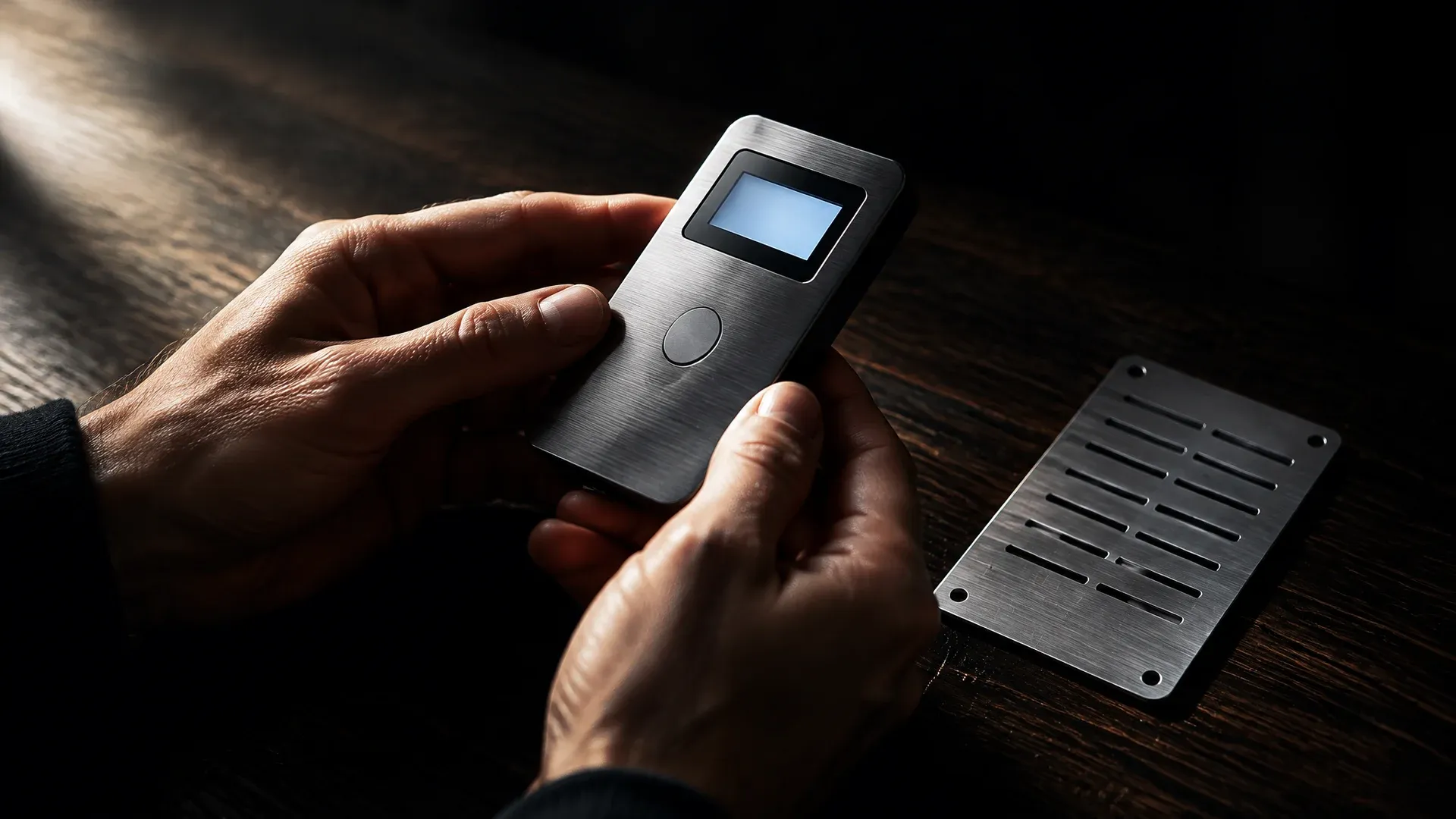
On custody, what counts before the date is above all the software version. A hardware wallet protects the key, not the transaction format: which version is built is decided by the companion application on your computer or phone. Updating it is therefore the actual step, and the same applies to software wallets.
Levels above and below
Above, the first level is the daily high of $1,322.79. Beyond it begins the range in which ZEC traded in mid-October, before the monthly loss of 16.3 percent arose. Below, the daily low of $1,212.24 is the next marker; it also marks the point at which this day's recovery began.
The all-time high of $3,191.93 is 58.9 percent away. That figure is poorly suited as a target, though, because the high dates from Zcash's launch month in October 2016, when barely any units were in circulation. More reliable is the observation that the price is up 3.8 percent over a week and clearly down over a month: this day's upward push has not turned the monthly move.
Zcash NU7: a different pace applies from block 3,543,405
By this calculation, around nine days remain until activation. Three things can be done in that time and not afterwards:
- Update your wallet software. Check whether your application knows NU7, because a version that still builds version 4 transactions will be rejected after activation. Which programs are maintained is shown by our software wallet comparison.
- Empty old shielded addresses. If ZEC is still sitting in the Sprout pool, move the balance to a Sapling or Orchard address. Anyone preferring the route via a trading venue should read its deposit notes first; the authorised providers are in our exchange comparison.
- Record your acquisition data. Note the purchase date and price for every holding before you move anything, so the holding period stays provable later. The tools from our comparison of tax tools and portfolio trackers help with that.
The specifications in the original: ZIP 218 on the block time, ZIP 235 on the fees, ZIP 2003 on the transaction versions and ZIP 259 with the activation height.
(As of October 28, 2026. This article is not investment advice. Prices and fee structures change; check the terms with the provider before you buy.)
0
0

 Manage all your crypto, NFT and DeFi from one place
Securely connect the portfolio you’re using to start.


