
Google Cloud Details MPC Service for Institutional Bitcoin Custody

0
0
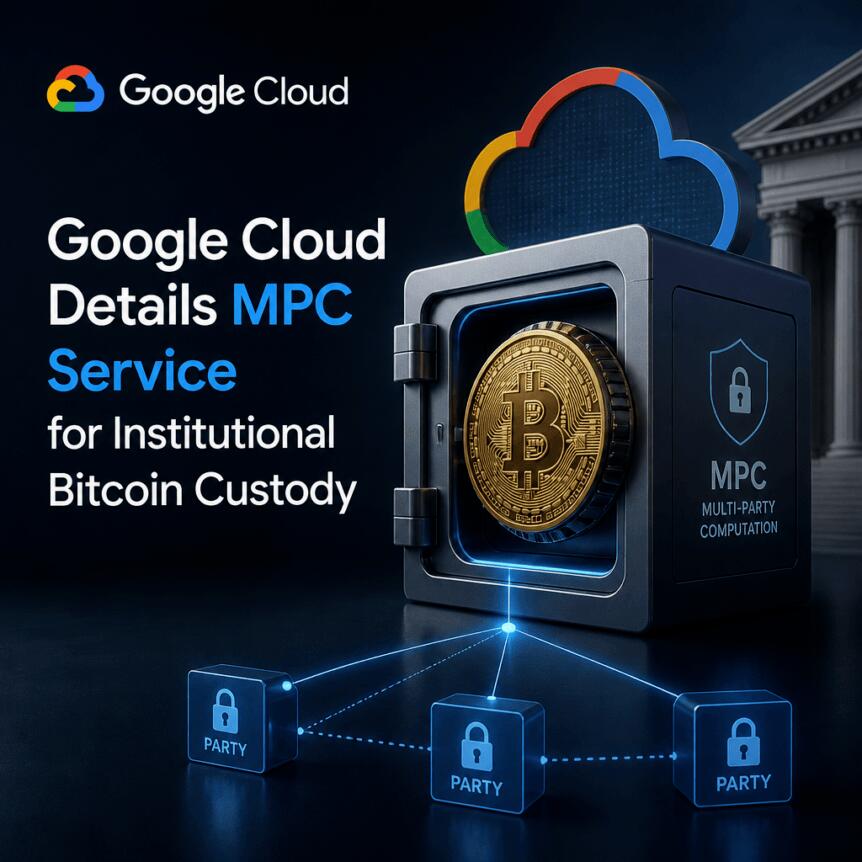
Google Cloud is moving a step closer to institutional-grade cryptocurrency custody with an updated preview offering for multi-party transaction authorization. The company’s Multi-party Compute (MPC) service is designed to let multiple parties authorize and sign cryptocurrency transactions while preventing any single participant from holding the full private key.
The new documentation update was published Monday, ahead of Google Cloud’s MPC Symposium in New York on Wednesday. While Google is still treating the MPC capability as a preview product—implying limited support and an evolving feature set—the company is also broadening its Bitcoin security controls, including new rules that assess transaction structure.
Key takeaways
- Google Cloud’s MPC service targets institutional custody use cases where no single party should control an entire private key.
- The service remains in preview, and Google’s documentation suggests it may come with constrained support compared with general availability products.
- Release notes updated by Google show expanded Bitcoin security rules, including evaluation of transaction amounts, destination address types, and change outputs.
- The documentation update arrives before Google Cloud’s MPC Symposium, featuring speakers from major financial institutions and crypto-native firms.
- Google has previously explored related confidential computing approaches through its Confidential Space environment.
Google Cloud expands its MPC approach for crypto custody
At the center of the update is Google Cloud’s Multi-party Compute (MPC) service, described in the company’s documentation as a way for financial institutions to jointly authorize and sign cryptocurrency transactions without any single party gaining complete private key control. In practice, MPC-based custody is intended to reduce key-managing concentration risk—an issue that becomes especially relevant for institutions that need robust internal controls and stronger operational assurances.
In the Google Cloud documentation, the MPC service is positioned as a “preview” product. That matters for readers evaluating maturity: preview offerings are typically subject to changes and may not carry the same level of operational guarantees, support commitments, or stability assurances that come with a full launch.
Google Cloud’s documentation page for the MPC service was updated Monday, and the company has continued to maintain release notes for the product that trace back to August 2026. Those release notes now reflect additional Bitcoin security logic, suggesting the preview is actively being refined rather than simply held static.
New Bitcoin security rules: amounts, address types, and change detection
Beyond the announcement-style documentation update, the concrete change for investors and builders may be in Google Cloud’s expanded Bitcoin security rules—documented in its MPC release notes. According to the release notes, Google has added evaluation steps that cover:
- Transaction amount checks to evaluate what is being sent.
- Destination address type detection to identify how the recipient is structured.
- Change output detection to identify whether and how the transaction returns value back to an address under the sender’s control.
For custody and institutional authorization systems, these categories of checks can be significant because they map to practical controls. Multi-party signing workflows often need to enforce policy constraints—such as allowing only specific spending patterns, address categories, or transaction behaviors—before the system permits the final signature.
While the release notes do not spell out every enforcement detail, the direction is clear: Google Cloud is strengthening the “rules layer” around what the MPC setup will consider permissible, rather than focusing solely on the cryptographic mechanics of distributed signing.
Event timing and institutional attention: MPC Symposium in New York
Google’s documentation update precedes the MPC Symposium taking place Wednesday in New York. The event description says it will include an “exclusive revealing” of Google’s “frontier MPC product and research projects.”
Speakers listed for the symposium include representatives from financial institutions such as Morgan Stanley, Citi, Wells Fargo, and OKX. The presence of established banks alongside a crypto exchange underscores how MPC is increasingly seen as a bridge between traditional finance security expectations and the operational requirements of digital-asset custody.
Still, readers should note the key tension in the current rollout: the cryptocurrency-relevant features are moving forward, but the MPC service remains a preview. That combination—fast technical iteration paired with limited product maturity—may influence how quickly institutions adopt it in production environments.
Confidential computing foundations behind Google’s MPC work
Google Cloud’s MPC effort has also been informed by earlier work in confidential computing. In a June blog post, Google described Confidential Space, a cloud environment intended to support secure multi-party computation and data sharing.
That background is relevant because it helps explain how Google may be structuring MPC in its ecosystem. MPC and confidential computing often overlap in their security goals—reducing the exposure of sensitive inputs, limiting access, and supporting controlled collaboration among parties. However, the updated MPC documentation and release notes focus specifically on the transaction signing and policy evaluation aspects that custody operators would care about day-to-day.
As Google develops the product, the interplay between the confidential-computing environment and the MPC signing workflow is likely to remain a core part of the story. For builders, this could affect how they design custody systems around access control, auditability, and the division of responsibilities across parties.
What to watch next
For institutions and teams evaluating MPC-based custody, the most important near-term signal is whether Google Cloud moves this preview capability toward broader availability while continuing to expand the Bitcoin security policy controls described in its release notes. Until that maturity step happens, prospective users will likely want to watch for changes in support commitments, documentation clarity around operational constraints, and any further policy enhancements tied to transaction structure.
This article was originally published as Google Cloud Details MPC Service for Institutional Bitcoin Custody on Crypto Breaking News – your trusted source for crypto news, Bitcoin news, and blockchain updates.
0
0


 Manage all your crypto, NFT and DeFi from one place
Securely connect the portfolio you’re using to start.
 Where will Bitcoin trade next?
Live Polymarket and Kalshi odds on Bitcoin price targets, compared side by side.
See Bitcoin price odds


