
US Dogecoin ETFs go a month without a single inflow as the DOGE price slips to $0.063

0
0

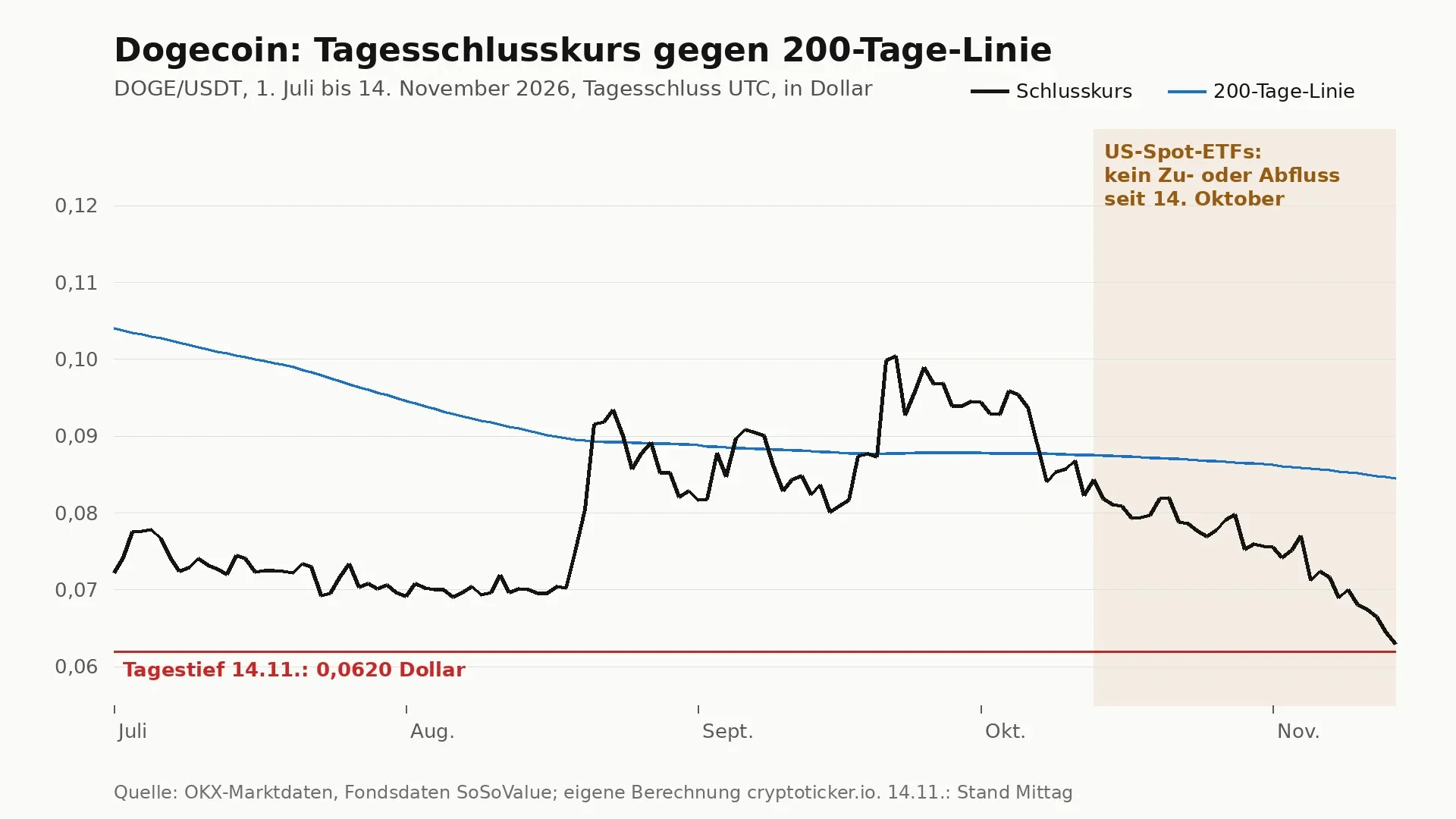
The record is clear: the two US spot ETFs on Dogecoin from Grayscale and 21Shares have not taken in or lost money on a single trading day since October 14, and their daily net flows stand at zero up to and including November 13. Our assessment follows further down: for a price that fell to a new intraday low of $0.0620 on Saturday, this removes a buyer that many investors had counted on over the past year.
One Dogecoin cost around $0.0631, or €0.0572, at midday on Saturday, November 14. According to CoinGecko, that is 3.5 percent less than 24 hours earlier and 12.4 percent less than a week ago. Over 30 days the loss is 21.4 percent. Bitcoin fell 2.9 percent over the same 24 hours and traded at a little over $67,000.
The fund figures come from the data service SoSoValue and were compiled on Saturday morning by U.Today. For investors in Europe this raises a practical question: anyone who wants exposure to DOGE has no access to the US funds here, but can choose an exchange-traded product on Xetra or a direct purchase on a crypto exchange. The two routes differ markedly in cost, custody and tax treatment.
Dogecoin price on Saturday: $0.0620 as the new intraday low
The week's downtrend continued into the weekend. According to data from the OKX exchange, DOGE fell as low as $0.0620 on Saturday, with the daily high at $0.0648. The week's daily closes form a staircase down: $0.0681 on Tuesday, $0.0675 on Wednesday, $0.0665 on Thursday and $0.0645 on Friday.
A longer look shows the scale. On November 14, 2025, Dogecoin closed at $0.1577, so the price has lost almost 60 percent since then. DOGE is now a good 91 percent below its record high of $0.7316 from May 2021. Its market capitalization is around $9.9 billion, putting Dogecoin 13th in CoinGecko's ranking.
The 200-day line, the average of closing prices over the past 200 days, stands at $0.0845 by our own calculation from OKX data. The current price is therefore about 25 percent below it. To get back to it, DOGE would have to rise by a good third.
US spot ETFs GDOG and TDOG: the last movement came on October 13
According to SoSoValue data, the Dogecoin ETFs recorded their last movement on October 13, a combined net outflow of $138,570. Since October 14 neither the Grayscale fund, ticker GDOG, nor the 21Shares fund TDOG has reported a daily inflow or outflow. That is 23 trading days in a row.
SoSoValue puts fund assets at $9.15 million for Grayscale and $1.58 million for 21Shares, $10.73 million in total. Grayscale thus holds a good 85 percent of the market. A third provider has already dropped out: Bitwise's Dogecoin ETF traded for the last time on October 14 and was liquidated on October 22, according to Blockonomi.
A net flow of zero does not mean nobody trades the fund shares. Investors continue to buy and sell them among themselves on the exchange. But no new shares are created and none are redeemed. TDOG also faces some unrest in its surroundings: 21Shares terminated its services agreement with House of Doge on November 5, as we reported on November 6. According to the regulatory filing, the fund's custody and fee were not affected.
How ETFs work: why a net flow of zero holds back the price
A spot ETF actually holds the coin it tracks. When demand for fund shares rises, so-called authorized participants create new shares. Authorized participants are large trading firms and the only parties allowed to exchange shares directly with the fund for cash or coins. For each new share, the fund has to buy Dogecoin in the market and store it. That purchase is exactly the channel through which an ETF inflow affects the price.
When money flows out, the process runs in reverse: shares are redeemed and the fund sells coins. If the flow stays at zero, the fund buys nothing and sells nothing. It then acts neither as support nor as a burden. For bitcoin, where the US funds take in several hundred million dollars on strong days, this channel is a noticeable price factor. For Dogecoin it was never large, and for a month it has come to a complete halt.
$10.7 million in fund assets: how small the ETF market for DOGE is
Converted at Saturday midday's price, fund assets of $10.73 million mean the two funds together hold around 170 million DOGE. Against a market capitalization of around $9.9 billion, that equals about 0.11 percent of all Dogecoin in circulation. For bitcoin, the US spot ETFs hold a share that is many times higher.
The figure puts the news into perspective in both directions. The standstill alone does not explain the price decline; the funds are too small for that. But it shows that the hope from autumn 2025, when Grayscale launched the first Dogecoin ETF, that the product would attract institutional money in meaningful amounts has not been fulfilled so far. The price still depends almost entirely on trading on crypto exchanges and in the derivatives market.
Since Friday: what has changed in price levels and the derivatives market
On Friday morning we analyzed the Dogecoin price after $7.7 million in long liquidations. DOGE stood at $0.063 at the time; we named $0.060 and $0.0575 as levels below and $0.068 above. Since then, Friday closed slightly higher at $0.0645, but on Saturday the price broke Friday's low at $0.0620. DOGE has not returned to $0.068; the high of the past 24 hours was $0.0665, according to CoinGecko.
In the derivatives market, positions continue to unwind. Open interest in DOGE perpetual contracts on OKX, the value of all positions not yet closed, was around $77.8 million at midday on Saturday. On Thursday it was still $83.4 million, on Friday $79.3 million. The funding rate, the payment exchanged between long and short sides every eight hours, is slightly negative at minus 0.005 percent. Short positions therefore pay the long side, which means most traders expect further losses.
Support at $0.062 and $0.060, resistance at $0.0665
The first support is Saturday's low of $0.0620, just under 2 percent below the current price. Below that comes the round $0.060 mark, which Blockonomi also named on Saturday as the next target if support breaks. If that does not hold either, the zone around $0.0575 that we cited on Friday comes into view.
On the upside, DOGE first has to recapture the 24-hour high of $0.0665, a good 5 percent above Saturday midday's price. Then come Wednesday's and Tuesday's closes at $0.0675 and $0.0681. The 200-day line at $0.0845 is out of reach for the foreseeable future. Notably, the line sits almost exactly where Dogecoin closed on October 13, the last day with an ETF flow. The price has lost about a quarter since then.
For leveraged traders the environment is tricky. The liquidation price is the level at which the exchange forcibly closes a leveraged position because the posted collateral has been used up. At ten times leverage, a move of a little over nine percent in the wrong direction is enough, so anyone going long at $0.0631 loses their stake at around $0.057.

21Shares Dogecoin ETP on Xetra: 2.5 percent a year in fees and custody at BitGo
You generally cannot buy the US ETFs GDOG and TDOG through a European brokerage account, because they have no key information document under EU rules. For investors in Germany there is instead the 21Shares Dogecoin ETP, which trades on Xetra under the ticker DOGE. Its ISIN is CH1431521033 and its WKN A4A5WJ. Formally it is a debt security that, according to the issuer, is fully backed by real Dogecoin.
According to the 21Shares product page, the product fee is 2.50 percent a year, and the coins are held by BitGo Europe GmbH. Assets under management were most recently around $7.9 million. The fee is deducted continuously from the value: on an investment of €1,000 the ETP costs around €25 a year, regardless of whether the price rises or falls. Your broker's order fees come on top. Which providers offer crypto ETPs at what cost is covered in our overview of crypto ETFs and ETPs in Germany.
The ETP's advantage is convenience. It sits in your usual securities account, and you need neither an account at a crypto exchange nor your own wallet. The drawback is cost: if you plan to hold DOGE for several years, the fee eats noticeably into returns.
Buying directly under MiCA: licence check and clean records
With a direct purchase you acquire real Dogecoin on a crypto exchange. Since the transition periods ended, providers that sell and hold crypto assets for customers in the EU need authorization under the European MiCA regulation. Before opening an account, check in the register of ESMA, the European securities regulator, whether your provider is listed there. Which licensed exchanges offer DOGE and what they charge per purchase we compare among the best crypto exchanges.
How gains on directly held coins and on an ETP are taxed depends on your country of residence, and the two routes are often treated differently. Clarify this with a tax adviser before buying; the crypto tax software comparison shows tools that document every purchase for you.
Editorial view: without new fund demand, the DOGE price lacks a buyer
Our assessment: for Dogecoin, the ETF standstill is less a trigger than a symptom. At $10.7 million the funds are too small to carry the price of a coin worth almost $10 billion. But the fact that not a single investor bought through this channel over an entire month in which DOGE lost about a quarter argues against the idea that cheap prices automatically attract new money. Supporting that view are the lowest level since October 2023, falling open interest and the negative funding rate: the market is shedding risk rather than building it.
What argues against it: reduced derivatives risk and a majority betting on falling prices are often the conditions from which short, sharp countermoves emerge. Analyst Trader Tardigrade points on X to the monthly chart and sees DOGE in a zone where the price turned in earlier cycles. Such a reversal is confirmed only once DOGE closes back above $0.0665 again. Any investment in Dogecoin can lead to a total loss.
Dogecoin ETFs at a standstill: October 13 remains the last fund day
- Decide how to buy. For a longer holding period, buying directly on an exchange with a MiCA licence is usually cheaper than an ETP with a 2.5 percent annual fee. Providers and costs are listed among the best crypto exchanges.
- ETP only with the right account. If you prefer to stay in a securities account, check your broker's order fees and Xetra access. Our comparison of the best crypto brokers gives an overview.
- Record the purchase date. Keep the date and price of every DOGE purchase. Depending on where you are taxed, the holding period can decide how a later gain is treated.
(As of November 14, 2026. This article is not investment advice. Prices and fee structures change; check the terms with the provider before you buy.)
0
0

 Manage all your crypto, NFT and DeFi from one place
Securely connect the portfolio you’re using to start.


