
Tether Supports Bolivian Fintech to Enable USDT Payments for Food and Banking

0
0
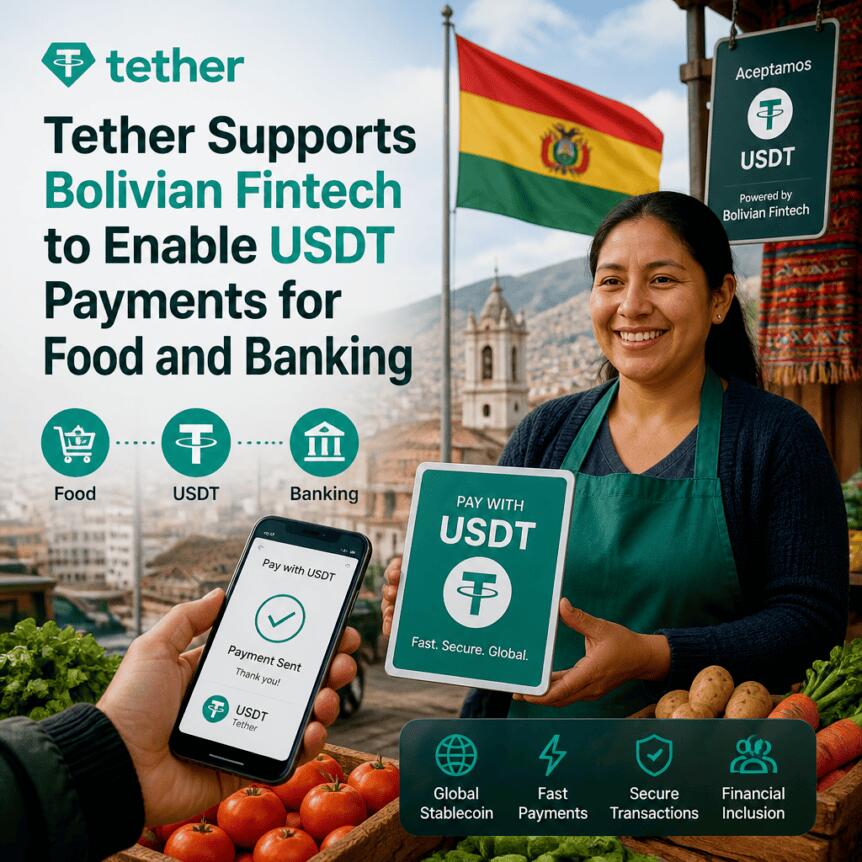
Tether is backing Bolivian fintech Peso with a pre-seed investment aimed at scaling USDT-based payments across Latin America, according to a Wednesday announcement on Tether’s website.
The funding is intended to expand Peso’s stablecoin payment infrastructure in Bolivia and beyond, including services designed to connect USDT with local currencies via banking rails and merchant payment systems. Tether did not disclose the investment size.
Key takeaways
- Tether invested in Bolivian fintech Peso to expand USDT payment infrastructure across multiple Latin American markets.
- Peso has already integrated USDT payments into Yango’s food delivery platform in Bolivia, enabling customers to pay with USDT.
- The fintech supports QR payments, merchant point-of-sale tools, and virtual accounts linked to Bolivia’s banking network using ACH transfers.
- The move aligns with growing local demand for dollar-denominated alternatives amid Bolivia’s ongoing US dollar shortage and inflationary pressures.
Tether’s pre-seed push into USDT payments via Peso
In its announcement, Tether said the pre-seed round will help Peso broaden its stablecoin payment services across Bolivia, Brazil, Colombia and Argentina. The plan includes bringing USDT payments to users through integrations that route value between stablecoin rails and local payment and banking ecosystems.
While Tether did not provide deal terms, the focus on payment infrastructure—rather than a single app or isolated merchant deal—signals an emphasis on distribution. For traders and users, that distinction matters: infrastructure deployments typically determine how easily stablecoins can be used for routine commerce and how smoothly institutions and merchants can integrate without building an end-to-end system from scratch.
How Peso is using USDT in day-to-day transactions
According to the announcement, Peso has already embedded USDT payment functionality into Yango’s food delivery offering in Bolivia. That integration allows customers to pay for orders using USDT.
Beyond app-based payments, Peso’s described tooling includes QR payments, point-of-sale services for merchants, and virtual accounts tied to Bolivia’s banking system. Those accounts are supported through ACH transfers, connecting traditional banking infrastructure with stablecoin payment flows.
For merchants, the ability to accept stablecoin payments through familiar payment interfaces—such as QR and POS—can reduce friction at the point of sale. For users, it can also reduce the steps required to spend in USDT, potentially improving stablecoin usability beyond transfers or trading.
Bolivia’s dollar gap and the policy backdrop for stablecoins
Tether’s investment lands in a broader context: the country has increasingly looked toward stablecoins since 2025, driven by a prolonged US dollar shortage and persistently high inflation. As access to foreign currency became more difficult, the demand for dollar-denominated alternatives grew, and some businesses began accepting USDT for purchases.
Earlier reporting highlighted that the government has been moving toward formal consideration of crypto and stablecoin integration. In November 2025, Bolivia announced plans to integrate cryptocurrencies and stablecoins into the financial system, including the possibility for banks to offer digital asset custody and crypto-linked financial products. Later, in July 2026, the country began considering a regulatory framework that would recognize USDT for uses such as payments, savings and trade alongside the boliviano and the US dollar.
That regulatory discussion followed a major macro trigger. Bolivia abandoned a long-standing currency peg in June, according to earlier coverage from Cointelegraph, and the resulting strain contributed to further demand for dollar-linked alternatives like USDT.
More stablecoin-linked fintech activity in Bolivia
Alongside Peso’s expansion, other fintech developments point to a steadily building local ecosystem around USDT-based services. On Tuesday, lending platform Tala announced a partnership with El Dorado to deliver embedded credit through El Dorado’s digital wallet. The program is designed to let eligible customers receive and repay loans in USDT on the Tempo blockchain, according to the announcement on Tala’s website.
Taken together, these initiatives suggest stablecoins are not only being used for payments but are also being explored for lending and other financial functions—an important step if regulators move toward recognizing stablecoin payments and financial products more formally.
Investors and builders watching this space should monitor whether Bolivia’s evolving regulatory framework for USDT turns from consideration into enforceable rules that clarify licensing, custody expectations, and how stablecoin payments integrate with banking systems—especially as more fintechs roll out USDT-based features across regional markets.
This article was originally published as Tether Supports Bolivian Fintech to Enable USDT Payments for Food and Banking on Crypto Breaking News – your trusted source for crypto news, Bitcoin news, and blockchain updates.
0
0

 Manage all your crypto, NFT and DeFi from one place
Securely connect the portfolio you’re using to start.


