
Inside Spout’s 0% Stock Loans: Marc Ryan on Using Blockchain Tech to Make Stocks Productive

0
0
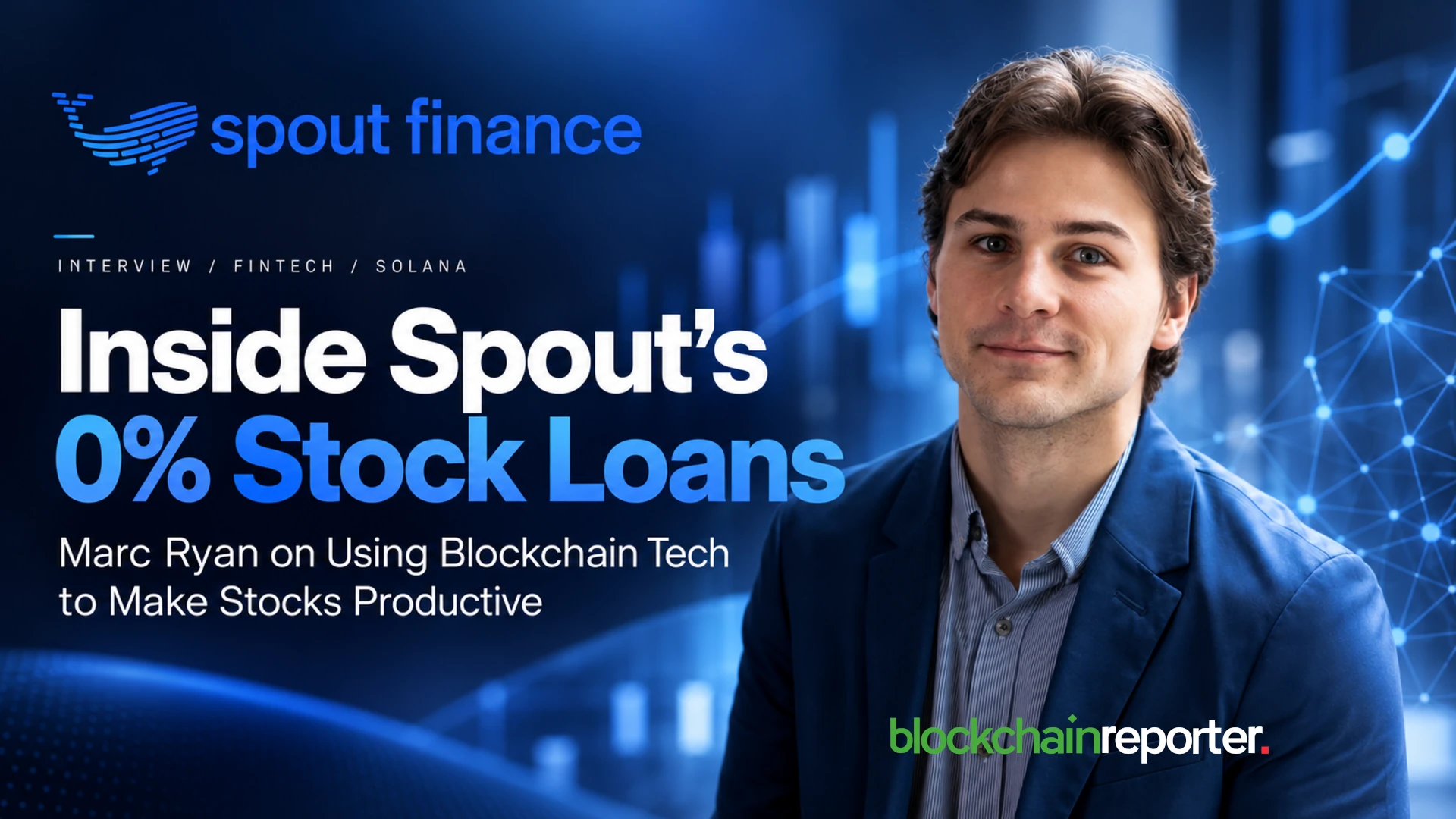
Spout, a Solana-based protocol that lets investors borrow against tokenized US stocks without paying interest, has raised a $2 million strategic round with backing from Draper Dragon, Anchorage Digital, Flow Traders and Solana Labs, among others. We spoke to Marc Ryan, Spout’s co-founder and CEO, about the two-tier credit system he saw in investment banking, how the protocol pays lenders without charging borrowers, and what has to happen before its private beta opens.
You started your career in investment banking. What did you see there that eventually led to Spout?
I worked at HSBC, including on the Arm IPO. What struck me was a two-tier credit system sitting in plain sight.
On one side of the building, we arranged debt for large companies at rates a retail investor would assume were a typo. On the other, an individual holding a perfectly good portfolio of those same companies’ stock pays around 12% to borrow against it. Same underlying asset, same credit logic, completely different price. The only variable is who you are.
The second thing was how much of the work was simply moving information around. Underwriting is largely the business of assembling facts that already exist, verifying them slowly and charging for the delay. A lot of that collapses if the asset and the information about it sit on the same ledger, and anyone can check both instantly.
Spout came out of holding those two observations side by side.
Margin loans have been around for as long as brokerages have. Why has borrowing against stocks stayed so expensive for individual investors?
Because nobody has had a way to attack it.
Margin interest is not a cost being passed through to you. It is a product. The brokerage borrows cheaply, lends to you at a spread and keeps the difference. That spread is one of the most reliable revenue lines in the business, and no competitor can undercut it without giving up the same revenue themselves. It is also not a number most people shop on. You compare commissions and app design, and you discover the margin rate after you have already moved your account.
So the rate does not fall, because falling requires replacing that income with something else, and there was no something else.
Prime brokerage solves exactly this problem for institutions. It generates revenue from the collateral itself rather than from the borrower, which is why a hedge fund’s financing costs look nothing like yours. Running that at individual scale needs a shared ledger and programmable custody, and until recently neither existed.
That is the real unlock, and it is not tokenization for its own sake. It is the ability to produce income from the collateral, so that you no longer have to produce it from the borrower.
If the borrower pays no interest, where does the lender’s return come from, and what makes it go up or down?
It comes from selling optionality on the collateral, not from the borrower.
When you post stock with us, it would otherwise sit there doing nothing, exactly as it does in a brokerage account. We write covered calls against it, far out of the money, on a weekly cycle. The premium from those calls is what pays the lender. The borrower keeps the stock’s downside and its upside up to the strike, and pays no interest.
The lender has no directional exposure to the stock. They own a stream of option premium, which is why the return is largely indifferent to whether the market goes up or down.
What moves it is the gap between implied and realized volatility. Options on large, liquid US stocks persistently price in more movement than actually occurs. That gap is where the premium comes from, and it exists because of structural demand, not because anyone is making a mistake. Pension funds and institutional allocators buy protection on blue chip holdings as a matter of policy, not because they have a view. Retail investors buy upside calls on a handful of names with enormous enthusiasm. Both are price-insensitive buyers, and someone has to be on the other side of them. When that gap is wide, the lender earns more. When it compresses, the lender earns less. The lender side is split into a senior and a junior tranche.
Selling volatility on blue chip stocks isn’t a new idea. What is different about the way Spout does it?
It is an old trade. Hedge funds and structured product desks have run it for decades, so the novel part is not the premium. The problem has always been the tail. If you sell calls and the stock rips through the strike, you eat it. That is why systematic volatility selling has the reputation it does, and why institutions are wary of the trade even when the expected value is good. They want the premium. They do not want the tail that comes attached to it.
What we do differently is separate the two and give each to the party that wants it. Because the vault has two sides, rather than one fund doing both, the return and the risk can go to different people. The lender receives the premium and carries no directional exposure to the stock. The borrower carries the tail, which costs them the upside above the strike. They are entirely comfortable with that, because they are long the asset anyway and they get a 0% loan in exchange.
Put another way, every borrower on Spout is running a covered call. It is the most widely used options strategy among retail investors, and millions of people already do it voluntarily. The only difference is what they are paid in. Normally you write a covered call and receive cash. Here you write one and receive free financing.
Two parties with opposite appetites: one wants yield without direction, the other wants leverage and already owns the risk. Until you have a permissionless two-sided market, those two have no way to trade with each other. That is what the vault is for, and that is the thing that did not exist before.
Why does this need tokenized stocks? What can you do onchain that a traditional brokerage account can’t?
Almost everything a tokenized stock does today is worse than a brokerage account. You can buy the same share from a broker for free, with better execution and real settlement. Any product whose entire proposition is “the same stock, but onchain” is asking people to accept something worse in exchange for novelty. That is why most of this category has not gone anywhere.
As far as I can tell, the prime brokerage-style borrowing we have built is the first thing you can do with a tokenized equity that beats the offchain version rather than imitating it.
Strictly speaking, the strategy does not require tokenized stocks. What it requires is that the vaults live onchain, because that is what lets liquidity arrive permissionlessly. You need a two-sided market where anyone can be the lender and nobody has to be approved to become one. A brokerage cannot do that. It has to know and onboard every participant.
But it works best with tokenized equities, because they are programmable and borrowing is only one layer of what you can stack on them. Someone can post tokenized stock here, borrow stablecoins at 0% and put those stablecoins to work somewhere else onchain the same afternoon. Try that with shares at a broker. The asset there is inert by design.
Which tokenized equities will borrowers be able to use, and how do you decide which assets to support?
Eleven at launch, deliberately. They span large cap tech, AI, crypto-linked ETFs, pharmaceuticals, energy, gold and financials.
We wanted the initial launch to be targeted. It is also important to note that the volatility gap only behaves predictably in large, liquid, heavily traded names, where there is a deep options market and constant institutional hedging flow. Move down the market cap curve and the options thin out, spreads widen and the gap becomes erratic. You can still write the calls. You just cannot promise anyone a consistent return from doing it. So we could probably support most of the top 200 stocks, but not more than that for now.
The round brings together venture funds, a market maker, a digital asset bank, among others. What do these backers bring beyond capital?
Each of them answers a question we could not answer on our own.
Draper Dragon is the Asia question. We expect Asia to be a large share of our eventual user base, and their entire practice is bridging US technology into Asian markets.
Anchorage Digital is the custody question. They are the first federally chartered digital asset bank in the United States. If you want institutions anywhere near this, custody is the first thing they ask about and the first thing that disqualifies you.
Flow Traders is the market structure question. We write options against real collateral on a weekly cycle, which makes execution quality not a detail but the product itself. Having one of the world’s largest market makers look closely at how we do that is worth more than the check.
We did not take money from anyone whose only contribution was money.
Your angels include Solana Labs co-founders Anatoly Yakovenko and Raj Gokal, and former CFTC chairman Chris Giancarlo. How did those relationships come about?
Both came from the same habit: I talk to a lot of people, and I read what they write.
I had read Chris Giancarlo’s work long before I contacted him. He was writing years ago about financial instruments moving onchain, at a point when most of the industry was busy launching another L2 nobody needed. He was describing what we are building before there was anywhere to build it. He also understands the regulatory terrain from the inside, which matters enormously in this category. I sent him a cold message, and he took the meeting.
With Toly and Raj, we knew we wanted to build on Solana, so we applied to the Solana Incubator and got in. That put us in rooms with people across Solana Labs and the Solana Foundation over a sustained period. What we are building lines up closely with what they have said publicly about what Solana is for: real financial activity at a cost that makes it sensible to do onchain. The relationship grew out of the work rather than out of a pitch.
Spout isn’t on mainnet yet. What has the devnet beta taught you so far, and what needs to happen before the private beta opens?
The most useful thing it has told us is who actually shows up, and there are two distinct people.
The first wants exposure to a stock but also wants their capital to stay liquid. They do not want to choose between owning the position and having money to deploy. They post the stock, take the stablecoins and go do something else with them.
The second is a long-term holder who wants leverage, and for that person the interest rate is the entire decision. Over a few weeks, a 12% margin rate is an annoyance. Over three years, it compounds into a serious share of the return. That person is not really shopping for a loan. They are shopping for more exposure, and the cost of carry determines how much of it they can hold. For them, 0% is not a better deal. It is a different product.
Before the private beta opens, the gate is audited. The protocol holds other people’s equity collateral and writes options against it. There is no version of this where we open it up before the contracts have been through external review.
You describe the longer-term plan as a credit layer that issuers, exchanges and wallets can plug into. What would that look like for a partner in practice?
A white-label margin product that drops into someone else’s interface. An exchange, a wallet or a tokenized equity issuer can offer their own users 0% borrowing against their holdings without building any of the machinery underneath it. The API is built. An SDK and an MCP server are in progress.
The way I think about it, we are a layer, not a destination. The useful property of building this onchain is that other people can build on top of you without asking permission. There are financial instruments and funds that could be constructed on top of a 0% borrow that do not exist yet, and then instruments on top of those. We do not need to imagine all of them. We need to make the layer underneath dependable enough that other people bother.
Spout is not yet live on mainnet. Its beta runs on Solana devnet, and the company says the private beta will open after its smart contracts have completed external audits.
0
0

 Manage all your crypto, NFT and DeFi from one place
Securely connect the portfolio you’re using to start.


