
Solana Publishes Open-Source Delivery-versus-Payment Program With JPMorgan Input

0
0
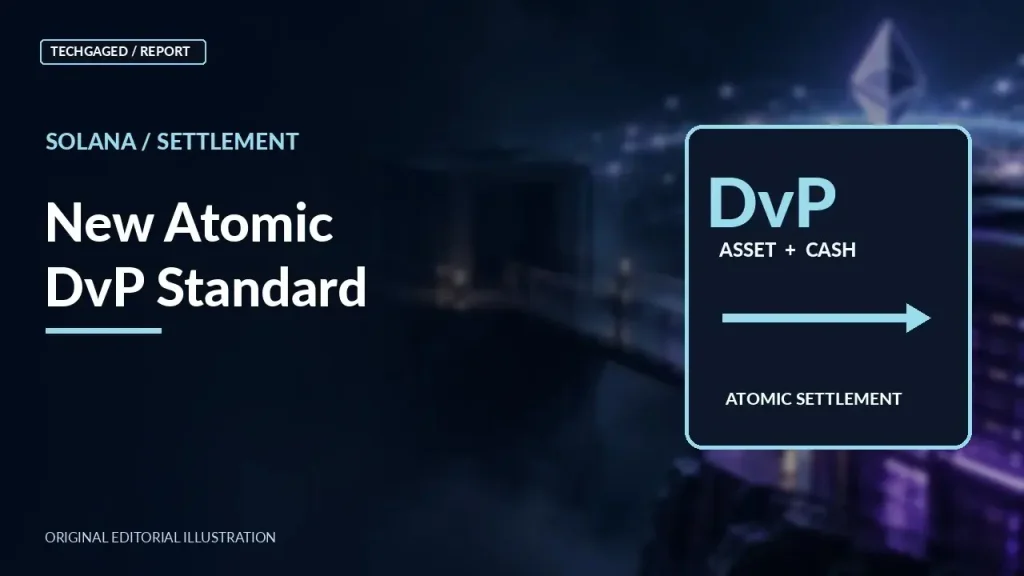
Solana Foundation has released an open-source delivery-versus-payment (DvP) program designed to help financial institutions settle tokenized securities and their associated payments within one coordinated blockchain transaction. JPMorgan provided input on institutional settlement requirements, but that contribution does not itself prove JPMorgan has deployed the program for live customer securities trades.
According to the October 6 Foundation announcement, the MIT-licensed program includes isolated escrow and settlement deadlines. Its purpose is to reduce principal risk: neither the asset nor the payment should transfer unless both legs satisfy the agreed conditions.
Delivery-versus-payment is a longstanding capital-markets principle rather than a new invention of crypto. Traditional securities infrastructures already use it to prevent a seller from delivering an asset without receiving funds or a buyer from paying without receiving the asset.
Atomic settlement brings existing controls onchain
The technical idea is that the asset delivery and payment are coordinated so that they either complete together or do not settle at all. This can reduce the risk between two counterparties during execution, although it cannot eliminate losses caused by fraudulent assets, invalid customer instructions or legal disputes outside the transaction.
The Foundation says Solana DvP supports SPL Token and Token-2022, including extensions relevant to regulated issuers such as pausable tokens, transfer hooks and permanent delegates. These features can help enforce eligibility and control requirements that a freely transferable speculative token might not need.
JPMorgan contributed feedback about the mechanics expected by institutional market participants. The release refers to security audits and early design partners, while also seeking further participants. The difference between audited software and broad production adoption must remain clear.
What institutions still need to solve
Even when token and cash settlement are atomic, real-world securities require legally recognized ownership, custody arrangements and reconciliation with other market records. A token’s delivery may not complete a legal transfer unless the relevant jurisdiction and issuer arrangements treat it that way.
Liquidity also remains a constraint. A DvP mechanism can reduce settlement risk without creating buyers, sellers or a liquid secondary market for a security. Counterparties still need to agree on price, find suitable cash assets and manage default and dispute procedures.
Financial institutions evaluating the program should examine supported token extensions, permissions of escrow agents, audit scope, recovery from failed operations and how the system interacts with compliance screening. Speed alone is not sufficient for regulated settlement.
The announcement is a tangible step toward reusable blockchain infrastructure for traditional markets. Its next proof point will be documented use in live workflows with clear settlement volumes, institutions and legal frameworks, rather than projections about network throughput or SOL’s price.
The post Solana Publishes Open-Source Delivery-versus-Payment Program With JPMorgan Input appeared first on TechGaged.
0
0

 Manage all your crypto, NFT and DeFi from one place
Securely connect the portfolio you’re using to start.


