
Dogecoin funding rate at 7.4 percent a year: the next step

0
0
Anyone betting on a rising Dogecoin price on Tuesday morning and using leverage to do it is paying for the privilege again. The funding rate for the perpetual futures contract on Dogecoin stood at 0.0068 percent at the Tuesday morning settlement on the OKX exchange. That rate falls due every eight hours. Annualised, it comes to 7.4 percent that a leveraged long position carries in running costs alone, before the price has moved at all.
Two things are therefore on the record: since Monday afternoon's settlement, funding has run against the buy side for three consecutive periods, and the ratio of accounts has shifted markedly within a single week. What our editorial team concludes from this for the days ahead is set out further down in a section of its own, kept separate from the figures.
What the funding rate actually is
A perpetual futures contract, usually called a perpetual or simply a perp in trading, has no expiry date, unlike a classic future. To keep its price pinned to the spot rate even so, the two sides pay each other a balancing amount at fixed intervals. That is precisely what the funding rate is.
The direction reveals who is pressing. If the rate is positive, buyers pay sellers, because the futures price sits above the spot rate and more capital is betting on rising prices. If it is negative, the payment runs the other way. OKX settles three times a day, at 00:00, 08:00 and 16:00 UTC. The Hyperliquid exchange collects the amount hourly.
For an investor this is no side issue but a running rent on your own position. At 7.4 percent a year, the price has to rise by that amount alone for an unleveraged position to break even. Anyone using tenfold leverage pays the same rent on the entire position size but carries it with a tenth of the equity. The 7.4 percent a year then becomes a good 74 percent, measured against your own stake.
Eight days of funding, and buyers paid in seventeen of them
A single rate says little. We therefore examined the past 24 settlements on OKX, which is eight full days. In 17 of them the rate was positive, in seven negative. On average it stood at 0.0035 percent per settlement, or 3.8 percent a year annualised. Tuesday morning's figure is thus close to double the eight-day average.
On Hyperliquid, where settlement is hourly, the rate stood at 0.00125 percent an hour on Tuesday morning. That is 0.03 percent a day and just under 11 percent a year, markedly more again than on OKX. According to the platform, around 1.01 billion DOGE sit there in open positions, and leverage is capped at ten times.
The numbers are small enough to be easily missed in day-to-day trading. That is exactly where their effect lies, because the amounts accrue for as long as the position is open, including on days when the price does nothing. This analysis was compiled by cryptoticker.io itself on October 27, 2026.
Almost five long accounts for every short account
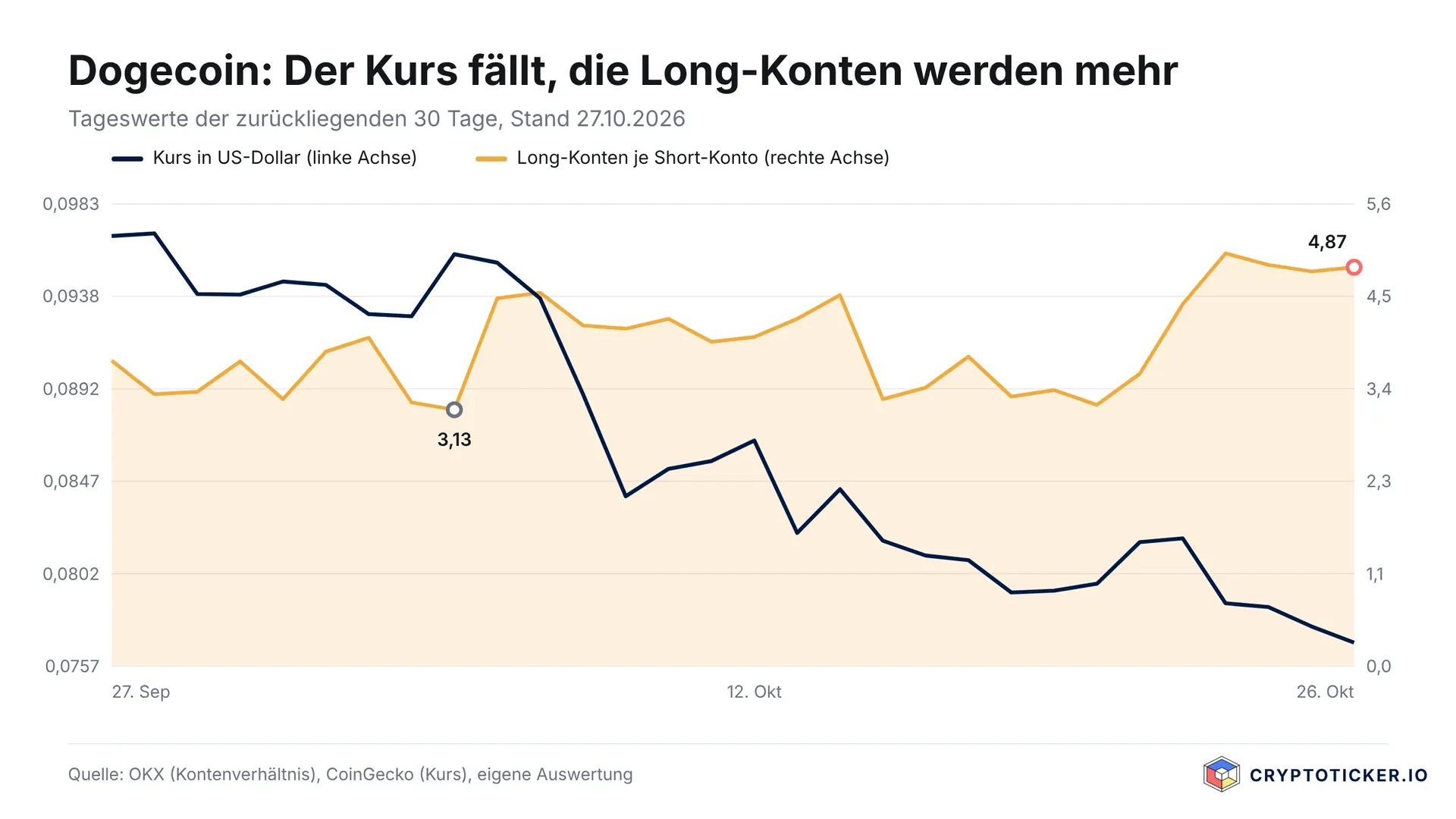
Alongside this, the way traders are positioned has shifted. OKX publishes daily how many accounts hold a long position, measured against those holding a short position. On October 20 the figure stood at 3.19 long accounts per short account. On October 26 it was 4.87. That is an increase of just under 53 percent in six days. This week's peak came on October 23 at 5.04, and the highest reading of the past 180 days was 5.53.
Why an account ratio is not the same as capital
Here a distinction is worth drawing that market reports often blur. The ratio counts accounts, not money. An account with 200 euros at stake weighs exactly as much in it as one with 200,000 euros. What is counted is the number of participants on each side, and that is a statement about sentiment, not about market power.
Open interest shrinks while the accounts multiply
This is why the second measure repays a look. Open interest gauges how many contracts are open in total, and with it the capital behind the market. On OKX it stood at 124.9 million DOGE on October 20. By October 26 it was 120.2 million, or 3.8 percent lower. On Tuesday morning the open contracts corresponded to a value of around $96.7 million.
Taken together, the two series produce a picture worth remembering: there are more accounts betting on rising prices, but no more capital. Positions are therefore getting smaller on average. That points to many individual retail stakes rather than one large address trying to move the price here. Caution is still warranted: both figures come from a single exchange and do not cover the whole market.
The spot market sits 0.5 percent above its monthly low
On Tuesday morning DOGE was quoted at $0.0772. Over 24 hours the price moved by 0.11 percent, over seven days it fell 2.6 percent, and over 30 days 21.4 percent. The low of the past 30 days was marked on October 26 at $0.0768, so the current level sits 0.5 percent above it. The highest reading of the period dates from September 28 at $0.0969.
The $0.0750 level we described on October 24 in our article on the 65-day low has held since. From Tuesday's level the distance down to it is 2.9 percent. On the upside, the next cap sits at $0.0819, the highest reading of the past seven days, 6.1 percent away.
To place the wider setting: daily turnover came to around $392 million and the market capitalisation to $12.05 billion. On Monday we reported that the Dogecoin blockchain was recording 22,538 transfers a day. Usage has not changed since; the derivatives market has.

In Germany leverage stops at two, in the rest of the world at ten
This is where the paths diverge sharply, depending on where someone trades. For contracts for difference on crypto assets, Germany applies the BaFin general administrative act of July 23, 2019, with which the regulator carried the temporary measures of the European securities watchdog ESMA into national law on an open-ended basis. For retail clients the highest permitted leverage on crypto assets there is 2:1, so the margin is 50 percent of the notional value. Added to that are negative balance protection, automatic close-out at half the margin posted, and a ban on bonuses.
The perpetual contracts the figures in this article come from are not subject to that cap, because the platforms behind them hold no authorisation for German retail clients. Anyone trading there moves outside European investor protection: no deposit guarantee, no German supervision, and no German place of jurisdiction in a dispute. The MiCA regulation changes nothing about that for as long as the provider does not enter the EU in the first place. Anyone wanting to compare the authorised alternatives will find them in our overview of the best perp DEXs and of the large crypto exchanges.
How far the price can fall before the position is closed
The relationship between leverage and the distance to liquidation is plain arithmetic, and it is routinely underestimated in day-to-day trading. As a rough rule: the distance to the liquidation price equals the reciprocal of the leverage, less fees and funding. From Tuesday's level of $0.0772 that produces the following values.
- Twofold leverage, the German cap on contracts for difference: the buffer reaches down to about $0.0386, 50 percent below the current price.
- Fivefold leverage: around $0.0618, 20 percent below.
- Tenfold leverage, the cap on Hyperliquid: around $0.0695, only ten percent below.
The third case deserves attention, because $0.0695 is not far away. Within the past 30 days the price has moved by a good fifth. A daily move of ten percent is something Dogecoin has shown several times this year. Running funding shortens that distance further, because it eats into the margin for as long as the position stays open.
The holding period does not survive the move into derivatives
For tax purposes, a spot purchase and a futures contract are two different worlds in Germany, and the difference is a stark one. Anyone buying DOGE directly and holding it is operating within private disposal transactions under section 23 of the Income Tax Act. After a holding period of one year the gain is tax-free, and below the exemption threshold of 1,000 euros in a calendar year it is tax-free before that as well. On the state of the planned reform of this period we maintain a page of its own on the crypto holding period.
A perpetual or a contract for difference, by contrast, counts as a forward transaction and falls under investment income under section 20 of the Income Tax Act. There is no holding period there after which anything becomes tax-free. What falls due is 25 percent withholding tax plus the solidarity surcharge, and church tax on top for members of a church, regardless of whether the position was open for an hour or for two years.
There has been one easing since the end of 2024. With the Annual Tax Act 2024, promulgated on December 5, 2024, the legislator scrapped the 20,000-euro ceiling on offsetting losses from forward transactions outright and abolished the separate offsetting pool. Losses from perpetuals can since be set against all investment income. For automatic tax deduction by domestic institutions, the new rule applies from January 1, 2026. A portfolio tracker that keeps spot and derivatives positions separate saves work here; which tools manage that is set out in our comparison of crypto tax software.
What holders without leverage get out of this
Even those who never touch a futures contract can read something off these figures. A heavily long leveraged side against a weak spot price means that a slide below the known levels will force positions closed. Those forced sales hit the same spot market and amplify the move for a few hours. The same applies in the other direction, when the price picks up and the few short positions have to be covered.
Our assessment of the state of the derivatives market
From our editorial point of view, the current positioning is more a risk than a signal of a recovery. Three documented points support that: the account ratio has risen by 53 percent within six days, open interest has fallen 3.8 percent over the same period, and the spot price sits merely 0.5 percent above its monthly low. More participants are therefore betting on a turn without new capital arriving, and the price is not following them.
Against that stands the fact that funding rates, at 7.4 percent a year, remain historically moderate. In overheated phases, rates in the high double digits have been charged on meme coins. The market is therefore lopsided, but not overstretched. Both series also come from one exchange; a picture across all venues would be needed to put the finding on firm ground. This is expressly not a buy or sell recommendation.
Dogecoin leverage: at $0.0695 the arithmetic turns uncomfortable
For the days ahead, three concrete points can be drawn from the figures.
- Weigh funding costs against your holding period. At 0.0204 percent a day, an open position costs around 0.6 percent of the position value over a month. Anyone looking to bet on a recovery for longer than a few weeks does better buying directly on an authorised exchange, and the holding period runs in the meantime.
- Look up your own liquidation price rather than estimating it. At tenfold leverage it sits around ten percent below the entry, so near $0.0695 at a price of $0.0772. The trading interfaces display the exact value per position; it shifts upward with every funding payment.
- Document spot and derivatives holdings separately. Two different sections with two different periods apply to the tax return. A tax tool with separate bookkeeping takes that work off your hands, as long as the exports from both platforms are available.
(As of October 27, 2026. This article is not investment advice. Prices and fee structures change; check the terms with the provider before you buy.)
0
0

 Manage all your crypto, NFT and DeFi from one place
Securely connect the portfolio you’re using to start.


