
Crypto losers of the week: Avalanche falls 17.6 percent, bitcoin 13.2 percent

0
0
Key points
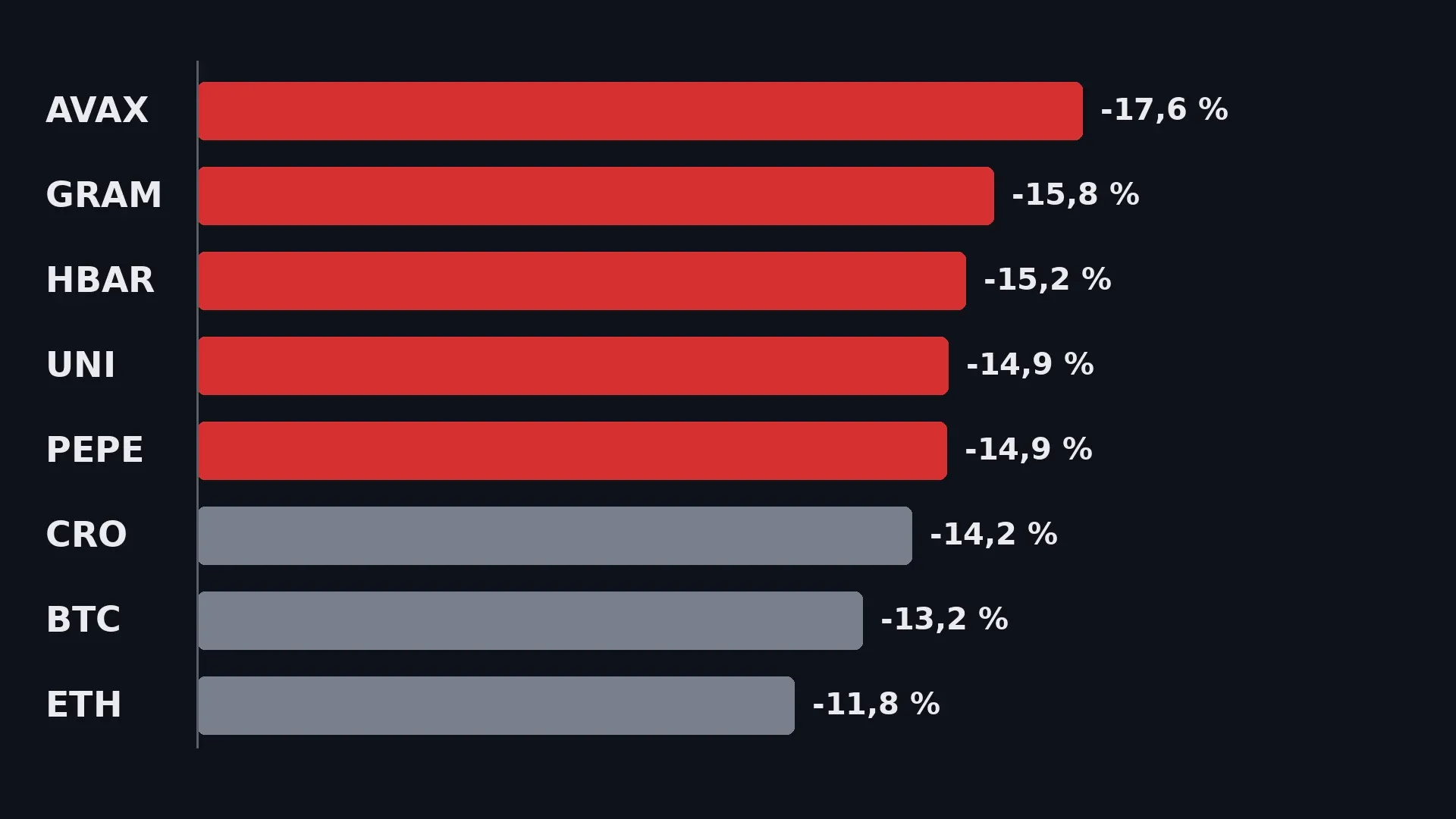
- Avalanche is the weakest coin in the top 50 by market value, down 17.6 percent over seven days (CoinGecko, as of November 19, 2026, 11:50 a.m. CET).
- Gram (formerly Toncoin), Hedera, Uniswap and Pepe follow, with weekly losses of between 14.9 and 15.8 percent.
- Bitcoin lost 13.2 percent over the same period, and the Fear and Greed Index stands at 10, in the extreme fear range.
This week's losers in the crypto market are mostly altcoins that are falling harder than bitcoin. At 11:50 a.m. CET on Thursday, November 19, 2026, Avalanche (AVAX) sits at the bottom of the 50 largest coins with a seven-day loss of 17.6 percent. That is the result of a cryptoticker.io analysis of CoinGecko market data. Stablecoins, tokenised loans and gold-backed tokens are excluded, because their price is tied to another asset.
The decline covers almost the entire market. Bitcoin trades at $63,830 and has shed 13.2 percent in seven days, while ether is 11.8 percent lower at $1,805.55. The five weakest coins therefore lost between 1.7 and 4.4 percentage points more than bitcoin. Of the 33 top-50 coins that remain once the pegged assets are removed, only three closed the week in positive territory: RAIN, MemeCore and LEO.
Crypto losers of the week: the top 50 table
The table lists the five weakest coins and, for comparison, bitcoin and ether. It is based on CoinGecko market data in US dollars from midday on Thursday, November 19, 2026. The rank refers to market capitalisation, meaning the price multiplied by the number of coins in circulation.
| Rank | Coin | Price (USD) | 24 hours | 7 days |
|---|---|---|---|---|
| 27 | Avalanche (AVAX) | 7.08 | −0.3% | −17.6% |
| 31 | Gram (GRAM) | 1.025 | −1.3% | −15.8% |
| 35 | Hedera (HBAR) | 0.0555 | −3.5% | −15.2% |
| 26 | Uniswap (UNI) | 5.21 | −0.3% | −14.9% |
| 50 | Pepe (PEPE) | 0.00000382 | +2.3% | −14.9% |
| 1 | Bitcoin (BTC) | 63,830 | −0.7% | −13.2% |
| 2 | Ethereum (ETH) | 1,805.55 | +0.1% | −11.8% |
Just behind the five laggards is Cronos (CRO), down 14.2 percent. The daily comparison stands out: the market has barely moved over the past 24 hours, and most of the weekly losses date from the days before the Fed minutes.
Why are altcoins falling? Fed minutes and a fear index at 10
One trigger common to the whole week is the interest rate question in the US. On November 18, the US Federal Reserve published the minutes of its latest meeting. As cryptoticker.io reported the same evening, some members considered a move of more than 25 basis points conceivable, and bitcoin subsequently fell to $62,700. Earlier that afternoon, a warning from Fed Governor Christopher Waller about a possible rate hike had already pushed the price below $63,000 (report of November 18, 2026).
Higher rates make safe assets more attractive and raise the cost of the loans that traders use to leverage their positions. Altcoins are hit harder, because their trading is thinner and a larger share of positions runs on credit. This shows up in what is known as beta: the term describes how strongly an asset fluctuates relative to the overall market. A coin with a high beta falls considerably further than bitcoin in a weak week.
Market sentiment is reflected in the Fear and Greed Index from alternative.me. It combines volatility, trading volume, social media and bitcoin dominance into a single value between 0 and 100. The data line for November 19, 2026:
Fear and Greed Index: 10, “Extreme Fear” (previous day 11, a week ago 28)
alternative.me, data retrieved November 19, 2026 (source)
Since November 14, the index has stood at 13 or below every day. If you want to check the fees and safeguards of trading venues in a phase like this, you will find them in the comparison of the best crypto exchanges.

The five weakest coins of the week in detail
1. Avalanche (AVAX)
Avalanche costs $7.08 and has lost 17.6 percent in seven days. That leaves it roughly 95 percent short of its record of $144.96 from November 2021. The path there is notable. On November 9, Ava Labs announced that a planned New York Stock Exchange platform for tokenised stocks would use Avalanche for clearing and settlement, as Decrypt reported. The price jumped at first but gave back the gain within a few days. On November 14, AVAX slipped below $8, as cryptoticker.io reported at the time on the NYSE rally that had been surrendered. The platform still needs regulatory approval, so any effect on demand for AVAX remains an open question.
2. Gram (GRAM)
Gram is the cryptocurrency of The Open Network, which is closely tied to the Telegram messenger. Until June 2026 the coin was called Toncoin (TON); it was then renamed following a community vote. More on its development can be found in our Toncoin price prediction. The price stands at $1.025, which is 15.8 percent lower than a week ago and roughly 88 percent below the record of $8.25 from June 2024. No trigger specific to this week is documented; Gram fell together with the altcoin market.
3. Hedera (HBAR)
Hedera trades at $0.0555 and has lost 15.2 percent in seven days, 3.5 percent of that in the past 24 hours alone. That also makes HBAR the weakest of the five coins on a daily view. The gap to its all-time high of $0.569 from September 2021 is roughly 90 percent. There are no signs of a hack, a network outage or a delisting at a major exchange; the decline runs in parallel with the overall market.
4. Uniswap (UNI)
The token of the decentralised exchange Uniswap stands at $5.21, a loss of 14.9 percent in seven days. According to a cryptoticker.io report from November 14, UNI closed that day at $4.88 on the Kraken exchange, its lowest close since August 29. The price has since recovered by about 7 percent from that low. It remains roughly 88 percent short of its record of $44.92 from May 2021.
5. Pepe (PEPE)
As a memecoin, Pepe is the smallest asset on this list and, ranked 50th by market capitalisation, only just makes it into the analysis. The price is $0.00000382, 14.9 percent below the level of the previous week. PEPE is the only one of the five losers to have gained over the past 24 hours, by 2.3 percent. The gap to its record from December 2024 is roughly 86 percent.
Altcoins vs bitcoin: why the gap widens in weak weeks
The list shows a pattern that often repeats itself in downturns: bitcoin falls, and the smaller coins fall harder. All five laggards now trade 86 to 95 percent below their respective records, while bitcoin is about 49 percent below its high of $126,080 from October 2025, according to CoinGecko. Anyone holding altcoins therefore carries a higher volatility risk than with bitcoin, and that applies in both directions.
A look at the winners helps to put this into context. Only RAIN (up 15.8 percent) and MemeCore (up 10.7 percent) posted double-digit gains among the top 50, both of them coins with small trading volume relative to their market capitalisation. Broad buying across altcoins, the hallmark of a so-called altseason, is not visible in this data.
If you trade altcoins in this phase, make sure the trading venue is authorised in the EU. Which providers hold a licence under the European MiCA regulation is shown in the comparison of regulated crypto exchanges.
Crypto losers of the week: the fear index has been at 13 or below for six days
The week ends with clear losses for altcoins, and the market is waiting for fresh signals from the US Federal Reserve. As long as the Fear and Greed Index remains in the extreme fear range, coins such as Avalanche, Hedera or Uniswap react more strongly than bitcoin to every piece of interest rate news. The next edition of the weekly losers will be published next Thursday with new data.
(As of November 19, 2026. This article is not investment advice. Prices and fee structures change; check the terms with the provider before you buy.)
0
0


 Manage all your crypto, NFT and DeFi from one place
Securely connect the portfolio you’re using to start.
 Where will Bitcoin trade next?
Live Polymarket and Kalshi odds on Bitcoin price targets, compared side by side.
See Bitcoin price odds


