
Dogecoin is missing from the new CME index while Chainlink is in, despite being a third larger

0
0
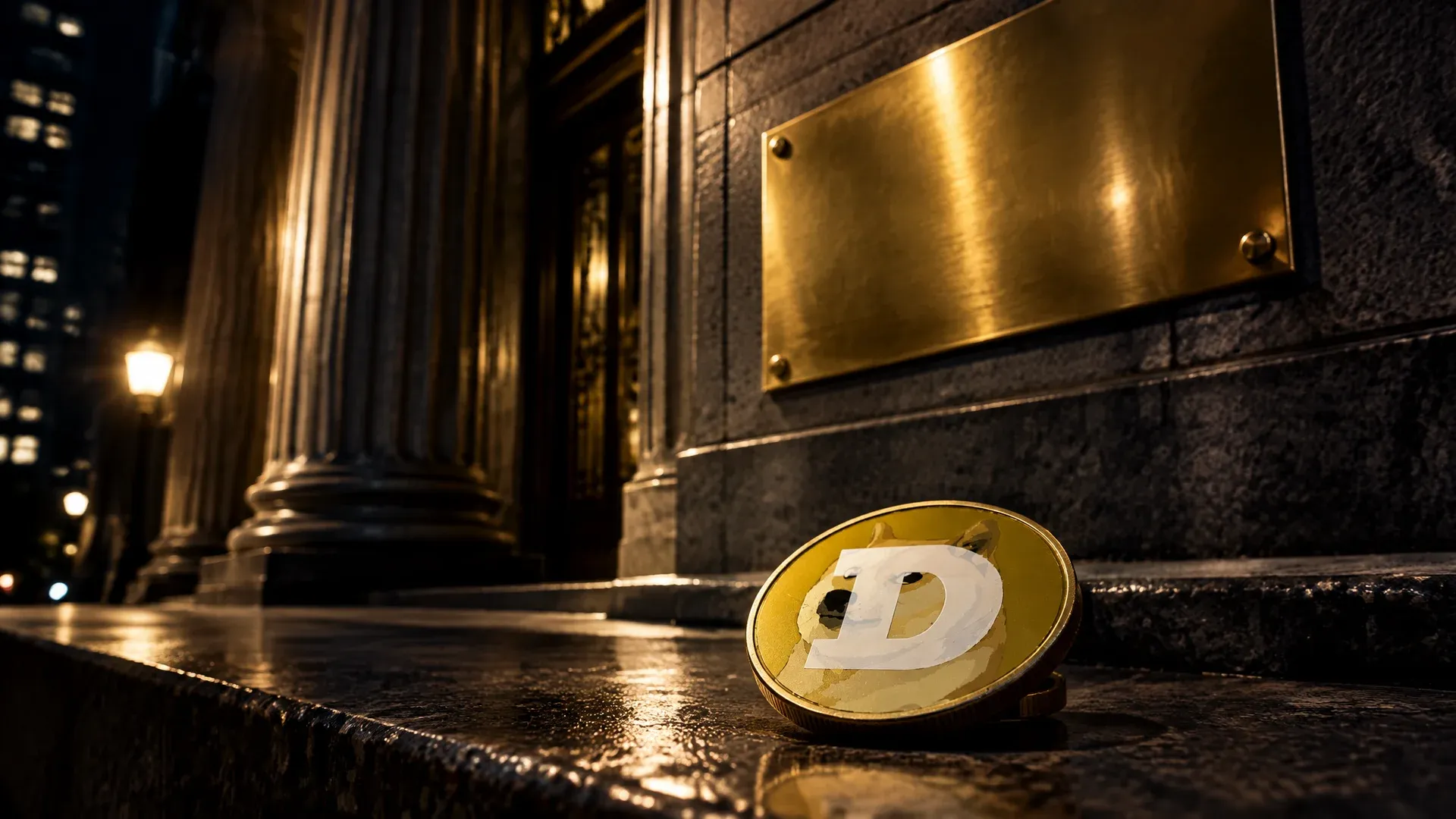
Dogecoin costs $0.0848 on Tuesday afternoon. Market capitalisation stands at $13.2 billion, roughly a third above that of Chainlink, which sits at $9.97 billion on the same day. Even so, the emerging index launched at the end of August by CME Group and CF Benchmarks lists Chainlink as a member and Dogecoin not. The reason is not in the price but in the rulebook: the index excludes memecoins and additionally measures how much value sits in the applications on a blockchain. On that second yardstick Dogecoin fails, and that explains more about the coming months than any single day's move.
The CME index takes ten coins, and Dogecoin is not one of them
CME Group and CF Benchmarks launched two benchmarks on August 31, 2026. One, the CME CF Crypto Market Index, covers twelve assets including Bitcoin and Ethereum. The other, the CME CF Emerging Crypto Index, leaves out the two large ones and bundles ten assets: BNB, XRP, Solana, Hyperliquid, Chainlink, Stellar, Sui, Uniswap, Avalanche and Aave. The indicative weights from the CF Benchmarks study of August 13 put BNB at 32.0 percent, XRP at 27.6 percent, Solana at 18.5 percent and Hyperliquid at 14.6 percent. For the remaining six assets, Chainlink included, 7.3 percent is left in total. Weighting follows free-float market capitalisation, with a review every six months on the first business day in June and December.
An index on its own is just a number. It matters once products are built on it. That is exactly why a futures exchange constructs such benchmarks: indices like these are the basis for futures contracts, for certificates and for funds that track a group of assets rather than individual coins. Anything not in the index does not appear in those products. Single-asset products on Dogecoin are unaffected; basket products are not. crypto.news has written up the details of the composition and the launch.
Chainlink is smaller than Dogecoin and still in
Comparing the two assets shows that size alone does not carry. Dogecoin sits at $13.2 billion in market capitalisation on October 13, Chainlink at $9.97 billion. The gap in daily turnover is similar: $780 million for Dogecoin against $404 million for Chainlink. On the two figures investors look at first, Dogecoin would be the stronger candidate.
The admission rules, however, ask for something else. First, memecoins are expressly excluded, and Dogecoin is the oldest and largest of them. Second, a coin has to be custodiable in a way that lets institutional houses hold it. Third, and this is the point that can be measured, the value held in the applications on a blockchain is set against the token's fully diluted market capitalisation. The rulebook names no public threshold for this, but the direction is unambiguous.
The usage filter: what sits on a blockchain is what decides
A simple idea sits behind the third criterion. A blockchain that carries lending, that issues stablecoins and that hosts trading venues ties up capital. The industry calls that tied-up capital total value locked, or TVL: the sum of all funds deposited in the applications on a blockchain. Set it against the token's market capitalisation and you get a measure of how much of that market value rests on actual usage and how much on expectation.
Chainlink supplies price data to a large number of applications and, with its staking offering, features in that calculation itself. Solana and Avalanche carry application ecosystems of their own, Aave is a lending market, Uniswap a trading venue. Dogecoin has none of this, and for a reason that was never meant to be a shortcoming: the Dogecoin blockchain cannot execute programs. It transfers value, and has done so reliably since 2013. For a metric designed to measure tied-up capital, that leaves close to nothing.

How to check the admission criteria yourself
The three points can be followed without a data service. For the memecoin criterion a project's own description is enough: Dogecoin was launched in 2013 explicitly as a joke project, and nothing about that has changed. For the custody criterion you check whether regulated custodians carry the coin, which they do for Dogecoin. For the usage criterion you look up the blockchain's TVL and divide it by the token's market capitalisation. If the result sits close to zero because the blockchain cannot carry applications, the filter is the reason for a no, not the size.
A sober expectation for December follows from that. The first regular review of members falls on the first business day in December. As long as the rules apply unchanged and the Dogecoin blockchain runs no applications, nothing changes in the composition as far as Dogecoin is concerned. Anyone betting on inclusion is betting on a rule change, not on a price path.
The Dogecoin blockchain in numbers on October 13
How little happens on the blockchain itself can be put in figures. The data below comes from the public statistics at Blockchair, queried on October 13 at 14:44 UTC. Over 24 hours, 1,375 blocks were found and 19,853 transactions processed. That is about 14 transactions per block. In the mempool, the queue of transfers not yet confirmed, 20 transactions totalling 5,127 bytes were sitting at that moment. A blockchain under load looks different.
The remaining figures round out the picture. Network hash rate came to 3.51 petahashes per second and the number of reachable nodes to 494. The largest single transfer of the past 24 hours was worth $46.6 million, which shows what the blockchain is used for: large transfers between a few addresses, not many small operations inside applications. Newly minted in the same period was Dogecoin worth around $1.17 million, roughly 13.7 million coins, because issuance continues with no cap.
These numbers are not a criticism of the design. Dogecoin was built as a means of payment, not as a platform. But they explain why a metric looking for tied-up capital finds nothing at Dogecoin. And they mark the difference from the project that starts precisely here.

DogeOS is built to close exactly this gap
On September 30 the team behind the MyDoge wallet opened a public testnet for DogeOS. It is an application layer on top of Dogecoin, technically a zero-knowledge rollup: a second layer that executes transactions itself, bundles them and then posts a cryptographic proof of the result on the Dogecoin blockchain. The layer understands the Ethereum programming environment, and fees are paid in DOGE. The base blockchain stays unchanged.
Several applications were named at launch, among them Barkswap as a liquidity engine, Superposition Finance for lending, Derps for perpetual futures, Split Markets for options and USDoge as a collateralised stablecoin. According to the report, the project was funded with $6.9 million in a round led by Polychain Capital in May 2025. Timothy Stebbing, a director of the Dogecoin Foundation, said of it: “L1 ledger purity must stay intact while we introduce utility one layer above, and that is what DogeOS represents to me.” Unchained has gathered the particulars.
For the index question the timing is what counts, and it is open. There is no date for the launch of the live network. Founder and chief executive Jordan Jefferson said only that the timetable would be communicated along with the next development steps. A testnet ties up no capital, and as long as no main network runs, the metric the index looks at does not move.
The bridge hangs on validators and a TEE signer
Anyone who later wants to move real DOGE onto this second layer should know what security there depends on. According to the developer's statements to The Block, the bridge requires three things at once: valid zero-knowledge proofs, signatures from a majority of DogeOS validators, and the signature of a so-called TEE signer, that is, a shielded execution environment. For now the order of transactions is set by a permissioned sequencer, not an open market.
The most important point comes at the end of that list. The Dogecoin blockchain itself does not verify these proofs. That would require a new opcode called OP_CHECKZKP, proposed since July 2025 and not implemented so far. Until that happens, whoever sends value across the bridge is relying on the validators and the shielded environment, not on the blockchain. That is not a warning about the project but a description of the trust model. In the testnet it has no consequences, because no real value sits there. At the launch of the main network it will be the first question.
The ETF channel stands at zero in October
The index is not the only route through which institutional money reaches a coin. For single-asset funds on Dogecoin, though, things look no better at present. According to an evaluation by 24/7 Wall St. based on data from the provider SoSoValue, there was not one trading day in October through the 12th of the month with a net inflow or net outflow. Shares were traded only between investors. Total net assets across all Dogecoin funds came to around $14.9 million, against $15.6 million paid in since launch.
On Monday, October 12, the first flow figure of the month then arrived, as an exit: FXStreet reports $399,460 of outflows from the Dogecoin funds. Measured against spot turnover of $780 million a day, that is not a number that moves a price. As an indication of interest on the product side it is telling.
There is also a date. Bitwise is halting trading in its Dogecoin fund BWOW on NYSE Arca after October 14, so tomorrow. Anyone keeping shares receives a cash payout on October 22 based on the net asset value of October 21. The net assets of that fund stood at about $684,000 on October 8. We reported on the process itself and on the distribution of the remaining holdings across two custodians on October 12, in Dogecoin custody: 144.8 million DOGE across two custodians.
What has changed since the report of October 12
Two things have been added since that article. First, October 12 is the first flow day this month, and it came out negative. Second, the price has barely moved, but the day's range is instructive: Dogecoin fell as far as $0.080215 on October 13 and rose as far as $0.085368, trades at $0.0848 in the afternoon and is therefore 0.28 percent below the previous day. The intraday low of $0.080215 is the level that has been added since; the concentration of fund holdings with two custodians, the subject of October 12, is unchanged.
Over longer horizons it sorts out like this: over seven days Dogecoin is down 11.72 percent, over 30 days it is up 1.64 percent. The distance to the high of $0.731578 from May 2021 is 88.41 percent. The figures come from CoinGecko, as of October 13, 14:44 UTC.
Holding period, buying route and custody in Germany
The index exclusion changes nothing about the legal framework in Germany; it only shifts expectations about inflows. The three points that actually affect your return stay the same.
For tax purposes Dogecoin counts, like other crypto assets, as an other asset. A sale within a year of purchase is a private disposal under section 23 of the German Income Tax Act and is taxed at the personal rate, above the annual exemption limit of 1,000 euros. After a year has passed the gain is tax-free. If you want to use the one-year rule you need unbroken records of the purchase date and purchase price, and that is exactly where most returns come apart. Which tools keep this history is covered in our overview of crypto tax software and portfolio trackers.
On the buying route, what counts since MiCA came fully into force is the provider's authorisation. Venues licensed as crypto asset service providers in the European Union are subject to supervisory duties and must keep client holdings segregated. Whether a provider holds that licence is recorded in the register of the competent supervisor. Then there is the cost side: on small amounts, the spread between instant buy and order book is a bigger item than any one day's price move. Which venues work on which terms is broken down in our crypto exchange comparison.
On custody, the situation with Dogecoin is simpler than with many altcoins, because the blockchain knows nothing beyond transfers. A wallet of your own is enough, and it makes you independent of what a fund provider or a trading venue decides. If you want to hold a balance for years, separate it from the trading venue. That applies all the more if a second layer does eventually launch: the bridge to it is an additional trust relationship, and part of your holding need not enter into it.
The editorial team's assessment
Our assessment: the exclusion from the emerging index carries more consequences for Dogecoin than the small number of affected products suggests, but it is also not a verdict on the coin. The facts in this text support that: the criterion Dogecoin fails is the usage filter, and that measures something Dogecoin was never designed to deliver. Against that stands the fact that the filter cannot be argued with. It is a number, it sits close to zero, and the six-month review in December will not change that as long as no main network for applications runs. Anyone holding Dogecoin should therefore not count on institutional inflows via basket products. What remains are the single-asset funds with around $14.9 million in combined assets and a month without a net inflow. That is the picture, and it is measurable.
Dogecoin in the index: the December review decides on inclusion
Three steps make sense now, and none of them depends on the day's price.
- Check your purchase records for completeness and note the purchase date for every holding, so that you can actually prove the one-year rule under section 23 of the German Income Tax Act. Which tool keeps the history is shown in our comparison of tax tools.
- Look up whether your trading venue is licensed as a crypto asset service provider in the EU and what a purchase in the order book costs you there compared with an instant buy. The providers' terms are in the crypto exchange comparison.
- Separate the part of your holding you want to keep for years from the trading venue and move it into custody of your own. The devices and how they differ are in the hardware wallet comparison.
The next date on the calendar is the first business day in December, when CF Benchmarks reviews the members of both indices. Until then it is not Dogecoin's market capitalisation that decides, but the question of whether anything sits on the blockchain that can be counted as tied-up capital.
(As of October 13, 2026. This article is not investment advice. Prices and fee structures change; check the terms with the provider before you buy.)
0
0


 Manage all your crypto, NFT and DeFi from one place
Securely connect the portfolio you’re using to start.


