
Aptos Encrypted Mempool Goes Live: What Changes for MEV?

0
0
Aptos Encrypted Mempool: How Does Transaction Encryption Work?
Aptos said on October 12, 2026, that the Aptos Encrypted Mempool is live on mainnet. The opt-in feature encrypts a transaction's payload on the client before submission, keeping its contents hidden while validators agree on block ordering. After the block is finalized, validators decrypt the payload for execution. Sender addresses and transaction fees remain visible, so the feature provides payload privacy rather than transaction anonymity.
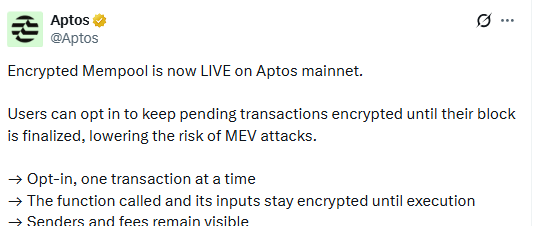
The goal is MEV protection. MEV, or maximal extractable value, is profit made by reordering pending transactions, including front-running and sandwich attacks.
How Opt-In Encryption Works Step by Step
The feature follows AIP-144. The flow has three steps:
A compatible wallet or app encrypts the payload on the user's device
Validators agree on ordering without seeing it
After finalization, validators decrypt the batch and execute it
Decryption is performed by Aptos validators through a stake-weight threshold, rather than by an external decryption committee. AIP-144 also describes a trusted setup ceremony and other cryptographic components, so "no outside committee" should not be read as "no additional technical assumptions."
Aptos says Petra Wallet supports the feature and exchange Decibel plans to use it. Wallet support means access, not adoption. No adoption figure was identified in the sources reviewed.
Aptos Encrypted Mempool: What Stays Visible and What It Costs
Item | Status |
Transaction payload | Encrypted while ordering is decided; decrypted after block finalization, before execution |
Sender and gas fees | Visible |
Minimum gas-unit price | 200 Octas, twice the usual minimum |
Latency | Aptos reports about 20 ms in testing; AIP-144 earlier estimated under 10 ms. Test conditions and comparability should be confirmed. |
Keyless and account abstraction signers | Not supported |
This is a minimum price per gas unit, not a fixed total fee. Total cost depends on gas consumed.
The 20 ms figure comes from a 50-node test and is not shown to apply to every block. AIP-144 says blocks without encrypted transactions skip decryption.
Audit Scope, Limits and Open Questions
Audit firm zkSecurity published its report on March 13, 2026, after a four-week review by two consultants. It covered three phases of Aptos Core code, each tied to a named commit. Gas metering for encrypted transactions was out of scope. The report's contents list 30 findings. We did not confirm which were fixed before mainnet, and that does not mean any remain unresolved.
This Aptos Encrypted Mempool check lists points still open:
Documentation gap: an Aptos developer page last updated September 14 still describes encrypted pending transactions as available on devnet and testnet, while Aptos announced mainnet availability on October 12. The newer announcement establishes the launch claim, but developers should check the latest SDK instructions and network-specific support before integrating the feature
Simulation: AIP-144 warns that simulating a transaction in clear text through the same fullnode used for encrypted submission may allow the node to associate the clear-text and encrypted versions. Developers should follow the current SDK guidance rather than assume encryption alone prevents this correlation
Throughput: AIP-144 set a launch target above 1,000 encrypted transactions per second, while acknowledging that encrypted throughput would remain below the chain's maximum for unencrypted transactions. Actual sustained mainnet throughput has not been established by that target alone
The Bottom Line
This Aptos Encrypted Mempool launch adds opt-in payload privacy at the protocol level. It does not hide senders or fees, and adds cost and latency. Its real impact on MEV depends on adoption, which no source reviewed measures.
YMYL Disclaimer: This article is for information purposes only and is not financial, investment, or trading advice. Information is based on Aptos' October 12, 2026 announcement, AIP-144, Aptos developer documentation as read on October 13, 2026, and zkSecurity's March 13, 2026 audit report, as of October 13, 2026. Features, costs and wallet support can change. No wrongdoing is alleged or implied. Crypto assets are volatile and carry risk of loss, including full loss of funds. Always verify current details directly with official sources and consult a licensed advisor before making investment decisions.
0
0

 Manage all your crypto, NFT and DeFi from one place
Securely connect the portfolio you’re using to start.


