
Your Payment Provider Should Reduce Work, Not Add It

0
0
Every “Where is my payment?” message lands on someone’s payroll.
By Kate L., Commercial Director of NOWPayments
If you run an online business, payment inquiries have a way of pulling your team away from everything else. A customer uses a different network, or a purchase ends up under another email address. Someone has to find an answer while the customer waits.
As Commercial Director of NOWPayments, I look at how much of the follow-up the payment provider takes on. Serving customers across different systems brings these situations with it. Growing merchants need help managing them without developing specialist expertise around every deposit and refund.
When I discuss support with a merchant, I want us to be clear about how much their team will still need to handle after handing over a case.
In the first edition of Crypto That Works for Business, I looked at how checkout design helps customers complete a purchase. Here, I’ve followed the inquiries that reach support to examine what our team takes on and where merchant input is genuinely required.
Payment Ops Have a Cost Beyond the Fee
A processing fee appears on a statement. An afternoon spent tracing a deposit usually disappears into somebody’s working day.
In an October 2026 study, LexisNexis Risk Solutions and Datos Insights surveyed 150 payments executives at financial institutions. 37% reported costs exceeding $20 per failed or delayed payment. Financial institutions have different operating models from merchants. The finding puts a price on handling these cases in that setting; an online business has its own costs to consider.
A request that starts in customer support sometimes reaches finance before anyone knows whether an order should be released. Even a straightforward refund takes longer when staff exchange details across several systems. Meanwhile, someone still owes the customer an update.
When comparing providers, ask who will handle those follow-ups. A lower processing fee deserves a closer look if the arrangement leaves your team tracing transfers and chasing answers.
The Provider Should Own the Payment-Specific Work
When a customer says they have paid, the merchant needs enough information to act. Asking for another payment before checking the original transfer risks creating a second reconciliation task.
Among NOWPayments payments created from January 16 through July 16, 2026, the “Failed” status was rare at 0.07%, while support also handles network delays, customer mistakes, refunds, and account-related issues.
The account-access case below illustrates why a customer might need help even after a successful payment.
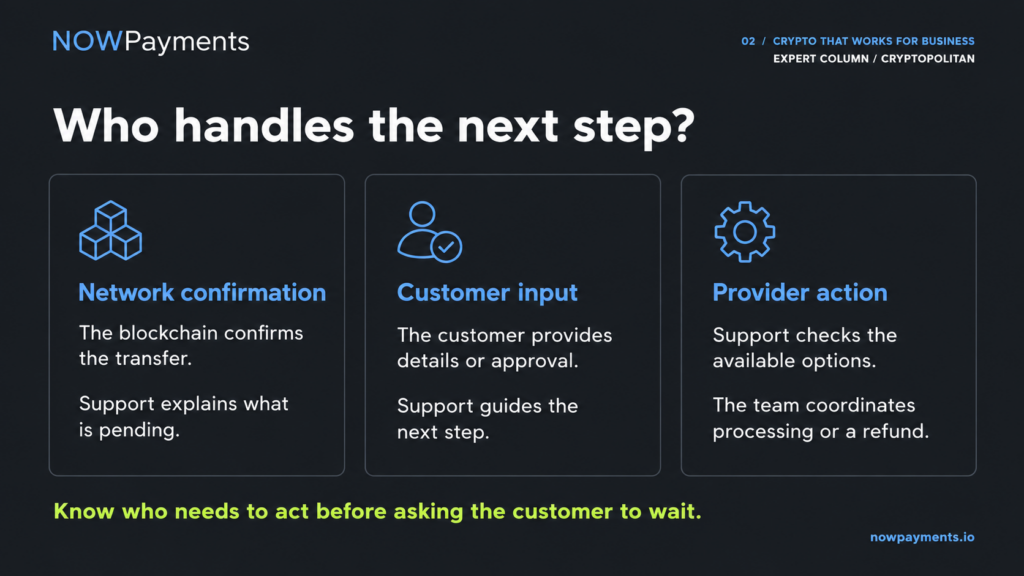
Our support team establishes what happened to the deposit and which options are available. Some compatible wrong-asset or wrong-network transfers can be processed manually, depending on merchant settings. Other cases require additional verification or an assessment of whether a refund is possible.
A Bitcoin payment can stay in “Waiting” for 20 to 30 minutes or longer while the blockchain confirms it. The delay is on the network’s side, outside NOWPayments’ control. Our support team checks the status and explains what happens next.
Network processing times also matter when a business sends payouts. Our six-month study of enterprise payouts across five blockchain networks examined processing speed across those networks, providing benchmarks to help set expectations before a recipient opens a ticket. A question about an individual transfer still needs someone to check its progress.
For the merchant, a useful handoff means supplying the payment details and knowing who will take the next step.
What That Ownership Looks Like in Real Cases
Our documented payment-support cases show what happened after the first reply.
What stood out to me was the case where the payment had already succeeded, yet the customer still needed help accessing the purchase.
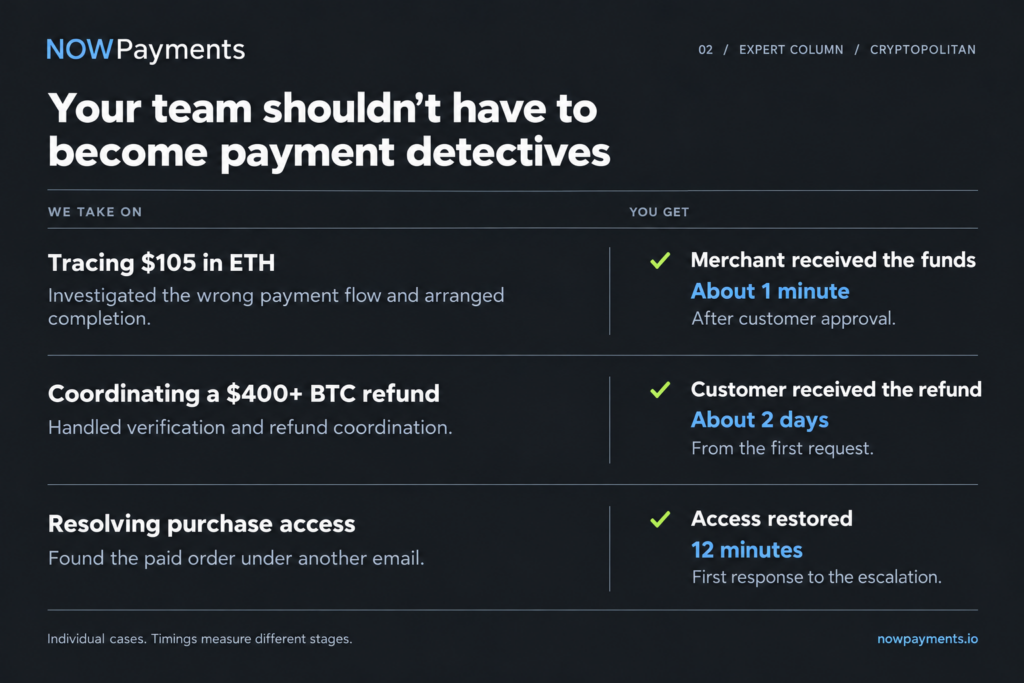
A customer had sent $105 in ETH through an incorrect payment flow. Our support team investigated and arranged manual completion. The merchant received the funds approximately one minute after the customer approved. Getting the payment through required someone to identify the available route and obtain the approval needed to proceed.
Returning a BTC payment worth more than $400 took approximately two days from the first request to the customer’s confirmation of receipt. The payment had appeared as “Failed,” and our support team managed verification and refund coordination. The case ended with the funds returned to the customer.
In the account-access case, the payment had already succeeded when our support team answered the escalated request within 12 minutes and coordinated an investigation that identified a different account email. The customer then confirmed that the issue was resolved; no further movement of funds was needed.
Digital businesses feel these gaps directly because a payment often triggers account access or a subscription renewal. The connection between payments and the services built around them is explored further in our research on stablecoins as business infrastructure. In the account-access case, the customer needed help reaching the purchase that was already paid for.
Grouping these cases under “failed payments” or “recovered sales” would obscure both the account issue and the refund.
For a merchant evaluating support, the useful details are the steps the provider takes. In these cases, our team investigated the payment flow or coordinated the checks needed to proceed. A prospective partner should be able to explain which of those tasks it handles and when your staff will need to step back in.
Speed Matters, but Ownership Matters More
Our support team reports that 97% to 98% of chats are picked up within three minutes, against a 95% target. For email, 98% to 99% are picked up within 20 minutes, also against a 95% target.
A prompt response gives the merchant somewhere to turn.
After that first reply, the process matters. Sending the merchant verification instructions leaves it to collect the details and relay them back. Guiding the customer through verification directly gives support the information to pass to whoever is authorized to proceed. Both approaches can begin quickly, but the second leaves fewer follow-ups for the merchant.
Speed is also where AI usually enters the conversation. A 2025 study in the Quarterly Journal of Economics examined 5,172 support agents and found that AI assistance increased issues resolved per hour by 15% on average. Finding relevant past cases or identifying missing information are practical starting points in payment operations. I would judge the benefit by whether that assistance helps a person reach a reliable decision sooner, without creating corrections that the merchant has to chase afterward.
How to Test a Provider Before You Sign
Bring a payment inquiry your team has actually dealt with. Ask the provider to walk through its response, including the points where it would need your input.
Then look at what remains on your side:
- Internal involvement: how often your team needs to investigate a payment itself.
- Handoffs: where the case moves between your team and the provider.
- Follow-ups: whether someone owns the next update or your staff must keep requesting it.
- Completion: who checks that the intended outcome was reached, whether that means funds arriving or access being restored. For a refund, who confirms receipt?
If your staff still chase every update and explain every next step, a fast first response has addressed only a small part of the task.
As volume grows, the division of tasks affects how much staff time you need to devote to payments. Having the provider trace deposits and coordinate refunds gives your team fewer cases to manage itself. Our examples show how those tasks were handled; measuring the merchant’s time and costs would establish the size of the benefit.
Your payment volume should grow faster than your payment support workload.
If you’re considering NOWPayments for your business, bring a payment scenario your team regularly deals with and ask who would handle each step.
Methodology: The LexisNexis Risk Solutions/Datos Insights benchmark describes financial institutions and should not be applied as a handling-cost estimate for crypto merchants. The “Failed” share reflects status at the October 13, 2026 export for payments created from January 16 through July 16, 2026; it establishes neither success nor recovery rates and does not measure financial loss. NOWPayments support-response figures are team-reported ranges covering approximately 12 to 18 months and measure the interval ending at the agent’s greeting; financial resolution is a separate outcome. Individual cases illustrate provider responsibilities and documented outcomes, with different timing starting points, and do not establish outcome frequencies or measured merchant savings. The AI study examined assistance for human agents at a software company, and the discussion here expresses the author’s perspective without reporting a NOWPayments AI deployment or measured AI results.
0
0

 Manage all your crypto, NFT and DeFi from one place
Securely connect the portfolio you’re using to start.


