
Best Crypto to Buy Now: Bitcoin Slips Under $81K as Zcash Locks Its NU7 Upgrade for November 5

0
0

$10,000 in Zcash at this morning’s $1,177.59 buys 8.49 ZEC. If ZEC simply reclaims its September 26 high of $1,698, that position is worth $14,419. The bet rests on one dated fact: Zcash’s NU7 network upgrade is now locked to mainnet block 3,543,405, which the chain should reach around November 5. The broader market is drifting the other way. Bitcoin slipped under $81,000 in the first hour of October 24 for the first time since mid-month, and only one top-10 coin is printing green.
Bitcoin traded at $80,882 as of 00:13 UTC on October 24, down 0.24% over 24 hours, per CoinGecko data. Ethereum sat at $2,379.52 (−0.17%), Solana at $102.49 (−0.95%), and XRP at $1.29 (−1.10%). BNB was the lone top-10 gainer, up 1.14% to $737.99. Zcash changed hands at $1,177.59, down 3.28% on the day, with a $20.0 billion market capitalization — the number that frames everything below.
Bitcoin Under $81K: A Level the Data Keeps Testing
The 30-day chart shows the story in one line. Bitcoin peaked near $86,490 on October 10, faded through the middle of the month, and has now spent four of the last six sessions under the $82,000 mark it defended through the first half of October. The slide from $86,490 to $80,882 is a 6.5% drawdown, and it has come on falling conviction rather than a single liquidation cascade: 24-hour volume near $23.9 billion is well below the October highs.
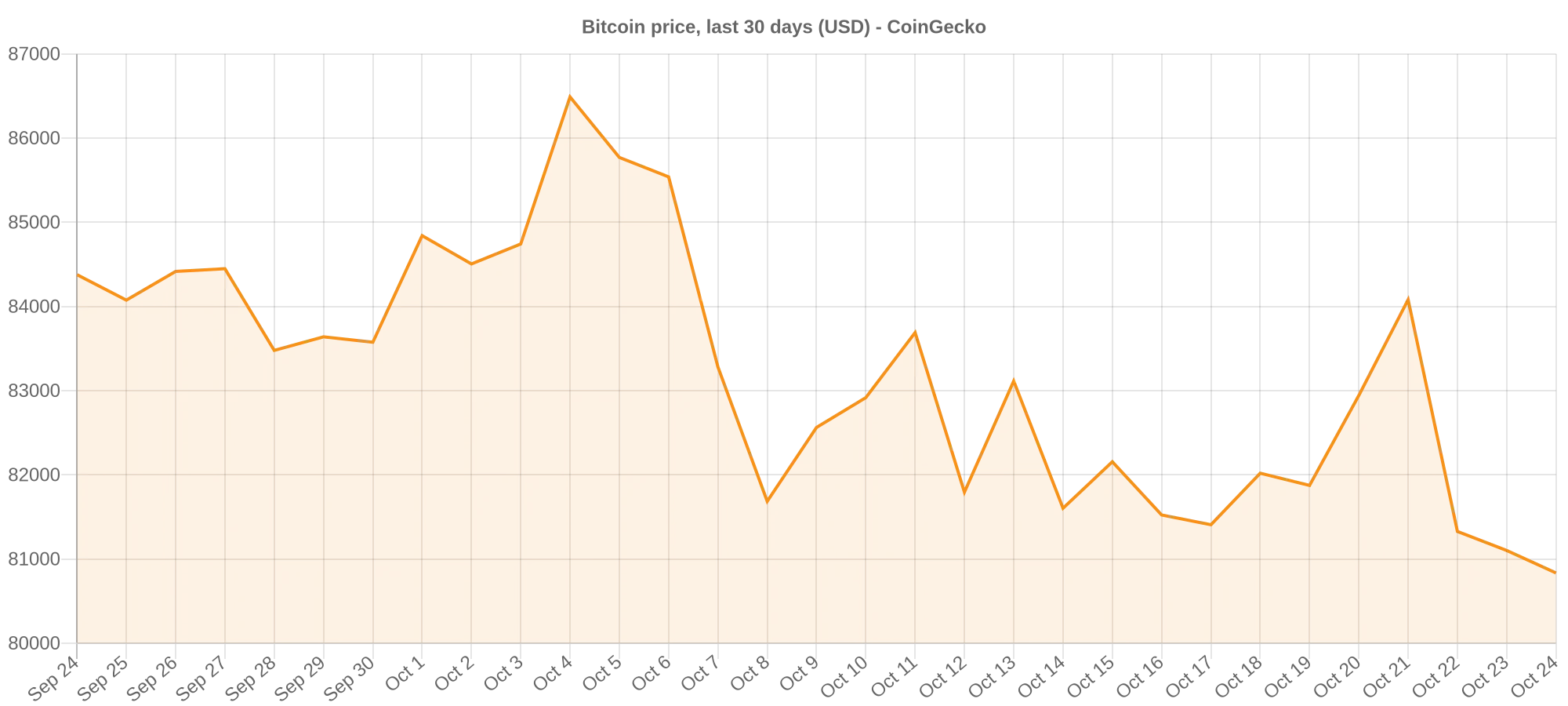
What matters for a trader is that $81,000 is not a random round number. It has acted as the pivot of the current range: buyers stepped in near $81,100 on October 22, and sellers have capped every push above $83,000 since the middle of the month. A daily close below $80,000 — the level defended through the weekend — opens the next test around $79,500, the deeper floor traders cited ahead of the Federal Reserve’s October 27–28 meeting. A reclaim of $83,000 puts the October 10 high back in play. Those are the two conditions, and both are data-bound, not vibes.
The Zcash Catalyst: NU7 Locks to Block 3,543,405
Zcash’s case is different because it is not waiting on a central bank. The Zcash Foundation released Zebra 7.0.0 on October 22, the first stable node release with mainnet support for Network Upgrade 7. The foundation is direct about what the upgrade changes: “NU7 brings blocks every 25 seconds instead of every 75, a Network Sustainability Mechanism that recycles part of every transaction fee into future block rewards, and new shielded limits that protect wallets from spam.”
Activation is not a calendar date but a block height: 3,543,405, targeted for around November 5. The upgrade had already gone live on testnet at block 4,465,026 on October 4. The speed change is the headline. Target block spacing falls from 75 seconds to 25 seconds, so the average wait for a first confirmation drops from 75 seconds to roughly 25 seconds. At target spacing, the chain produces about 3,456 blocks a day instead of roughly 1,152, and three confirmations clear in about 75 seconds rather than 225.
The fee change is the part most holders will actually feel. Under ZIP 235, the foundation writes, “60% of each block’s transaction fees are removed from circulation and placed in a reserve, while miners keep the other 40% so they still have every reason to include transactions.” Those reserved funds are scheduled to return gradually through later block rewards, beginning at mainnet block 8,939,664 — around February 2031. The 21 million ZEC supply cap does not change, and the halving schedule is untouched.
There is one deadline that is not optional. “Once NU7 activates, version 4 transactions are no longer valid,” the release states, and “because Sprout transfers can only use version 4, funds left in the Sprout pool become unspendable.” Anyone still holding ZEC in the original Sprout shielded pool must move it before block 3,543,405 or lose access. Node operators face the same cutoff: the foundation’s instruction is that “All Mainnet operators MUST upgrade before height 3,543,405 (~Nov 5) to stay on the consensus chain.”
The 2x Math: What Doubling Actually Demands
The money angle is concrete and the arithmetic is the own-work part of this screen. At $1,177.59 and a $20.0 billion market cap, a 2x on ZEC means $2,355 and a $40 billion market cap. That is not a re-rating of the entire Zcash story — it is ZEC returning to the $1,698 level it printed less than a month ago, before the NU7 testnet cycle began. The 8.49 ZEC a $10,000 position buys becomes $20,000 at that level, and $14,419 just by reclaiming the September high.
Bitcoin, by contrast, has to do much more for the same return. Doubling from $80,882 to $161,764 requires the market cap to grow from $1.63 trillion to roughly $3.25 trillion — a $1.62 trillion inflow that no single catalyst in the current calendar promises. BNB sits in between: a 2x to $1,475.98 needs its market cap to move from $97 billion to about $194 billion. The point is not that ZEC is the better asset in absolute terms. It is that a dated, network-level catalyst is a cheaper trigger than a macro regime change, and the math makes the tradeoff explicit.
The benchmark that matters is the one the market already tested. ZEC peaked near $1,698 on September 26 and has given back about 30% since, so today’s $1,177.59 is a retrace, not a new high. The NU7 activation is the first hard event since that peak that changes the protocol’s throughput, and the October 21 merge of the height into the ZIP specification removed the last “to be determined” from the schedule. That is what turns a retrace into a re-rating candidate.
Why This Setup Fails
The skeptical case is straightforward and should be taken seriously. First, ZEC is down 3.28% on the day while the rest of the market is flat — the NU7 catalyst has not yet shown up in price, and a protocol upgrade is a supply-and-throughput event, not a demand event. Faster blocks and a fee reserve do not, by themselves, bring new buyers. Second, the upgrade is still two weeks out, and the interim belongs to the macro calendar: the Federal Reserve decides on October 27–28, and a hawkish surprise would pressure every risk asset, ZEC included, regardless of its own roadmap.
Third, the Sprout migration is a real operational risk for a small but non-zero set of holders. Roughly 0.4% of shielded funds still sits in the legacy pool, and any of it left behind at activation becomes unspendable — a self-inflicted supply event that could read as confusion rather than progress if the migration warnings do not land. Finally, the broader privacy-coin trade has already run hard this year, which means some of the NU7 outcome may be priced into a token that is still up sharply on a year-to-date basis despite October’s pullback.
None of this breaks the trade, but it defines the invalidation. If Bitcoin closes the week under $80,000, the ZEC setup is fighting a falling tide. If NU7 slips past November 5 — the height is a target, not a promise — the catalyst is gone and the position thesis is gone with it.
The Levels That Matter Before November 5
For ZEC, the levels are clean: support at $1,081, the October 16 low after the inflation selloff, and resistance at $1,252 and then the $1,698 September peak. A close above $1,252 reopens the range top; a break of $1,081 puts the $1,049 mid-September low in view. For Bitcoin, the $80,000 close is the line in the sand, with $79,500 as the deeper floor and $83,000 as the reclaim that would turn the daily trend back up.
The two dates to keep on the calendar are October 27–28 (the Fed) and the November 5 NU7 window. The Zcash position is a bet that the second event matters more for one asset than the first one matters for everything else. That is the whole trade in a sentence, and it is why the Zcash news hub and the Bitcoin news hub are the two pages worth refreshing between now and then.
Frequently Asked Questions
What is the best crypto to buy now?
On October 24, 2026, the strongest dated catalyst sits with Zcash, whose NU7 upgrade is locked to mainnet block 3,543,405 for around November 5. Bitcoin is the safer core position but is drifting under $81,000 ahead of the Fed’s October 27–28 meeting.
What is Zcash’s NU7 upgrade?
NU7 is Zcash’s seventh network upgrade. It cuts target block spacing from 75 seconds to 25 seconds, adds a Network Sustainability Mechanism that diverts 60% of transaction fees into a reserve, and disables version 4 transactions, which makes legacy Sprout-pool funds unspendable at activation.
When does the Zcash NU7 upgrade activate?
NU7 activates at mainnet block 3,543,405, which the network is expected to reach around November 5, 2026. Because block production is not perfectly uniform, the exact time can shift slightly; the height, not a clock, controls activation.
Is Bitcoin a buy at $80,882?
Bitcoin trades under $81,000 with support near $80,000 and $79,500. A daily close below $80,000 opens the next leg down; a reclaim of $83,000 would turn the daily trend back up. The October 27–28 Fed decision is the next macro catalyst.
Disclosure: This article does not represent investment advice. The content and materials featured on this page are for educational purposes only.
0
0


 Manage all your crypto, NFT and DeFi from one place
Securely connect the portfolio you’re using to start.
 Where will Bitcoin trade next?
Live Polymarket and Kalshi odds on Bitcoin price targets, compared side by side.
See Bitcoin price odds


