
XRP forecast: Evernorth lists 473 million XRP on the Nasdaq, the price has not moved since Monday

0
0
XRP trades at $1.34 on Friday midday. The price has gained 2.7 percent over the past 24 hours, market capitalisation stands at $84.5 billion and ranks fifth among all cryptocurrencies (CoinGecko, as of October 16, 12:46 UTC). The real event of this week, though, sits on a balance sheet: since Monday, Evernorth, the largest listed XRP treasury in the world, has traded on the Nasdaq, and it holds 473 million XRP. Practically nothing has moved in the price since.
That is the question this article turns on: why does a price stand still when a company holding hundreds of millions of tokens goes public? The answer lies in the mechanics of the structure, and for investors in Germany it has a tax side that most reports leave out. Where the price can point over a horizon of months is set out in our XRP price prediction.
XRP at $1.34: where things stand on Friday midday
The trading range of the past 24 hours ran from $1.2827 to $1.3521 on Kraken. The market opened at $1.3334, and a good 16.6 million XRP changed hands on the dollar pair over that period. Trading volume across all exchanges comes to roughly $1.5 billion in 24 hours (CoinGecko).
Across the current year XRP is down about 28 percent, and the range of the past 52 weeks runs from $0.99 to $2.69. Anyone trying to place today's $1.34 therefore has two reference points: the price sits a good third above the yearly low and at roughly half the yearly high.
Evernorth holds 473 million XRP and has traded on the Nasdaq since Monday
Evernorth Holdings has traded under the ticker XRPN on the Nasdaq since October 12, 2026. On completion of the merger the company held around 473 million XRP, worth about $657 million at the then price of $1.39, plus roughly $300 million in cash before costs. Cryptobriefing reports this, citing the company's own statements at the start of trading.
Behind the vehicle stands a circle familiar in the XRP world: Ripple itself, Arrington Capital, Japan's SBI Group, Pantera Capital, the Kraken exchange and the trading house operator GSR. Evernorth is led by Asheesh Birla, a former Ripple executive. On the day trading began, the company brought in Hugo Jeandesboz as chief investment officer, previously co-CIO at Coinbase Asset Management.
The first trading day was unspectacular. The stock rose 5 percent at the open, traded as much as 13.43 percent above its starting level during the session and closed around 1.5 percent higher. The listing had originally been planned for October 8 and slipped over administrative questions.
How a SPAC merger becomes a treasury
A treasury company, a digital asset treasury in the jargon, is a listed company whose business purpose consists of holding a cryptocurrency. What gets bought is shares in a company whose balance sheet consists almost entirely of those coins, not the coins themselves.
Evernorth emerged from a merger with Armada Acquisition Corp. II, a shell company, completed on October 9. Going through such a shell, a SPAC, is the fastest route to a listing in the United States: the vehicle is already quoted, and the operating business grows into it. For the coin market, one detail in all this is decisive, and it is the one the headlines pass over.
Why tokens already bought create no fresh buying pressure
The 473 million XRP had been acquired before trading began. The listing itself removed not a single additional XRP from the market. All it did was make the ownership of that existing holding publicly tradable. Buying pressure on the spot market only arises once Evernorth buys more with its roughly $300 million in cash, or raises fresh capital through new shares and converts it into XRP.
This is precisely where the picture that the word treasury creates in the mind parts ways with reality. A holding on a balance sheet is a snapshot of past purchases, not a running stream of demand. What counts for the price is who buys today, and in what size.
If you want to check at which fees and under whose supervision you can acquire XRP yourself, the providers are set out in our overview of the best crypto exchanges. The difference between a share and a coin is not a formal one, as the tax section further down shows.
The US spot ETFs hold more than twice as much
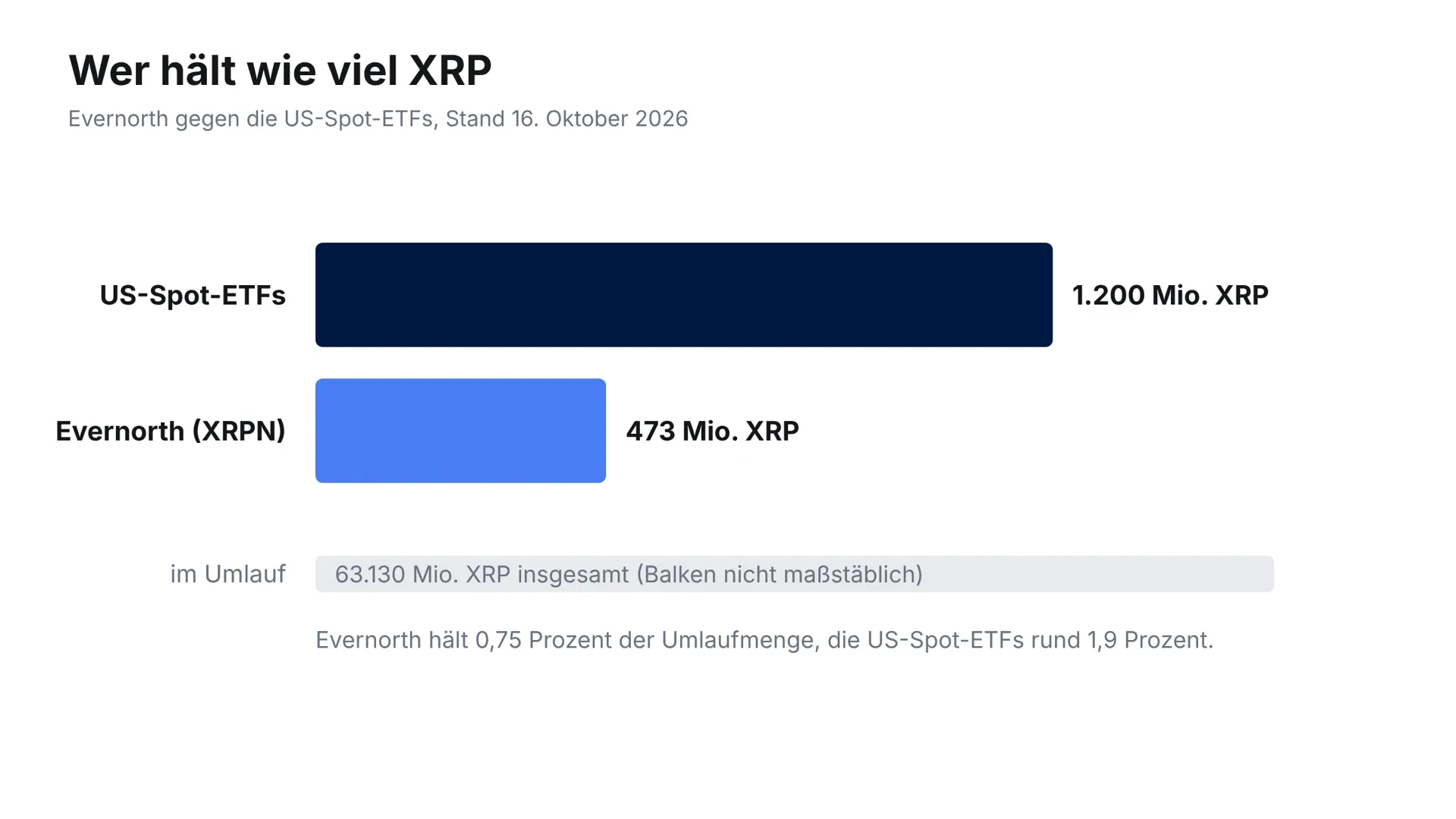
473 million XRP sounds like a lot. Measured against the circulating supply of 63.13 billion XRP, it is 0.75 percent. The US spot ETFs on XRP together hold around 1.2 billion tokens, more than twice as much, as The Motley Fool calculates on Friday. Writing there, Dominic Basulto concludes that new treasury companies will do little to lift the XRP price, however large they grow.
To compare the orders of magnitude: at today's price of $1.34, Evernorth's holding is worth around $634 million. Daily trading volume in XRP runs at roughly $1.5 billion. The entire holding of the largest listed XRP holder therefore changes hands almost three times on a normal trading day.
Thursday's fund flows: a $104,500 outflow, two funds pulling against each other
How little institutional demand is pressing into the market right now is shown by the previous day's fund flows. The US spot ETFs on XRP recorded a net outflow of $104,500 on Thursday. That is the smallest daily outflow of October so far, and it comes about in an unusual way: Franklin's XRPZ fund took in $3.6448 million while Bitwise lost $3.7494 million. The figures come from SoSoValue and were compiled by PANews on Friday.
A net figure close to zero does not mean calm in this case, but rotation. Investors are moving between two providers without money flowing into or out of the market as a whole. Net assets managed by the XRP spot ETFs stand at $1.528 billion, with cumulative net inflows since launch of $1.803 billion.
For the price question that means the two sources of demand the market has been watching for weeks are both delivering nothing new. The funds are standing still, and the new treasury has its purchases behind it.
What has changed since Thursday's futures market analysis
On Thursday we looked at the futures market here: open interest had fallen by 30 percent and the ratio of long to short accounts stood at 3.60. That is set out in our analysis of the short overhang in the XRP futures market from October 15.
Since then the market has tested the lower edge and held it. The price fell to $1.2827 in the meantime and now stands back at $1.34, the same level as at the time of that analysis. The difference lies in the quality of that level: yesterday it was a reading after a slide, today it is a reading after a test that held. What stood as a thesis then, the market has since put to the test once.
The levels: $1.2827 below, $1.3521 above
Two levels are defensible for the coming trading days, because they come out of actual trading rather than a model. On the downside it is the low of the past 24 hours at $1.2827. That is the point where buyers stepped in on Thursday. If it breaks, there is no catch line formed in recent trading until the area around $1.20.
On the upside it is the daily high at $1.3521. As long as the price stays below it, it is moving inside the range that has held since the start of the week. A daily close above it would be the first indication that the buying side wants more than to defend the low.
Both levels are points to watch, not price targets. A substantiated price target requires an author who stands behind it, and for XRP there is none for this week.

Share or coin: how to check your holding period on XRP
For investors in Germany, the Evernorth share is not a more convenient version of the same investment. A different regime applies to it for tax, and the difference is substantial.
XRP itself counts among other assets. A sale falls under private disposals pursuant to Section 23 of the Income Tax Act. Hold the tokens for more than a year and the gain is untaxed. Within the year, an exemption threshold of 1,000 euros applies to all private disposals taken together. Exceed it and the entire gain is taxable at your personal income tax rate, not only the part above the threshold.
A share such as XRPN, by contrast, falls under investment income. Here the flat withholding tax of 25 percent applies, plus the solidarity surcharge and church tax where relevant, softened by the saver's allowance of 1,000 euros a year. There is no holding period after which the liability falls away, whether the share sits in the portfolio for one year or ten.
That yields a concrete check before an order goes in: anyone wanting XRP exposure through a share is trading a position that becomes tax-free after twelve months for one that is permanently taxable. With a planned holding period of more than a year, the tax effect argues clearly for the coin itself; for short-term trading, that argument loses weight. Suitable tools for recording acquisition dates are in our comparison of crypto tax tools.
The one-year holding period itself remains under political observation. The Bundestag rejected its abolition on October 9 by 445 votes to 132, and the expected cabinet date then passed without a decision. We keep the state of play in our report on the cabinet date that passed. This text does not replace tax advice; for your own situation, a tax adviser remains the right address.
MiCA authorisation and custody: what counts on the buying route
Since the European Markets in Crypto-Assets Regulation came to apply in full, providers addressing customers in the EU need authorisation as a crypto-asset service provider. For the buying route that means two things. First, behind an authorised provider stands a European supervisor with a complaints channel. Second, obligations apply to the separation of client and own holdings.
The XRPN share is not covered by any of this. The paper trades as a US security through a broker, not through a crypto exchange. Whether a German broker makes it tradable at all depends on the individual house. If you are weighing that route, the providers are in our comparison of crypto brokers.
With the custody of XRP itself comes a detail many only notice on their first transfer: the XRP Ledger requires a minimum reserve per account, which stays permanently tied up and cannot be sent. Anyone moving tokens from an exchange to their own address should budget for that amount.
Our assessment: demand arises on the exchange, not on the balance sheet
From the newsroom's point of view, the expectation that a listing of this kind will lift the price is not substantiated. The facts for that are in this text: the 473 million XRP were bought before trading began, they amount to 0.75 percent of circulating supply, and the spot ETFs hold more than twice as much at around 1.2 billion tokens, without their flows moving anything this week. The price confirms the picture: practically unchanged since Monday.
Against that stands one point to be taken seriously. Evernorth has roughly $300 million in cash, and the shareholder circle of Ripple, SBI and Pantera has the means to add through new shares. If the company buys that amount in XRP on the market, it would come to a good 220 million tokens at today's price, a noticeable share of one trading day. That case has not been announced so far. What is substantiated to date is the holding, not the intention.
XRP at $1.34: a treasury is no substitute for demand
Three steps follow from this for the coming days:
- Settle your own time frame. With a planned holding period of more than twelve months, the tax position argues for the coin itself rather than a share on the same asset. Acquisition dates belong in the records from the outset; tools for that are in our comparison of crypto tax tools.
- Note the two levels. $1.2827 on the downside, $1.3521 on the upside. Only a daily close outside that range changes the situation; everything in between is the move of the current week.
- Check the buying route before the order. Fees, authorisation and withdrawal routes differ markedly between providers; an overview is in our comparison of the best crypto exchanges.
(As of October 16, 2026. This article is not investment advice. Prices and fee structures change; check the terms with the provider before you buy.)
0
0

 Manage all your crypto, NFT and DeFi from one place
Securely connect the portfolio you’re using to start.


