
Dogecoin price on the month's thinnest trading day: what you can do now

0
0

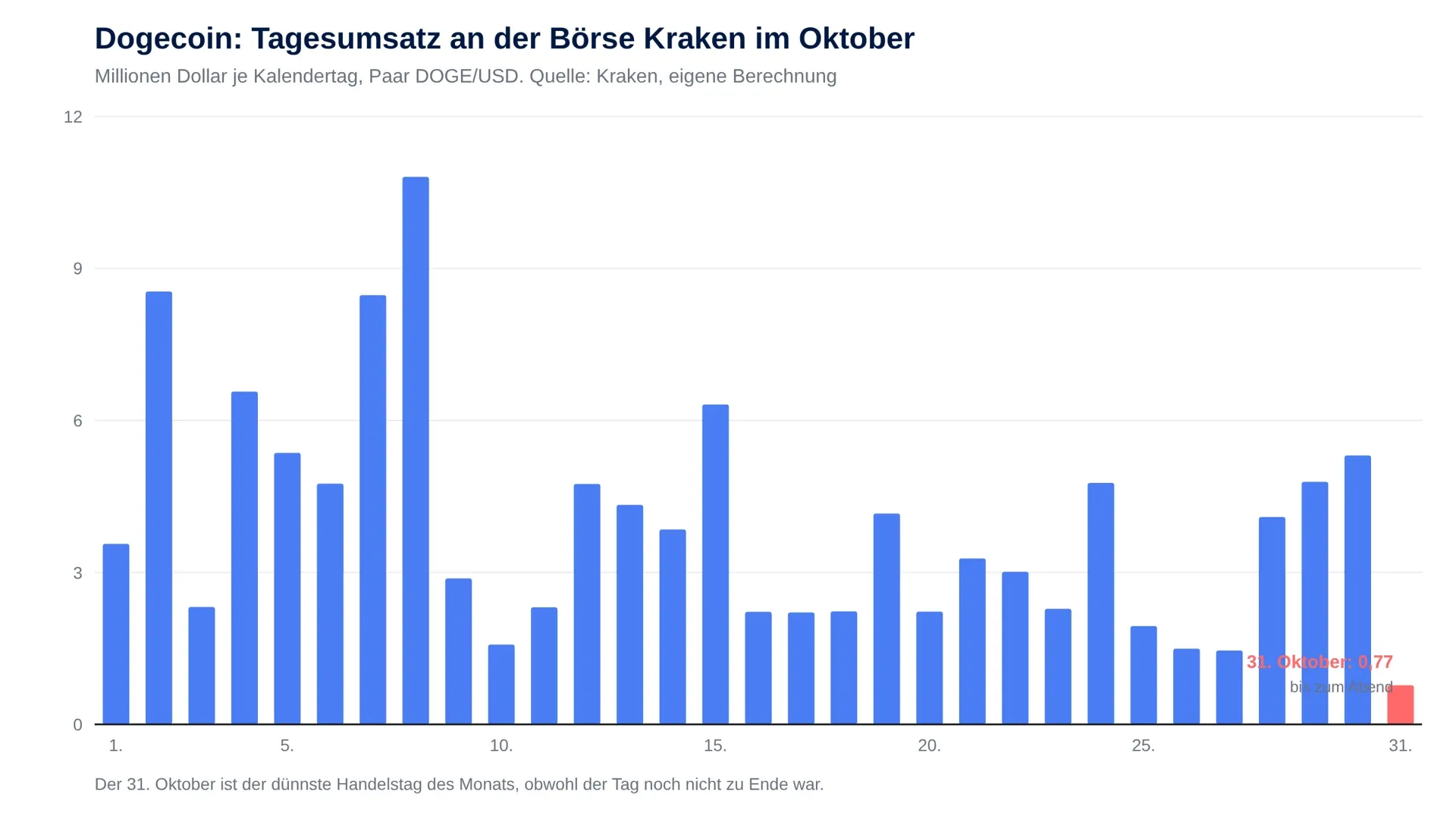
What is documented: Dogecoin worth $0.77 million changed hands on the Kraken exchange on Saturday up to the evening, spread across 2,582 trades. The October average was $3.96 million and 7,986 trades a day. Our assessment follows further below. For the price, this dried-up trading is the more important signal than the 0.5 percent gain that stood on the board the same day.
The price of Dogecoin stood at $0.0758 on Saturday evening, a gain of 0.52 percent within 24 hours according to CoinGecko data. Market capitalisation came to $11.86 billion, enough for rank 12 among all cryptocurrencies. More interesting than these figures this weekend is how little stands behind them.
Dogecoin price at $0.0758, turnover at the month's low
Saturday's daily range stayed narrow. Between the daily high at $0.076349 and the daily low at $0.074826 lay 2.04 percent. On October 29, only two days earlier, it was still 4.2 percent. The movement has therefore halved, and turnover has collapsed far more sharply.
The figures from the venue make that clear. On Kraken, 10.25 million DOGE came together on Saturday up to the evening. On Friday it was 70.98 million units in the same pair, and the number of trades stood at 14,219 instead of 2,582. Even if something is added in the final hours of the day, October 31 remains the thinnest trading day of the entire month.
What a trading day actually measures
Daily turnover is the sum of all purchases and sales of a calendar day at one venue, valued at the respective price. It says nothing about direction, but a great deal about participation: how many market participants post bids at all, and how large they are. A rising price on falling turnover means that few purchases were enough to lift it. That is exactly the case for this Saturday.
For comparison, the month's peak day: on October 8, 126.81 million DOGE and 19,659 trades ran across the same venue, worth $10.81 million. Saturday reached one fourteenth of that.
Turnover ratio: Dogecoin turns over less than Bitcoin and Litecoin
A single venue can mislead, so a look at the overall market is worthwhile. Across all exchanges together, Dogecoin worth $303.8 million was traded within 24 hours. Measured against a market capitalisation of $11.86 billion, that is 2.56 percent. This metric is called the turnover ratio and shows which share of the entire holdings changes hands in a day.
For Bitcoin, the same ratio stood at 3.95 percent on Saturday evening, and for Litecoin at 3.81 percent. Dogecoin therefore turns over markedly less than the two older assets, even though the coin is considered particularly active in trading. Only Shiba Inu came in below it, at 1.55 percent.
For investors, that is the real story of this weekend. A low turnover ratio means there is little counterparty in the order book. Whoever moves larger pieces shifts the price themselves, and in both directions.
A thin order book makes every market order more expensive
The order book is the list of all open buy and sell orders at an exchange, sorted by price. Between the highest bid and the lowest ask gapes the spread. The fewer orders are posted, the wider this gap becomes and the further away is the next price at which someone is still willing to trade.
A market order buys at the next best available price, whatever that is. In a thin book it eats its way upward through several price levels. The difference between the price you saw on screen and the price at which the order was actually filled is called slippage. On a day with 2,582 instead of 14,219 trades, it is measurably larger than usual.
A limit order, by contrast, sets the maximum price you are willing to pay. It is filled only if someone sells at that price, and it can sit unfilled. In exchange, you know in advance what the purchase costs. How far spreads and fees differ between venues is shown by our comparison of crypto exchanges; at small amounts, the fee structure often decides more than the price itself.
The $0.0750 level holds again, the target at $0.0695 did not arrive
On October 30 we described in this slot how the Dogecoin price broke the $0.0750 level and brought $0.0695 within reach as the next target. Since then the situation has turned, without any new wave of buyers being visible.
The daily close on October 29 was $0.07509, on October 30 $0.07588, and on October 31 $0.07562. The level of $0.0750 has therefore been reclaimed and has held on the two following days. The named target of $0.0695 was not reached, and the lowest point of the past seven days was $0.0721.
On the upside, the weekly high at $0.081357 caps the room. Between that high and the current price lie a good 7 percent. The two levels that count in the coming days are therefore named: $0.0748 as Saturday's daily low on the downside, $0.0814 as the weekly high on the upside. Both come from the trading of recent days and not from a model.

October balance: 20 percent down on shrinking turnover
Calculated across the whole month, the balance is clear. The last September close was $0.0944953, and the level on October 31 was $0.075617. That is exactly 20.0 percent of loss in one month. Over a year, Dogecoin stands 59 percent lower, and 89.6 percent separates the price from its all-time high at $0.7316.
The path within the month is notable. The highest-turnover days fell in the first half of October, when the price still swung between $0.084 and $0.096. In the second half, turnover has fallen below $4 million a day, and on three days even below $1.5 million. The step downward therefore came about on declining participation, not on a wave of selling.
Loss offsetting: what the October decline triggers for tax
Anyone who sold in October and made a loss in doing so should not put the records away. In Germany, purchases and sales of cryptocurrencies fall under private disposal transactions pursuant to Section 23 of the Income Tax Act. The decisive element there is the one-year holding period: anyone who holds for longer than twelve months sells tax-free, regardless of the size of the gain.
Within the year, the other side of the same rule applies. Gains are taxable as soon as all private disposal transactions of a year together reach the exemption threshold of 1,000 euros. Losses from these transactions can only be offset against gains of the same kind, not against employment income and not against share gains. Remaining losses are carried forward by the tax office into the next year or back into the previous one.
In practical terms: a loss on Dogecoin realised in October reduces the tax on a gain you made with another coin in the same year. For that, however, the loss has to appear in Annex SO of the tax return, and for that you need every transaction with date, quantity and price. Programs that pull the statement from the exchanges and calculate the deadlines automatically take this work off your hands.
Whether the holding period remains in this form is politically open. We keep track of the current state of the debate in our overview of the crypto holding period on an ongoing basis.
Our assessment: the thin trading weighs more than the daily gain
In the editorial team's view, the gain of 0.52 percent this Saturday is no sign of strength. The composition of the day supports that: 2,582 trades against an October average of 7,986, a daily range of 2.04 percent instead of 4.2 percent two days earlier, a turnover ratio of 2.56 percent against 3.95 percent for Bitcoin. A price that moves on a fifth of the usual turnover is easy to lift and just as easy to push back down.
A sober objection argues the other way: October 31 was a Saturday, and weekends are regularly quieter in the crypto market. That alone does not explain the decline, though. The month's four other Saturdays reached turnover of $2.32 million, $1.57 million, $2.21 million and $4.77 million, so two to six times this day. The drying-up is therefore more than a weekend effect, and it fits the path of the entire second half of the month.
What follows from that is no statement about direction. A breakout above the weekly high at $0.0814 would be worth little without rising turnover, because it would lack the participation to carry it. The same applies in reverse to a slide below $0.0748. The turnover figure of the coming days says more about the resilience of a move than the move itself.
Dogecoin turnover: only above $4 million does a move carry
Three steps make sense this weekend, and all three can be done in a few minutes.
- Check the spread and the fees at your venue. Compare the highest bid with the lowest ask and convert the difference into percent. If it is above half a percent, a market order costs more than the trading fee itself. Which venues stay cheap on small orders is shown by the exchange comparison.
- Place purchases as a limit order in this market situation. Set the limit price at a value you are willing to pay, for instance near Saturday's daily low of $0.0748, and accept that the order can sit unfilled. Anyone who regularly moves larger amounts will find the terms for it in the broker comparison.
- Secure October's sales for the tax return. Pull the transaction statement from your exchange with date, quantity and price and file it with the documents for the 2026 tax year. The software for that is listed in the comparison of tax tools.
(As of October 31, 2026. This article is not investment advice. Prices and fee structures change; check the terms with the provider before you buy.)
0
0

 Manage all your crypto, NFT and DeFi from one place
Securely connect the portfolio you’re using to start.


