
Dogecoin today: one transfer moved $48.6 million, six transactions sat in the mempool

0
0
The Dogecoin chain settled 17,404 transfers over the past 24 hours, and a single one of them carried 5.12 percent of the entire daily value. $48,607,636 moved from one address to the next in that one transfer. At the same moment, six entries sat in the queue of unconfirmed transactions. Dogecoin traded at $0.085353 on Sunday morning, or €0.07631.
Those three figures describe a chain that is barely used and whose daily movement hangs on a handful of very large addresses. Two practical consequences follow for investors in Germany: a transfer costs almost nothing, and a sell order meets a book that is thinner than the $13.34 billion market capitalisation suggests. Every on-chain figure in this article comes from the public node dump at Blockchair, the price and turnover figures from CoinGecko.
$48.6 million in one Dogecoin transfer: 5.12 percent of the daily volume
The largest single transfer of the past 24 hours carried $48,607,636. Measured against total on-chain volume of $949.5 million, that is 5.12 percent. Put differently, every twentieth dollar that crossed the Dogecoin chain that day sat in one booking. The transaction carries the identifier 305a0b463533d4543b19fc26e3d80766442c79c54b2d142b3af2d9c6d5f399df and can be read in the public block dump.
Who stands behind it cannot be read off the chain alone. A transfer of that size fits a shift between two custodians just as well as the build-up or unwinding of a position. So no interpretation belongs here, only the measurement: a transfer of that size means the movement on the chain is not carried by many small payments.
On average, each of the 17,404 transfers came to 639,182 DOGE, or roughly $54,556 at Sunday morning's price. An average at that level does not come from tipping on the network. It comes from the kind of reshuffling that exchanges, custodians and large holders carry out.
11.12 billion DOGE in 24 hours: 17,404 transfers moved $949 million
11,124,324,222 DOGE crossed the chain. At a price of $0.085353 that equals $949.5 million. For comparison, reported exchange turnover over the same period came to $330,998,299. The chain therefore moved 2.87 times what changed hands on trading venues.
That ratio is unremarkable on its own. For Bitcoin it stood at 3.36 on the same day, higher still. High on-chain turnover proves neither demand nor selling pressure; it only counts how much value shifted between addresses, in-house reshuffling included. The figure becomes interesting only alongside the question of how many bookings it spreads across.
Six entries in the Dogecoin mempool: the median fee sits at 0.113 DOGE
The mempool is a network's waiting area. It holds transactions that have been sent but not yet taken into a block. The fuller it is, the more users have to bid to have their transfer pulled forward. On Dogecoin, six transactions sat there. On Litecoin there were 131, on Bitcoin 30,578.
Without a queue there is no fee competition. The median fee on a Dogecoin transfer came to 0.113 DOGE, around one US cent. The average paid was 0.38772 DOGE, about 3.3 cents. The average runs more than three times the median because the large transfers consist of more inputs and are therefore heavier; the fee is measured by data volume.
For a holder in Germany the practical point is narrow: the route from a trading platform into self-custody costs almost nothing on the chain. A move like that almost always gets expensive somewhere else, namely at the platform's flat withdrawal charge. That charge sits in the provider's fee schedule and is independent of the chain fee; a look at the fee schedule before the withdrawal is worth more than any optimisation on the transaction itself.
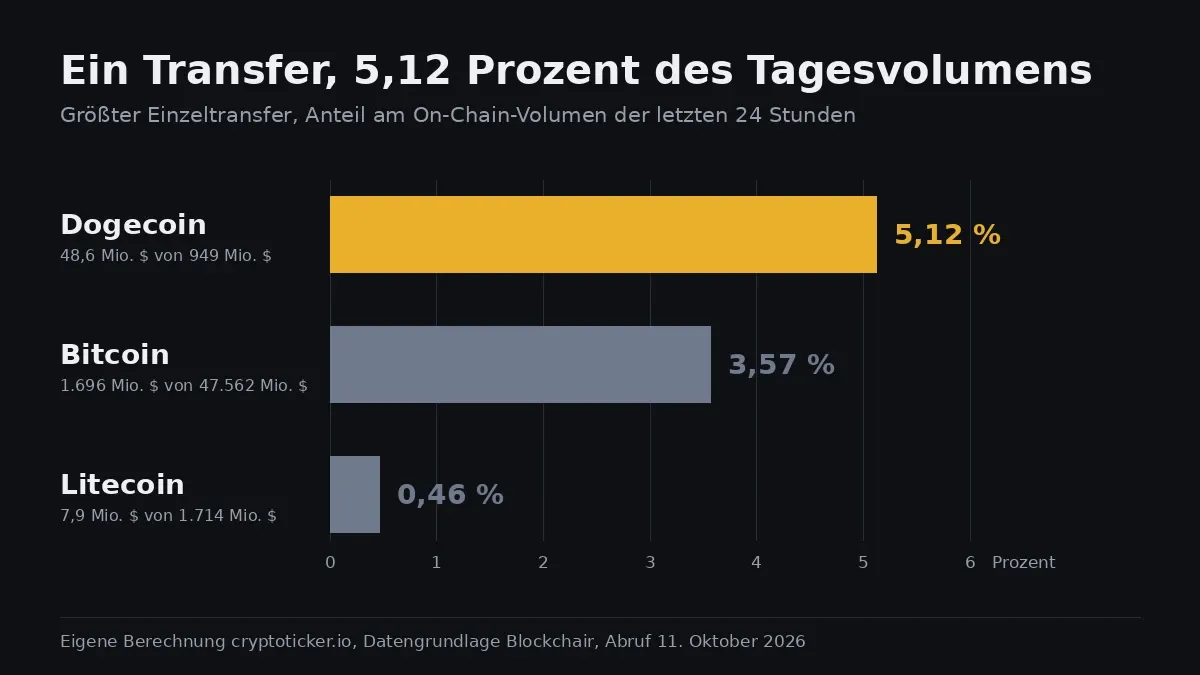
Dogecoin against Litecoin: 5.12 percent concentration vs 0.46 percent
Litecoin works as a yardstick because both chains use the same Scrypt algorithm and are secured by the same data centres at the same time. The largest Litecoin transfer of the past 24 hours carried $7.9 million, or 0.46 percent of that chain's volume of $1.714 billion. On Dogecoin the same figure stood at 5.12 percent, eleven times as high.
On Bitcoin, the largest transfer carried $1.696 billion; measured against chain volume of $47.562 billion, that is 3.57 percent. Dogecoin therefore sits above Bitcoin and far above Litecoin. The metric measures one day only and fluctuates; it holds up as a snapshot, not as a trend. Anyone who wants to track it over weeks will find the daily value in the public dump of each of these chains.
1,347 Dogecoin blocks instead of 1,440: the chain ran at 93.5 percent of its pace
Dogecoin targets one block a minute, so 1,440 blocks on a full day. 1,347 were counted. That equals 93.5 percent of the target pace and is the normal lag of the difficulty adjustment: when computing power leaves, blocks take longer until difficulty has caught up. The figure last stood at 45,739,871, with hashrate over the past 24 hours at 3.07 petahash per second.
Those 1,347 blocks carried 17,404 transfers, or 12.92 per block. How the data centres' income splits between issuance and fees is something we broke down on October 10 in the calculation on the shared mining budget.

Turnover ratio of 2.48 percent: a market order meets a thin book
Exchange turnover of $330,998,299 equals 2.48 percent of the $13.34 billion market capitalisation. The ratio says how much of the entire stock changes hands in a day. It is not a measure of the depth of any single order book, but the upper bound of what was tradeable across all venues together.
The difference counts when selling. A market order takes every offer standing in the book until the desired quantity is filled. In a thin book the executed average price slips below the quoted price as it goes, and the larger the order, the further it slips. A limit order, by contrast, names the worst price a seller will accept and stays put when the book cannot supply it.
The daily range shows how tight things were: 1.9 percent lay between the high at $0.0865 and the low at $0.084881. Working a market order inside a range that narrow easily gives away more than the venue's fee amounts to.
Since October 10: the Dogecoin daily low at $0.084881 has held
In our calculation of October 10 the price stood at $0.0862. Since then it has been $0.085353, a decline of 0.98 percent. Over 24 hours the loss comes to 1.04 percent, over seven days to 8.03 percent. The all-time high at $0.731578 lies 88.3 percent above the price.
Two levels can be justified from the daily data rather than from a drawing: the daily low at $0.084881, which has held so far, and the daily high at $0.0865. Both come from the past 24 hours and lose their meaning as soon as a new range forms. Levels from earlier days, such as the $0.0878 of the 200-day line from our calculation of October 4, now sit above the price and therefore act as resistance rather than support.
Holding period under Section 23 of the German Income Tax Act: a Dogecoin transfer between your own wallets is not a disposal
Moving DOGE from a trading platform to your own hardware wallet sells nothing. A transfer between addresses belonging to the same person is not a private disposal within the meaning of Section 23 of the German Income Tax Act and triggers no tax. The one-year holding period keeps running; it does not start again.
Documentation still matters. Without proof that the sending and receiving addresses belong to the same person, the acquisition date is hard to establish later, and whether a sale after one year is tax-free depends on it. Inside the year, gains from private disposals carry an exemption limit of €1,000 per calendar year; once it is exceeded the entire gain is taxable, not only the part above it. Anyone running many transfers cannot avoid clean record-keeping, of the kind portfolio trackers and tax tools deliver.
MiCA and the BaFin register: how to spot an authorised trading platform
The European regulation on markets in crypto-assets has applied in full since December 30, 2024. Anyone exchanging or holding crypto-assets commercially in the EU needs authorisation as a crypto-asset service provider. In Germany, BaFin keeps the register of authorised firms, and every provider appears there with its name and the scope of its licence.
Two things need separating here. Authorisation says something about supervision, own funds and a provider's obligations. It says nothing about the depth of its order book for a given pair. The two together decide what a sell order finally brings in, and both can be looked up before buying: the licence in the register, the depth in the venue's order book view. Holders who then want to keep their own coins in self-custody compare the form factors of custody devices separately.
Our take on Dogecoin: concentration is the risk, not issuance
The criticism levelled at Dogecoin is usually the unlimited issuance of new coins. The day's figures suggest a different emphasis. 13,470,000 DOGE were newly issued, worth $1,149,705. Over the same period $949.5 million crossed the chain, and $48.6 million of that sat in a single booking. Daily issuance therefore equals 0.12 percent of chain volume, while the one large transfer equals 42 times issuance.
Against that: a one-day measurement proves no structure. A single large transfer can be a reshuffle that does not return tomorrow, and the mempool reading is a snapshot. Only what has been measured repeatedly holds up. Our assessment is therefore this: issuance is calculable and small against the daily movement, the dependence on a few large addresses is not. Anyone holding DOGE should size the position by how much of it can be sold inside a narrow daily range without a discount. That is not a recommendation to buy or sell.
Dogecoin transfers: below $0.084, the depth of the book decides
Three concrete steps follow from the day's figures:
- Settle the order type before the range narrows. On Sunday, 1.9 percent lay between $0.084881 and $0.0865. A limit order names the worst price accepted; a market order takes what the book supplies. Which venues offer DOGE any meaningful depth at all is shown in the comparison of trading venues.
- Hold the flat withdrawal charge against the chain fee. On the chain, a transfer cost a median of 0.113 DOGE, around one US cent. Holders who move into self-custody regularly should know their provider's flat charge and pick the form factor of their wallet to match; the form factors and their differences are set out in the hardware wallet overview.
- Record every transfer with its date. The one-year holding period keeps running through a move between your own addresses, but only with proof. The record-keeping is handled by tax tools and portfolio trackers.
(As of October 11, 2026. This article is not investment advice. Prices and fee structures change; check the terms with the provider before you buy.)
0
0

 Manage all your crypto, NFT and DeFi from one place
Securely connect the portfolio you’re using to start.


