
Chainlink Institutional Investment and LINK's Future Outlook

0
0

Chainlink Institutional Investment: FLNK Filing and LINK's Future
Chainlink Institutional Investment: that phrase now has a filing behind it. Fidelity filed an S-1 registration statement with the U.S. Securities and Exchange Commission (SEC) for a spot Chainlink ETF.
The fund is expected to list on Nasdaq under the ticker FLNK. It would hold LINK directly and track its price.
The structure is simple on paper. The open questions are fees, timing and approval. This guide covers the network, the filing, the fund race and five signals that may shape the future of LINK.
Key Takeaways
The proposed fund would hold LINK itself and pay no staking rewards.
The S-1 leaves the fee, effective date and launch date blank.
Two rival spot funds already trade in the U.S.
What Is the Chainlink Oracle Network?
Blockchains cannot read outside data on their own. A price, a bank record or a shipping update has to be fed in. That job belongs to an oracle.
Sergey Nazarov and Steve Ellis introduced Chainlink in 2017. Its oracle network uses independent node operators, not a single data source.
Smart contracts, which are programs that run when set conditions are met, then use that data. Chainlink's official site also describes the Cross-Chain Interoperability Protocol (CCIP), built to move data and tokens across blockchains.
According to Chainlink, organizations pay for oracle services with LINK. Network service providers use it for security and rewards.
Source: official website.
What Fidelity Filed
The Fidelity Chainlink Fund is a Delaware trust formed on November 19, 2026. These details come from the S-1 dated November 25, 2026.
Feature | Filing detail |
Sponsor | FD Funds Management LLC, an FMR LLC subsidiary |
Holdings | $LINK on Ethereum only, no derivatives or borrowing |
Price source | Fidelity reference rate, updated every 15 seconds |
Staking | None |
Buyers would trade FLNK through a broker. No wallet or private key is involved.
Chainlink ETF vs Buying LINK Directly
A spot ETF holds the real asset, not futures contracts. The trust would own LINK, and shares would follow its value minus fees.
Staking means locking tokens to help secure a network for rewards. The S-1 says the trust will not stake, and it gives no reason.
Chainlink Staking is capped at 45 million tokens, or 4.5% of the 1 billion LINK supply. Withdrawals require a 28-day cooldown.
Direct LINK | FLNK shares | |
Staking rewards | Possible, if space allows | None |
Keys | You manage them | Custodians manage them |
Access | Wallet or crypto account | Brokerage account |
Grayscale vs Bitwise vs Fidelity Chainlink ETF
Fund | Launch | Published fee | Assets |
GLNK (Grayscale) | Dec 2, 2025 | 0.35% | $112.10M |
CLNK (Bitwise) | Jan 14, 2026 | 0.34% | $41.64M |
FLNK (Fidelity) | Not set | Blank | Not launched |
Together, the two live funds hold $153.74 million. That is reported assets, not new buying.
At GLNK's 0.35% fee, a $10,000 holding costs about $35 a year. That is arithmetic, not a forecast.
How Chainlink Institutional Investment Works Through a Fund
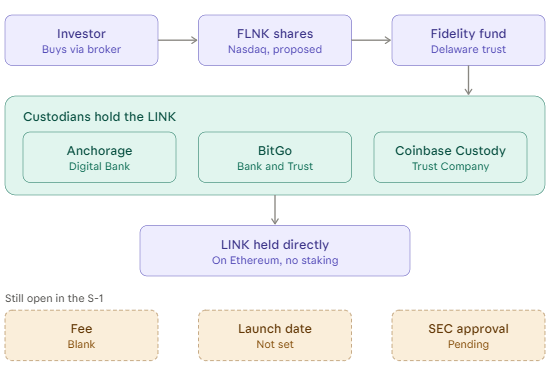
Large investors rarely buy tokens the way retail users do. Compliance teams want regulated access, outside custody and clean reporting.
A listed fund meets those needs. The investor sees a ticker, not a wallet. That is the logic behind most institutional crypto investment products.
Three routes now exist for $LINK exposure:
Route | Who holds the keys | Staking | Status |
Spot ETF (GLNK, CLNK) | Fund custodians | No | Trading |
Direct trading on Fidelity Crypto | Account provider | Not stated | Added Nov 24, 2026 |
FLNK | Fund custodians | No | Proposed |
The S-1 also cites a March 17, 2026 SEC and CFTC release that names LINK a digital commodity.
The fund is not registered under the Investment Company Act of 1940. It therefore lacks some mutual fund protections.
The Future of LINK: Five Signals Inside Fidelity's Filing
What the filing says: Fidelity filed an S-1 with the SEC to launch a spot Chainlink ETF, expected to trade on Nasdaq under FLNK. The fund would hold LINK directly and track its price. It would not stake the tokens or distribute staking rewards.
Anchorage Digital Bank, BitGo and Coinbase Custody would serve as custodians. Share creations and redemptions would be available in LINK or cash.
Who is already there: Grayscale and Bitwise offer spot Chainlink ETFs in the U.S. As of November 24, they held about $112 million and $42 million in assets under management.
The filing cannot predict a price. These five signals sit inside it.
1. Access as a product. FLNK would be the third spot fund. The category exists, but its assets are small so far.
2. Price without the network. LINK holders can stake to earn rewards, while Fidelity does not plan to stake. Two holder groups may form: price-only owners and network participants.
3. A pull toward custody. Anchorage, BitGo and Coinbase Custody would hold the tokens. Creation in LINK moves tokens into the fund. Creation in cash makes the fund buy them. The filing gives no estimate, so any supply effect is unproven.
4. A fee race. GLNK and CLNK publish fees. FLNK's cell is blank. Money moving between funds adds no net demand, so the fee is the first number to compare.
5. The network's own clock. Chainlink's materials frame tokenization and cross-chain settlement as its growth story. Those are issuer claims. An ETF does not change how much the network is used.
Signal | What it shows | What it does not prove |
Brokerage access | Demand for a product | Real buying |
No staking | Price-only exposure | Higher or lower value |
Custody | Institutional storage | Supply impact |
Fee race | Three funds competing | Net new money |
Oracle network | A working use case | Future adoption |
Watch next: an amended S-1 with the fee, the effective date, and early flows across all three funds.
Due Diligence Before Acting
The SEC has not approved FLNK. The fee and launch date are unknown. Crypto can lose value, including a total loss.
Never share a seed phrase. Treat any message offering early "ETF access" as a scam. An official-looking link is not proof that a product is safe.
Conclusion
Chainlink institutional investment now has a third major name attached. FLNK would be plain: $LINK held by custodians, no staking, a brokerage wrapper.
The fee, effective date and SEC approval are all pending. The longer story depends on whether network usage grows beyond today's claims.
Verification status: Filing details were checked against the S-1, and Chainlink's site as of November 26, 2026 (IST). Next update: when Fidelity files an amended S-1 with a fee or date, or when FLNK begins trading.
Disclaimer: This article is for information only and is not financial or investment advice. Crypto investments carry a risk of loss, including total loss.
0
0

 Manage all your crypto, NFT and DeFi from one place
Securely connect the portfolio you’re using to start.


