
Dogecoin Price at $0.087: 13.55 Million New DOGE Enter Circulation Every Day

0
0
Dogecoin costs around $0.087 on Thursday afternoon. That puts the price 1.3 percent below the previous day and 8.1 percent below where it stood a week ago. The more important number is not on the price ticker but in the blockchain: over the past 24 hours, 13.55 million new Dogecoin came into existence, every day anew, with no cap and no end. This article works out what that issuance costs a holder, and which checks in Germany hang on it.
Dogecoin Price Now: $0.087 and 8.1 Percent Down Over Seven Days
On Thursday, October 8, Dogecoin trades at $0.0870. The day's range ran from $0.0852 to $0.0897, measured against data from the exchange OKX. Over seven days that is a loss of 8.1 percent, and over 30 days one of 2.7 percent. A week ago the price still stood at about $0.0946.
Market capitalisation comes to $13.62 billion. The price is 88.1 percent away from the all-time high of $0.7316 reached on May 7, 2021. Trading volume on OKX added up to 421.2 million DOGE within one day, equivalent to $36.9 million.
Reading only these figures, you see a quiet downtrend in a weak overall market. Bitcoin lost 2.0 percent in the same period and Ethereum 6.5 percent. Dogecoin therefore falls harder than both, and there is a structural reason for that which has nothing to do with the state of the day.
13.55 Million New DOGE per Day: How the Issuance Works
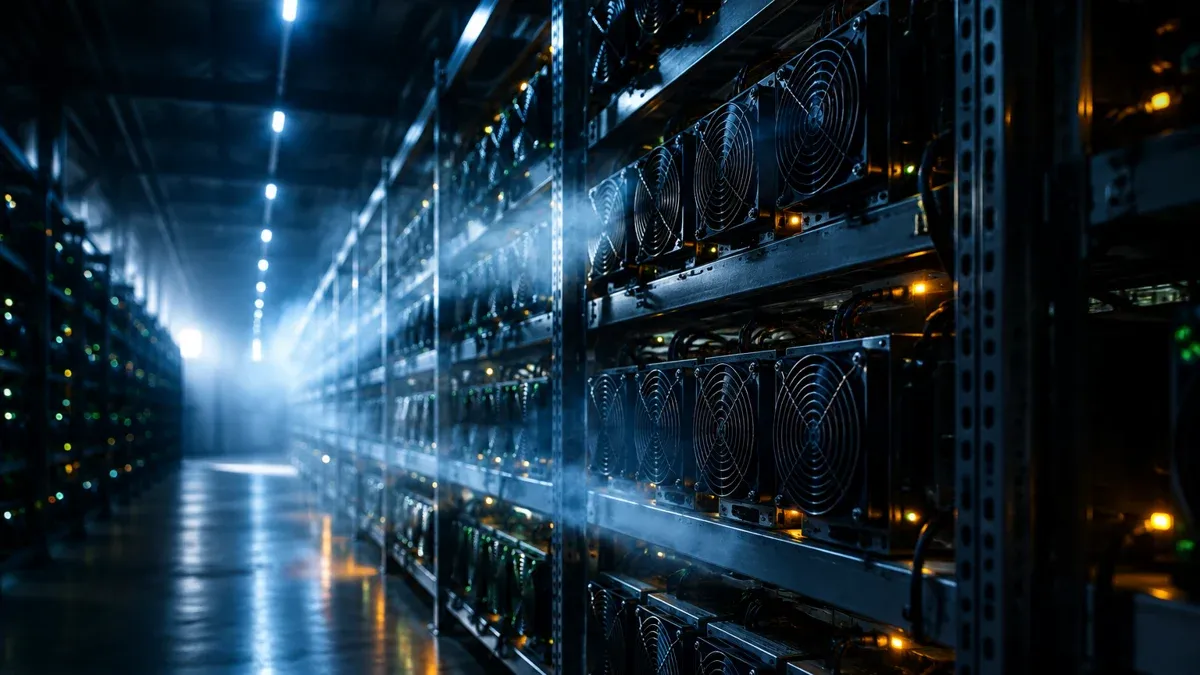
Dogecoin is mined, much like Bitcoin, but under different rules. Every block rewards the miner with 10,000 DOGE. The target time between two blocks is one minute, which arithmetically yields 14.4 million new coins a day.
Over the past 24 hours the miners found 1,355 blocks, somewhat fewer than the 1,440 of the target. The actual block time was 1.06 minutes. That gives 13.55 million new DOGE, worth around $1.18 million at the current price. The chain data comes from the block explorer Blockchair, and the most recent block carries the height 6,548,803.
By comparison, 17,896 transactions moved across the chain in the same period. That works out at roughly 757 freshly created DOGE for every transaction. The network's issuance therefore clearly exceeds its use, and it runs on regardless of whether anyone uses Dogecoin or not.
Issuance describes the quantity of new coins a network pays out under fixed rules. The process is neither a sale nor a market event but a protocol operation: the coins come into existence in the block and belong from then on to the miner who found it. Whether they hold or sell them is up to them.
Dogecoin Circulating Supply: Why Two Sources Are 15 Billion DOGE Apart
At this point the data gets messy, and that belongs in an honest article. The chain itself shows a circulating supply of 171.95 billion DOGE. The data service CoinGecko, by contrast, puts it at 156.24 billion. Between the two figures yawns a gap of 15.7 billion coins, around ten percent.
The difference arises because aggregators make assumptions of their own, for instance about lost or permanently unmoved balances, while the block explorer simply adds up what the protocol has paid out. Which number is the right one cannot be decided from outside. Only the range is therefore defensible, and that is exactly how this article goes on calculating.

2.9 to 3.2 Percent Dilution a Year: the Calculation for Holders
Extrapolated over a year, 13.55 million DOGE a day amounts to around 4.95 billion new coins. Measured against the chain's circulating supply that is 2.88 percent, and measured against the CoinGecko figure 3.17 percent. The honest statement is therefore: between 2.9 and 3.2 percent a year.
What does that range mean concretely? Anyone holding 10,000 DOGE today holds roughly 0.0000064 percent of all coins. In a year's time, with the same number of coins, it is only around 0.0000062 percent. The share shrinks although not a single coin was sold.
Counted in dollars, the market has to muster around $430 million in new demand every year just for the price to stand still. Daily that is $1.18 million, which corresponds to about 3.2 percent of the daily turnover on a large exchange such as OKX. Anyone expecting a stable Dogecoin price is implicitly expecting that inflow to arrive reliably.
Dogecoin Against Bitcoin and Ethereum: Three Issuance Models Compared
The figure alone says little, the comparison says more. Bitcoin has a hard cap of 21 million coins, of which 20.10 million have already been created, so 95.7 percent. The remaining issuance halves every four years and is therefore visibly running out.
Ethereum has no cap in the protocol but two counterweights: part of the transaction fees is destroyed, and anyone staking their coins gets a share of the newly issued quantity back. The circulating supply stands at 122.12 million ETH.
Dogecoin has neither a cap nor a halving nor any fee burning. The 10,000 DOGE per block have been fixed since 2015, as the network's project page describes it. In absolute terms the quantity stays the same, while in relative terms the inflation rate falls slowly, because the circulating supply grows. Going from three to under two percent will take roughly another two decades at this pace, though.
| Coin | Cap | Annual new issuance | Compensation for holders |
|---|---|---|---|
| Bitcoin | 21 million, 95.7 percent reached | falling, halving every four years | none needed |
| Ethereum | none | variable, partly offset by fee burning | staking |
| Dogecoin | none | around 4.95 billion DOGE, 2.9 to 3.2 percent | none |
No Staking on Dogecoin: the Difference From Ethereum and Solana
Dogecoin runs on proof of work, the same basic mechanism as Bitcoin. New coins go to miners who expend computing power, not to holders. The network's hash rate stood most recently at 3.40 petahashes per second.
Staking means depositing coins in the network to secure transactions and receiving part of the new issuance in return. With Ethereum and Solana the dilution can be offset partly or wholly along this route. With Dogecoin that route does not exist, because the protocol does not provide for it.
So anyone offered a Dogecoin yield somewhere is not getting protocol staking but a lending arrangement: a provider lends your coins on and gives you a share of the interest. You share in that provider's default risk, and it is not the same risk as holding the coin. This difference regularly disappears behind the word staking in advertising.
Holding Period Under Section 23 EStG: What Is Left of the Gain When You Sell Dogecoin
Suppose the calculation above convinces you and you want to reduce your holding. Then in Germany it is the calendar that decides first, not the price. Gains from selling crypto assets held privately fall under private disposal transactions in accordance with Section 23 of the Income Tax Act.
If you sell within a year of buying, the gain is taxable and carries your personal income tax rate. If more than a year lies between purchase and sale, the gain stays tax free. On top of that comes an exemption limit of 1,000 euros a year for all private disposal transactions together. An exemption limit is not an allowance: exceed it by one euro and you pay tax on the full amount, not only on the part above it.
In practice this means: before a sale, check which tranche you are actually selling and when you bought it. Anyone who has bought in instalments over years has holdings on both sides of the one-year line in their portfolio. A portfolio tracker that records purchases with dates settles that question in minutes, while searching through old exchange exports takes an evening.
Whether the one-year period will remain is under political discussion. Nothing has been decided so far, and as long as that is the case, the text of the law applies in its current form.
Buying Dogecoin Under MiCA: How to Recognise a Regulated Exchange
Since the European regulation on markets in crypto-assets took effect, providers addressing retail clients in Germany need authorisation as a crypto-asset service provider. BaFin lists the authorised companies in a public register, and the providers name their authorisation in their legal texts, usually under the imprint or legal notices.
How to recognise an authorised provider: it names the seat of the supervisory authority granting the licence, it holds client funds separately from its own assets, and it issues you an annual statement listing your purchases with date and price. That last point is underestimated until the tax return comes due. An overview of the trading venues authorised here is in the crypto exchange comparison.
Storing Dogecoin: Which Wallet Really Supports the Dogecoin Chain
Dogecoin runs on a chain of its own, not on Ethereum. A wallet that only handles Ethereum standards can do nothing with real DOGE. If you come across a Dogecoin entry in a pure Ethereum wallet, it is a token that tracks the price, and not the coin itself.
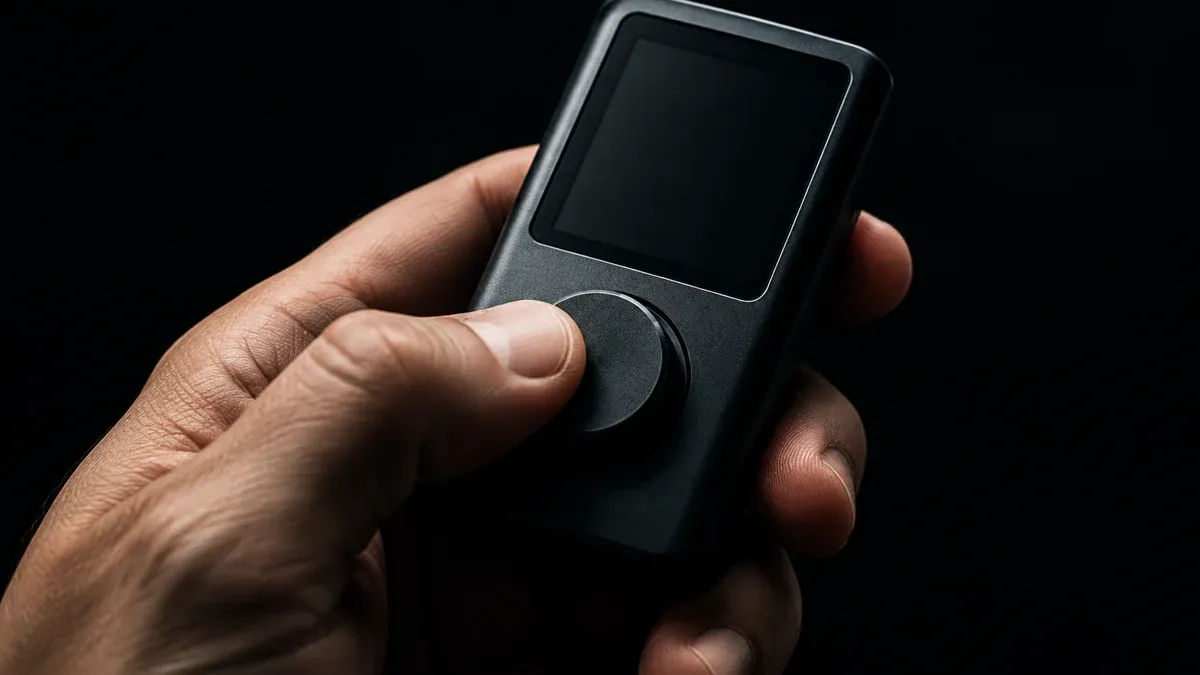
For self-custody you need either the project's reference software or a hardware device whose manufacturer explicitly lists the Dogecoin chain. Check that in the device's support list before you buy it, not afterwards.
The fees argue for moving on chain: a Dogecoin transaction most recently cost $0.0100 at the median and $0.0393 on average. Withdrawing from an exchange to your own wallet is therefore not a question of cost with Dogecoin, unlike on some other chains.
Leverage on Dogecoin: a Funding Rate of 0.01 Percent and the Liquidation Risk
Part of Dogecoin trading runs through perpetual futures contracts, known as perpetuals. Their price is tied to the spot price through the funding rate: a payment that flows between buyers and sellers every eight hours, depending on which side is driving the contract away from the spot market.
On OKX this rate stood most recently at 0.01 percent per period, the neutral standard value. Three times a day that makes 0.03 percent, extrapolating to just under eleven percent a year that a long position carries in running costs alone. The exchange's framework allows up to 0.75 percent per period when the market becomes one-sided.
More important than the costs is liquidation. At tenfold leverage a price decline of around ten percent suffices to close the position. Dogecoin has lost 8.1 percent in the past seven days alone, and that in a market without any particular event. Anyone working with leverage should know the relationship between leverage and weekly swing before opening the position; the terms of the trading venues are in the perp DEX comparison.
Levels at $0.085 and $0.09: What the Dogecoin Price Measures Itself Against Now
On the downside the next measured level sits at the daily low of $0.0852. If the price falls below it, the round level of $0.0800 is the next orientation that traders keep in their books.
On the upside the daily high of $0.0897 bounds the range, and behind it stands the round level of $0.0900. The week's starting point of $0.0946 would only be reached if the price gained 8.8 percent. These levels are observation points from the trading of the past few days, not a forecast; a reasoned outlook is carried by the prediction page further down.
Either way, none of these levels changes anything about the calculation in the fourth section. The issuance runs on independently of the price, 13.55 million coins a day, and it is the only part of this article that can be predicted with certainty.
Dogecoin Issuance: 4.9 Billion New DOGE a Year, No Staking
The question in the headline cannot be answered in general terms, but it can be sharpened. Anyone holding Dogecoin for the liquidity and the low fees has reasons that the issuance leaves untouched. Anyone holding it as a long-term store of value is calculating against 2.9 to 3.2 percent dilution a year, without a protocol that gives any of it back. Three steps help with the decision:
- Gather your purchase dates. Establish which of your tranches have already passed the one-year period under Section 23 EStG and which have not. Without that list, every sale is a bet on your own tax assessment. Tools that keep it automatically are in the comparison of crypto tax tools.
- Settle your custody. Check whether your wallet carries the Dogecoin chain itself or only tracks a price. At a median fee of $0.01, moving to your own keys is cheap; suitable devices are listed in the hardware wallet comparison.
- Check your trading venue. If you buy more, do it with a provider authorised under the European regulation and with a usable annual statement. The candidates are in the crypto exchange comparison.
(As of October 8, 2026. This article is not investment advice. Prices and fee structures change; check the terms with the provider before you buy.)
0
0


 Manage all your crypto, NFT and DeFi from one place
Securely connect the portfolio you’re using to start.


