
Bitcoin Hashrate Reaches 7-Month High as AI Shift Doesn’t Reduce Mining Pressure

0
0
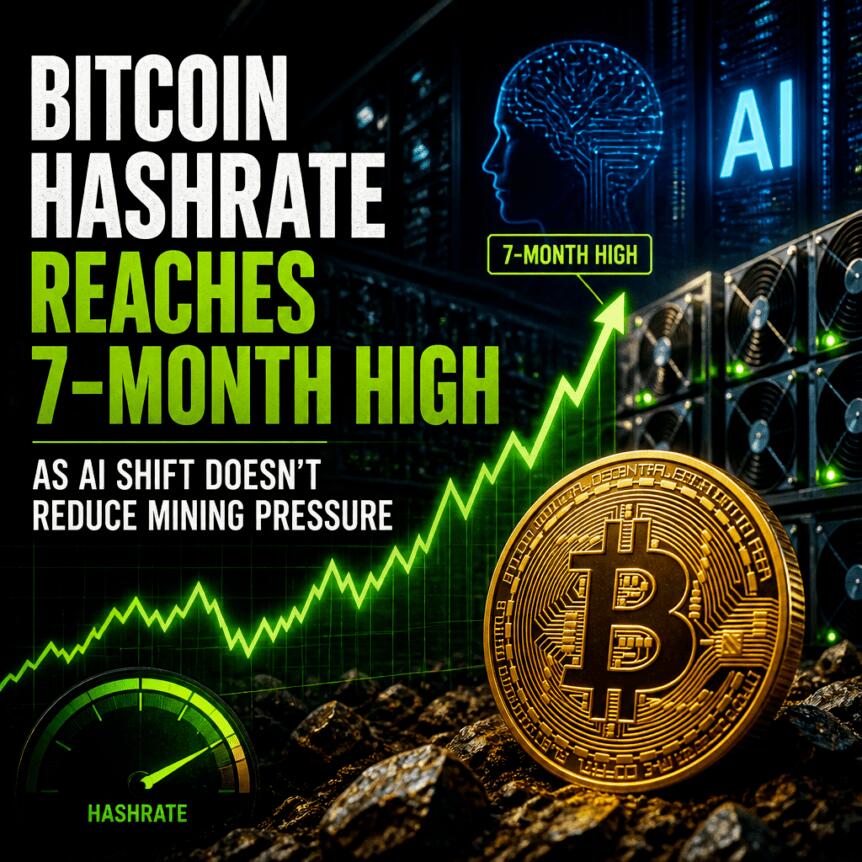
Bitcoin’s network hashrate has rebounded to a seven-month high, even as some of the industry’s largest publicly traded miners redirect capacity toward artificial intelligence and high-performance computing (HPC). The development suggests that the machines taken offline for AI workloads are not disappearing entirely—some portion may be re-entering Bitcoin mining through other operators, keeping competition intense for remaining network participants.
BlocksBridge Consulting, in its latest Miner Weekly newsletter, reports that Bitcoin’s seven-day average hashrate has recovered above 1 zettahash per second (ZH/s)—or 1,000 exahashes per second (EH/s)—its highest level since March 3. Hashrate, which reflects the computing power used to secure the Bitcoin network, is closely watched because it can indicate how much mining capacity is actively competing for rewards.
Key takeaways
- BlocksBridge says Bitcoin’s seven-day average hashrate has climbed above 1 ZH/s, the highest reading since March 3.
- The rebound points to continued mining activity despite a visible shift of some capacity toward AI/HPC by major public miners.
- Mining difficulty rose 5.92% on Oct. 16, and BlocksBridge expects another 5.16% increase at the next adjustment.
- While some displaced hardware may be returning via smaller miners buying secondhand equipment, the exact share is unclear.
- Industry observers continue to frame higher hashrate as a strengthening signal for Bitcoin’s fundamentals.
Hashrate recovery despite AI-driven capacity shifts
The central question for market participants is whether Bitcoin mining is losing capacity faster than new operators can replace it. BlocksBridge’s data points to a recovery instead: after the industry began redirecting mining resources toward AI workloads, the network’s broader hashrate trend appears to have stabilized and then strengthened.
According to BlocksBridge, the hashrate increase comes while difficulty has moved higher—an important detail because difficulty rises when more mining power is competing. That pattern implies that, at least on aggregate, the network is not experiencing prolonged “breathing room” even as some miners pivot to AI.
BlocksBridge directly ties this to the competitive pressures miners face. In its analysis, the firm notes that the hashrate rebound suggests fewer opportunities for remaining miners to gain advantage solely due to AI migration. In other words, even if certain facilities or fleets are repurposed, the overall network computing power has not fallen in a way that reduces competition.
Difficulty is rising, and another increase may be coming
Network difficulty offers a near-real-time window into the direction of mining capacity. BlocksBridge reports that difficulty increased by 5.92% on Oct. 16, with the firm projecting a further 5.16% rise at the next adjustment.
If that projection holds, difficulty would climb by roughly 11.4% across two consecutive adjustments. That would reinforce the idea that the network has maintained—or regained—substantial competitive hashing power. For miners, higher difficulty typically means more compute is required to achieve the same share of block rewards, pressuring margins unless electricity costs, hardware efficiency, or revenue dynamics improve.
For investors and operators, the implication is straightforward: the shift toward AI does not automatically translate into reduced mining competition for Bitcoin. Instead, miners—both old and new entrants—appear to be keeping enough hardware pointed at the network to sustain upward difficulty pressure.
Where displaced mining capacity may be going
BlocksBridge previously reported that the transition to AI and HPC for publicly traded miners has been accompanied by a substantial reduction in their realized hashrate, alongside a sharp increase in their reported AI/HPC revenue. It also estimated that the displaced mining capacity amounted to roughly $1.5 billion in mining hardware.
That raises a practical question: if some capacity is being unplugged from Bitcoin mining, how much of the associated equipment stays out of circulation, and how much is redeployed? In its current analysis, BlocksBridge suggests that some of the missing hashing power could be absorbed by smaller and mid-sized miners purchasing equipment from larger operators.
As an example, BlocksBridge highlights Sazmining, which advertises secondhand Antminer S21 XP machines and offers deployment options through hosting facilities in Paraguay and Texas. For miners with access to comparatively cheaper electricity, used hardware can sometimes be more economical than financing new equipment—meaning displaced fleets from AI conversions could continue mining Bitcoin elsewhere, even if the original operator has changed its strategy.
Still, BlocksBridge emphasizes uncertainty. It notes that it is unclear how much of the sold equipment genuinely originates from publicly traded miners, and how much of that equipment has returned to the network. Until clearer data emerges on equipment origin and deployment, the hashrate recovery indicates capacity is returning somewhere—but it does not definitively pinpoint which segment of the market provides the replacement.
What higher hashrate signals for Bitcoin’s “store of value” narrative
Beyond operational dynamics, some market observers interpret rising hashrate as a supportive fundamental signal. Earlier coverage from Cointelegraph has described rising hashrate as an “indirect bullish signal” that can reflect ongoing institutional investment in publicly traded mining companies.
That framing is also reflected in comments attributed to CryptoQuant founder and CEO Ki Young Ju, who recently argued on X that “higher hashrate means stronger security and better fundamentals as a store of value,” tying network strength to Bitcoin’s durability narrative.
While these interpretations focus on long-term fundamentals rather than near-term miner profitability, they intersect with the current data: a network that sustains hashrate gains despite difficulty increases may be reinforcing confidence among participants who view computational security as a core pillar of Bitcoin’s value proposition.
However, readers should keep the tension in mind: higher difficulty means the network is drawing more hashing power, but it does not guarantee improved outcomes for all miners. Profitability still depends on efficiency, power costs, and how quickly equipment cycles translate into usable Bitcoin mining capacity.
Looking ahead: will the replacement pipeline hold?
The key watch items are whether the hashrate continues climbing or stabilizes after this seven-month peak, and whether subsequent difficulty adjustments keep trending upward. With some miners reportedly reallocating hardware to AI/HPC, the market will likely look for clearer evidence on how quickly equipment displaced by AI conversions is absorbed by secondary buyers—and whether that re-entry is consistent enough to offset ongoing competition.
This article was originally published as Bitcoin Hashrate Reaches 7-Month High as AI Shift Doesn’t Reduce Mining Pressure on Crypto Breaking News – your trusted source for crypto news, Bitcoin news, and blockchain updates.
0
0

 Manage all your crypto, NFT and DeFi from one place
Securely connect the portfolio you’re using to start.
 Where will Bitcoin trade next?
Live Polymarket and Kalshi odds on Bitcoin price targets, compared side by side.
See Bitcoin price odds


