
South Korea Stablecoin Regulation Update: BOK Pushes Payment Status

0
0
What Is Changing for Stablecoins Under the Forex Law Update
The latest stablecoin news from Seoul is big for South Korea Stablecoin Regulation. The government and the Bank of Korea (BOK) want to change the Foreign Exchange Transactions Act (FETA). This is the forex law.
The goal is simple: they want stablecoins to count as payment tools. Local outlet Digital Asset shared the plan on October 23, 2026.
The Bank of Korea gave lawmakers the details. It did so in papers for the 2026 National Assembly audit, and the BOK says it is working with the government on the change this year.
It also wants to track crypto that moves across borders. No press release has come out yet, so the details come from those audit papers.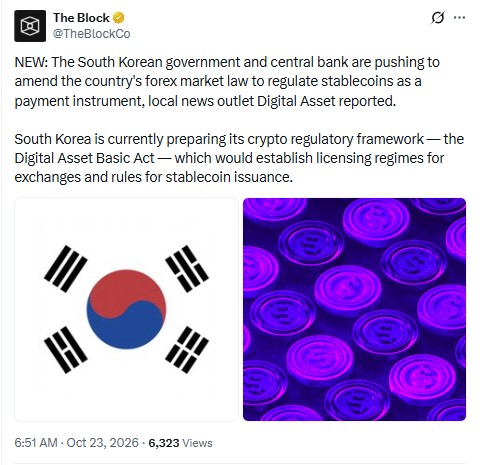 Source: The Block X-Post
What the May Forex Act Amendment Already Changed
This is not the first step; in May 2026, lawmakers passed a new rule that targets firms that send crypto between Korea and other countries.
These firms must sign up with the Ministry of Economy and Finance (MOFE) by early December 2026. That is when the rule starts.
Firms that skip the sign-up can face jail reports that say up to three years. In early October, the finance ministry shared a draft decree. The public can comment until around October 26, and the notice number is 2026-259.
The draft decree is expected to cover:
-
Which transfers count, even some private wallet ones
-
What firms need to sign up, such as systems and staff
-
How firms report transfer data
-
How checks and inspections work
-
How data goes to tax, customs, and other regulators
South Korea Stablecoin Regulation: Why Authorities Want Oversight
USDT and USDC are popular in Korea; people use them to send money abroad, and they also use them to settle deals. But the forex law does not list them as a means of payment, so they sit in a gray area.
This gap lets large sums move outside bank checks, and the officials have long raised red flags. They worry about money laundering and tax evasion, and they also worry about stress on the forex system; new rules would add reports and checks.
Where the Digital Asset Basic Act Fits Beside the Forex Rule
The FETA change is not a full license plan, as rules for issuers should come from a separate law. It is called the Digital Asset Basic Act. It aims to cover exchange licenses and stablecoin issuing rules.
It also sets legal terms, as the chief of the Financial Services Commission said around October 22 that talks are almost done.
Lawmakers should review that act in November 2026. The two tracks show where South Korea's stablecoin regulation is going. One track covers money flows.
| Item | Status | Focus |
| FETA transfer firm rule | Passed May 2026, starts early December 2026 | Sign-up for cross-border transfer firms |
| Draft decree | Public comment until around October 26 | Scope, reports, checks |
| FETA stablecoin change | Planned this year, per BOK audit papers | Stablecoins as payment tools |
| Digital Asset Basic Act | Assembly review expected November 2026. | Licenses, issuing, legal terms |
What Exchanges and Users Should Watch Before December
Many details are still open, including the final text of the change, which coins will qualify, and whether small payments will be exempt.
The exact wording will decide who must follow the rules, so watch the National Assembly and ministry notices for news.
Points to watch:
-
The government and BOK draft of the stablecoin change
-
The final decree after the comment period
-
The start of the sign-up rules in early December 2026
-
The November review of the Digital Asset Basic Act
Firms may face higher costs but clear rules often cut doubt. Once the rules start, firms that move stablecoins across borders must register and report.
Conclusion: South Korea is slowly folding crypto into its existing money rules while a separate law takes shape alongside it. The BOK plan is still only a plan, and the details could shift before anything is final.
How South Korea's stablecoin regulation ends up affecting exchanges, issuers, and everyday users will depend on that final text.
Disclaimer: This article is for educational and informational purposes only and should not be considered financial or investment advice. Always conduct your own research before making an investment.
0
0

 Manage all your crypto, NFT and DeFi from one place
Securely connect the portfolio you’re using to start.


