
How to Buy SUI: A Complete Guide for Beginners

0
0

How to Buy SUI and Get Started With the Sui Network?
A coin that climbs the trending list draws a crowd fast, and Sui is the latest example. Buyers in the US, Europe, the Middle East, and beyond keep asking where to begin. This guide explains how to buy SUI on a licensed exchange, from account setup to safe storage, and what fees, tax records, and risks to expect. Market figures are a snapshot from 13 November 2026.
Why Is SUI Trending With Buyers Right Now?
CoinGecko’s trending list had Sui at number 11 on 13 November, after number 7 on 11 November, so interest has lasted three days. According to CoinGecko SUI data, SUI traded near $0.7768 on 13 November, down 3.3% over 24 hours. Reports say dip buyers are eyeing layer-1 coins after the recent crash. A trending coin is not a safe coin, though, and the price can fall as fast as it rose.
Key Takeaways Before Buying SUI
A buyer opens an account with an exchange licensed in the buyer’s region, verifies identity, funds the account, and places a small SUI order. Storage is the next decision.
Compare the all-in cost, not only the fee line.
Start with a small order and a test transfer.
Keep a record of every trade for tax.
Never share the recovery passphrase.
Selection checklist: a license in the buyer’s region, SUI listed, fees shown before the order is confirmed, two-factor login, and clear withdrawal rules.
How to Buy SUI Step by Step on an Exchange?
Licensed exchanges follow a similar path. Menu names differ, but the order does not.
Create an account with an exchange that serves the buyer’s country.
Verify identity (KYC) with a passport or ID card, and often a selfie.
Turn on two-factor authentication before adding money.
Deposit funds by bank transfer, debit card, or credit card.
Choose a SUI pair in the local currency. If SUI/USDT is only available, then buy USDT first.
Place a small order and verify the balance.
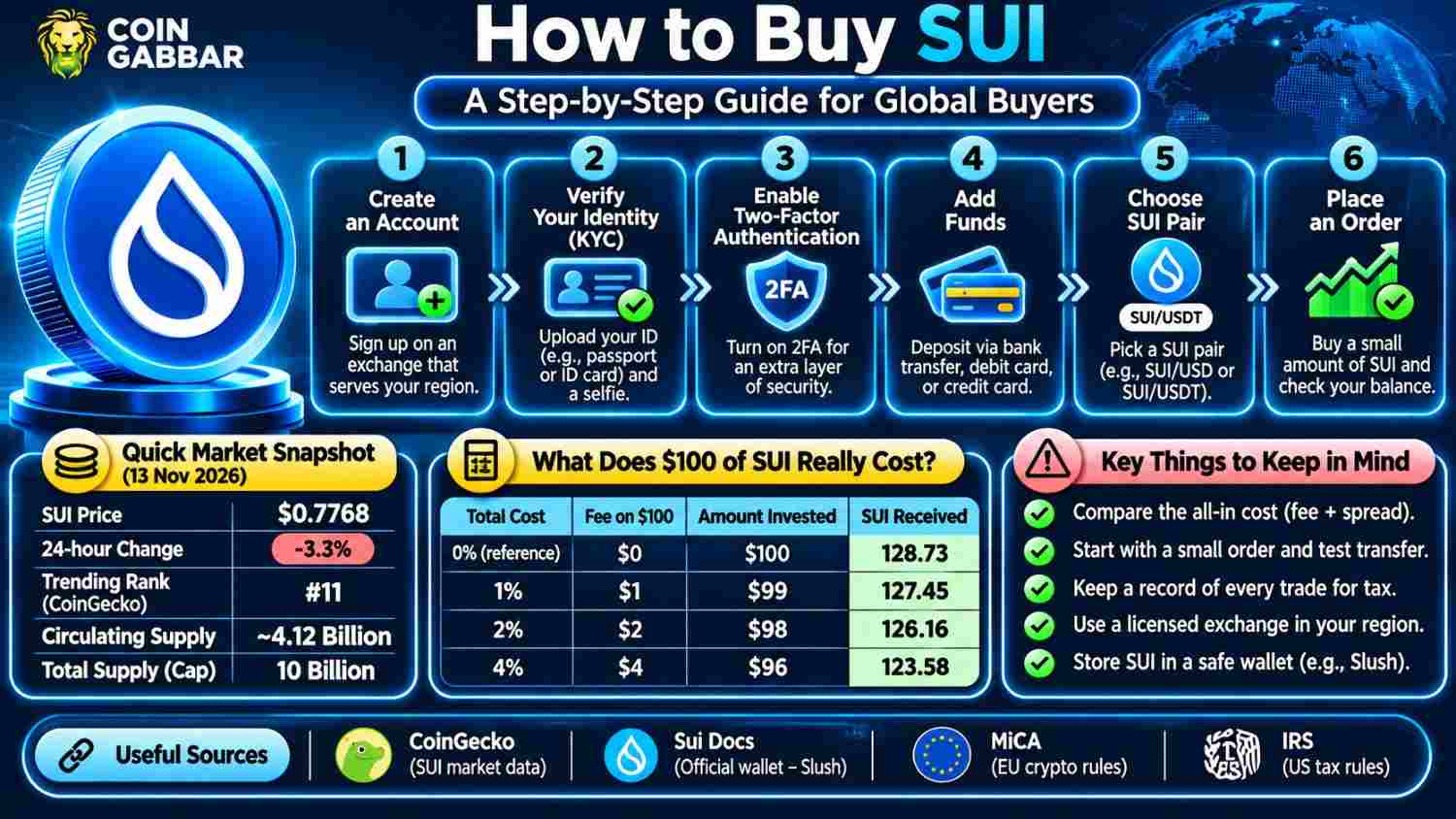
Market orders are executed instantly; limit orders will wait for your price. Bank transfers are generally the cheapest but slowest. Cards are instant but often pricier.
What Does $100 of SUI Really Cost After Fees?
At $0.7768, $100 with no fees buys about 128.73 SUI. Fees and spread, the gap between the market price and the quoted price, reduce that amount.
Total cost | Fee on $100 | Amount invested | SUI received |
0% (reference) | $0 | $100 | 128.73 |
1% | $1 | $99 | 127.45 |
2% | $2 | $98 | 126.16 |
4% | $4 | $96 | 123.58 |
Source: CoinGabbar calculation using the CoinGecko price of $0.7768, checked 13 November 2026. Fee levels are examples, not quotes.
The gap between a 1% and a 4% total cost is about 3.87 SUI, or roughly $3, on this single order. On small, repeated buys, that adds up.
How to Move SUI to a Self-Custody Wallet Safely?
According to the Sui official documentation, Slush is the official Sui wallet from Mysten Labs. It runs as a Chrome extension, an iOS app, an Android app, and a web app.
It offers two account types. Social login uses Google, Apple, Facebook, or Twitch and needs no recovery passphrase. A recovery passphrase account is self-custodial, so the holder keeps the keys and the backup. The docs recommend social login for people new to wallets.
The address should be copied from the wallet, never from a message. The Sui network should be chosen at withdrawal, and a tiny test transfer should go first. Fake wallet pages exist, so Slush should be opened from the official docs, not from an ad.
What Do US, EU, and Middle East Rules Mean for SUI Buyers?
United States: The IRS treats digital assets as property, so selling or swapping SUI can create a taxable gain or loss. Example: a buyer purchases SUI for $100 and sells it for $150. The gain is $50, and how it is taxed depends on the holding period and income.
European Union: MiCA sets licensing rules for crypto service providers. An ESMA consumer warning still says many crypto assets are highly risky and protection is limited.
Middle East: Several Gulf markets run their own licensing for crypto firms, and a few countries in the wider region restrict crypto. Tax treatment of individual gains also varies, so buyers should confirm it with the national regulator.
Elsewhere: Buyers in other countries should check the national regulator’s official list before signing up. A license is a compliance step, not a safety guarantee.
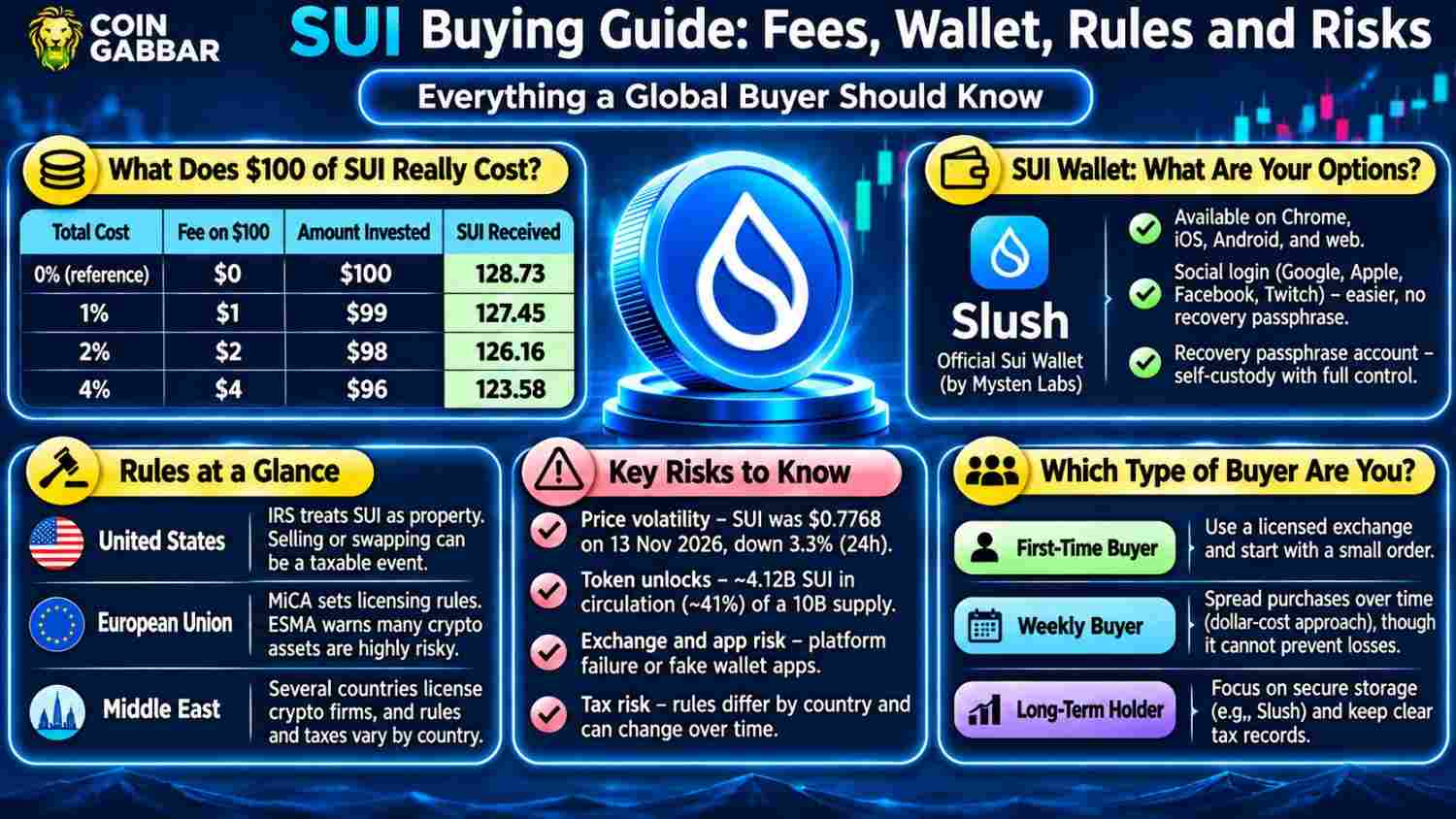
Rules differ by country, so a local tax adviser can confirm what applies in each case. Keeping the date, cost, and proceeds of every trade gives an adviser clean records.
What Risks Should SUI Buyers Know Before They Start?
Price swings come first. SUI sat near $0.7768 on 13 November, and trending does not mean rising.
Token unlocks come next. A late-October report put the supply cap at 10 billion SUI, with about 4.12 billion circulating, or roughly 41%. Releases arrive monthly, and three trackers gave different dates and sizes for early November. An unlock means tokens become transferable, not that they are sold. For how a past release looked, see CoinGabbar’s September SUI unlock report.
Exchange failure, fake apps, and tax mistakes complete the list. A license does not prove an exchange is safe or solvent.
What Are the Main SUI Buyer Types?
A first-time buyer should focus on a licensed exchange and a small first order. A weekly buyer can spread purchases over time, though that cannot prevent losses in a long decline. A long-term holder should put storage and tax records ahead of the entry fee. For buyers still choosing a chain, CoinGabbar’s Sui vs Solana comparison may help.
Terms Every SUI Buyer Meets
KYC: the identity check an exchange requires.
Spread: the gap between the market price and the quoted price.
Limit order: an order that fills only at the chosen price or better.
Recovery passphrase: the word list that restores a wallet.
Token unlock: the release of locked tokens so they can be transferred.
Final Thoughts on How to Buy SUI
The mechanics are simple—verify, fund, order, then store. The harder part is judging cost, custody, and risk. The first order should stay small, every transfer should be tested, and the price paid, the date, and the exchange should be recorded. Sui ecosystem activity deserves attention alongside the price. Only money that can be lost without harm belongs in SUI.
Expert Opinion
CoinGabbar analysis suggests Sui has an active DeFi scene, but monthly unlocks and market swings cut both ways. Learning how to buy SUI is the easy part, and sizing the position is harder. This view rests on the CoinGecko data and fee table above, and it is not a forecast.
Disclaimer This article is for information only and is not financial, legal, or tax advice. Returns are never promised or assured. Crypto assets are volatile, and all the money put in can be lost. Readers should consult a qualified adviser before investing.
0
0

 Manage all your crypto, NFT and DeFi from one place
Securely connect the portfolio you’re using to start.


