
Bitcoin and Stocks Slip as Fed Waller Signals Possible 50 bps “Shock”

0
0
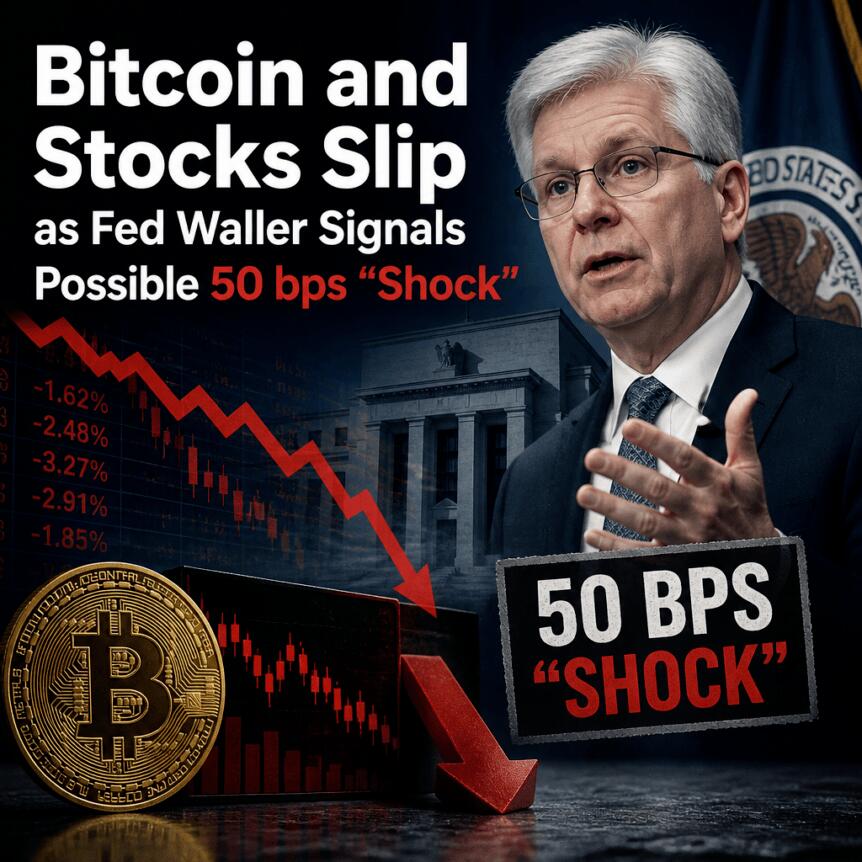
Bitcoin slipped below the $63,000 level as U.S. equities weakened shortly after the Wall Street open, with traders also weighing renewed Federal Reserve hawkishness. The move underlines how closely BTC’s short-term direction continues to track broader risk sentiment—and interest-rate expectations.
In the background, Fed governor Christopher Waller argued that the central bank may need to “shock people” with a more aggressive policy step at the December meeting, while analyst David Eng pointed to sustained capital outflows as a key reason buying has struggled to regain traction.
Key takeaways
- Bitcoin fell around 3% after the U.S. market open, dropping to near $63,000 as stock indices slid on inflation concerns.
- Fed governor Christopher Waller said policymakers might need to consider a 50-basis-point hike in December, contrasting with market expectations for 25 bps.
- According to Eng, 30-day capital outflows totaling $8.7 billion—and spot BTC ETF net outflows—are keeping sell pressure “extreme.”
- CME’s FedWatch data still heavily favors a 25-basis-point move in December, with probabilities above 95%.
Bitcoin’s weakness ties back to stocks and rates
TradingView data showed Bitcoin trading down roughly 3% on the day, with the decline building in the hours leading into the U.S. session. The timing mattered: U.S. stock indices opened softer and struggled to extend an early recovery, reinforcing a risk-off tone across markets.
On the equity side, the S&P 500 was down about 0.3% at the time of reporting, while the Nasdaq Composite hovered near its daily open after initially turning higher. That same mixed tape also came amid renewed attention to the AI complex following Nvidia’s Q3 earnings beat, though crypto traders did not appear to treat it as a direct catalyst for BTC.
Bitcoin, meanwhile, continued to work through the same technical zone it has been struggling to reclaim: a trading range between $64,000 and $66,000 that has been in place since Nov. 15. With no clear upside trigger in sight, the market leaned into downside pressure instead.
Waller’s “shock” comments push hawkish expectations
One of the most direct macro influences cited in the session came from Fed governor Christopher Waller. Speaking to CNBC, Waller argued that the Fed’s response to inflation could require a 50-basis-point rate hike at the December FOMC meeting—an outcome that would be larger than the market’s prevailing baseline of 25 basis points.
Waller noted that CPI inflation has stayed above the Fed’s 2% target for an extended period, and he warned that businesses may be becoming comfortable passing through roughly 3% (or higher) annual price increases to consumers. He framed the policy debate in stark terms, suggesting the Fed could need to “shock people” into reassessing what inflation levels should be considered tolerable going forward.
He also argued that the inflation challenge may be spreading beyond areas directly tied to current geopolitical drivers, referencing the U.S.-Iran war and related oil-price pressures. The practical takeaway for traders: Waller’s remarks reinforce the possibility that the Fed remains willing to move faster if it believes inflation persistence is broadening.
Still, the market’s immediate pricing was not aligned with Waller’s more aggressive scenario. CME Group’s FedWatch Tool indicated that traders overwhelmingly favor a 25-basis-point hike in December, with the odds for that outcome above 95%. In other words, Waller’s comments may increase uncertainty at the margin, but they have not yet rewritten consensus expectations.
Notably, economist Robin Brooks challenged the hawkish framing. In a Tuesday Substack analysis, Brooks argued that cooling in oil prices reduces the need for additional tightening commitments and described the prospect of further rate hikes as a “terrible mistake.” While Brooks’ view is not policy guidance, it highlights the debate inside the broader economic conversation: whether inflation is truly re-accelerating or merely reflecting recent supply dynamics.
Outflows, not only price action, are driving sell pressure
Beyond rates and equities, crypto-specific flows were a central part of the bearish case presented in the session. Analyst David Eng warned that sell-side pressure remains “extreme” at current Bitcoin levels, attributing it to sustained net outflows.
Eng cited $8.7 billion in net capital outflows over the past 30 days. He also referenced spot Bitcoin exchange-traded funds (ETFs), noting net outflows of $2.1 billion year-to-date from U.S. spot BTC ETFs. The implication is that even if BTC attempts a technical bounce, the flow backdrop remains unfavorable.
Eng’s framing was also forward-looking. On X, he argued that Bitcoin does not require additional “buying every month” to reverse the damage; rather, it needs the balance between incoming and outgoing capital to improve. At the current 30-day pace, Eng estimated that a roughly $290 million per day improvement would eliminate the measured net outflow.
For investors and traders, this distinction matters. Price can sometimes stabilize without immediate inflows if selling pressure eases—but if outflows persist, rallies may struggle to hold. Eng’s comments therefore point to a practical monitoring checklist: not just where BTC trades, but whether the net flow trend in spot ETFs and broader capital movement begins to turn.
What to watch next for BTC momentum
With Bitcoin sitting below $63,000 and unable to decisively reclaim the $64,000–$66,000 area, the next question is whether macro expectations or crypto-specific flows change first. Traders will likely keep focusing on Fed commentary that could alter rate-hike probabilities, while flow metrics—especially spot ETF net flows—may determine whether the market can transition from “range repair” to a more durable trend.
In the near term, the key uncertainty remains whether the outflow dynamic improves quickly enough to counteract lingering sell pressure, and whether Waller’s hawkish framing finds traction in market pricing before December.
This article was originally published as Bitcoin and Stocks Slip as Fed Waller Signals Possible 50 bps “Shock” on Crypto Breaking News – your trusted source for crypto news, Bitcoin news, and blockchain updates.
0
0

 Manage all your crypto, NFT and DeFi from one place
Securely connect the portfolio you’re using to start.
 Where will Bitcoin trade next?
Live Polymarket and Kalshi odds on Bitcoin price targets, compared side by side.
See Bitcoin price odds


