
50 euros a month in Bitcoin, 118 instalments since 2017: savings plan vs lump sum

0
0
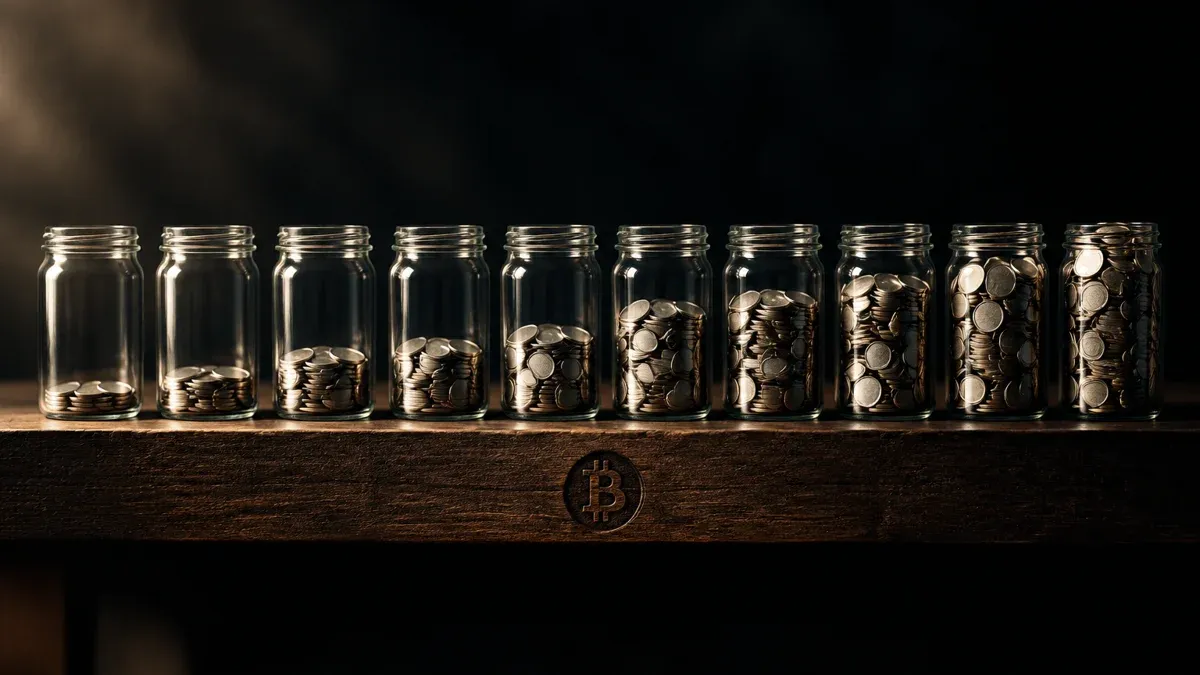
Fifty euros a month is the figure most people start with when they first consider a Bitcoin savings plan. The short answer to whether it pays off: anyone who began in January 2017 and has bought 50 euros every month since has paid in €5,900 and holds 0.7137 Bitcoin for it. At the price on October 5, 2026 that is around €54,500, a good nine times the money paid in. Anyone who only started in January 2024 is up just 14.5 percent on the same instalments.
Both figures come out of the same calculation, and that is precisely the point: what a savings plan ends up delivering is decided above all by the entry date and the time in the market. This article works through five periods, sets each instalment plan against a lump sum of the same amount, and shows where fees and German tax law cut in. Bitcoin traded between €76,300 and €76,400 on Monday; every closing value below is calculated at that level.
What 118 instalments of 50 euros in Bitcoin since January 2017 produced
A savings plan buys a fixed amount on fixed dates, whatever the price. When Bitcoin is high, your 50 euros buy little; when it is low, they buy a lot. Across 118 monthly instalments since January 1, 2017 that works out at an average entry price of €8,267 per Bitcoin. Today a Bitcoin costs around €76,400, so 50 euros still buy 0.000655 BTC.
The table shows five entry dates. Each line assumes an instalment of 50 euros on the first of the month, and the value refers to October 5, 2026.
| Start | Instalments | Paid in | Bitcoin | Value today | Return | Average price |
|---|---|---|---|---|---|---|
| January 2017 | 118 | €5,900 | 0.71370 BTC | €54,514 | +824.0 percent | €8,267 |
| January 2021 | 70 | €3,500 | 0.08975 BTC | €6,855 | +95.9 percent | €38,998 |
| January 2022 | 58 | €2,900 | 0.07336 BTC | €5,603 | +93.2 percent | €39,531 |
| January 2024 | 34 | €1,700 | 0.02549 BTC | €1,947 | +14.5 percent | €66,689 |
| October 2025 | 13 | €650 | 0.00971 BTC | €742 | +14.2 percent | €66,909 |
The middle row stands out. Anyone who started in January 2022, shortly after the high of the time had broken, is almost exactly as well off today as someone who got in a year earlier. The reason is the average price: both sit at around €39,000, because the instalments paid during 2022 were executed at very low prices and dragged the average down.
Cost averaging: why the Bitcoin savings plan lands at an average price of €8,267
Cost averaging describes a plain mechanism: because the amount is fixed and the price moves, you automatically buy more units when prices are low than when they are high. Your average price therefore always sits below the arithmetic mean of every price in the period.
Across the 118 instalments since 2017 that difference is enormous. The average price of €8,267 did not exist on any single day. It comes about because the instalments paid between 2017 and 2019 bought at a few hundred to a few thousand euros per Bitcoin and still account for the bulk of the units held. The instalments from 2024 on cost ten times as much per unit and contribute correspondingly little to the quantity. We worked this effect through in detail on September 19, 2026, using an example with a 100 euro monthly instalment over twelve payments.
The effect has a flip side that rarely appears in marketing copy: it only lowers your entry price if the market actually falls along the way. In a market that rises from start to finish, the savings plan is the more expensive route, because every later instalment costs more than the first.
Bitcoin savings plan vs lump sum: when the monthly instalment is the worse route
The honest counter-test is the lump sum, where the same total is invested on the first day of the period instead of spread across months.
| Start | Same total | Savings plan today | Lump sum today | Ahead |
|---|---|---|---|---|
| January 2017 | €5,900 | €54,514 (+824.0 percent) | €475,019 (+7,951.2 percent) | Lump sum |
| January 2021 | €3,500 | €6,855 (+95.9 percent) | €11,063 (+216.1 percent) | Lump sum |
| January 2022 | €2,900 | €5,603 (+93.2 percent) | €5,283 (+82.2 percent) | Savings plan |
| January 2024 | €1,700 | €1,947 (+14.5 percent) | €3,245 (+90.9 percent) | Lump sum |
| October 2025 | €650 | €742 (+14.2 percent) | €491 (−24.5 percent) | Savings plan |
In three of the five periods the lump sum would have done better, in the longest one by a wide multiple. That is neither an accident nor an argument against savings plans. It follows from the fact that Bitcoin has risen steeply over ten years: invest everything early and you are invested for longer.
The catch in this comparison is that nobody in January 2017 knew it would turn out that way, and that hardly anyone puts €5,900 at once into an asset that had fallen by more than 80 percent twice in the years before. A savings plan does not buy you a higher return. It buys you the chance to start at all. We looked at the two routes side by side against the current market on October 3, 2026.

Since October 2025 the picture flips: plus 14.2 percent against minus 24.5 percent
The bottom row of the table is the most interesting case. On October 1, 2025 a Bitcoin cost around €101,100; today it is around €76,400. Anyone who had invested €650 in one go back then would be sitting on €491, a loss of 24.5 percent. Anyone who instead transferred 50 euros thirteen times holds €742 today and is up 14.2 percent.
The gap of almost 39 percentage points arises purely because the later instalments were executed at markedly lower prices. This is exactly the situation a savings plan is built for: a falling or sideways market. The reverse also holds. The lead melts away as soon as the price climbs back above the entry point.
What a 1.5 percent spread costs a savings plan over 118 instalments
Crypto savings plans often advertise free execution. You still pay, only through the spread. The spread is the difference between the price at which a provider buys and the price at which it sells; it sits inside the quote and never appears as a separate line on a statement. We pulled together the terms nine providers disclose on this from their own fee pages on August 14, 2026.
How hard that bites can be shown on the 118 instalments above. The higher the mark-up per execution, the less Bitcoin lands in the account, and that shortfall in quantity grows along with the price.
| Mark-up per instalment | Total fees | Value today | Difference against zero |
|---|---|---|---|
| 0.0 percent | €0 | €54,514 | – |
| 1.0 percent | €59 | €53,969 | −€545 |
| 1.5 percent | €88 | €53,696 | −€818 |
| 2.0 percent | €118 | €53,423 | −€1,090 |
€88 in fees turns into €818 less in final value over nine years. The reason is that every fraction of a Bitcoin not bought takes no part in the whole subsequent rise. On an instalment of 50 euros this is the single most important cost lever, more important than account charges or withdrawal fees.
The claim that execution is free, and what it leaves out
"Free execution" only means that no order fee is charged. What matters is whether the provider names a reference price its own quote can be measured against. Without that figure you cannot establish the actual mark-up. A high-street bank or a broker may also offer a certificate or a debt security instead of coins, which is a different thing in law. Comdirect, for instance, lists 29 certificates with no order charge in its savings plan but not a single genuine coin, as we read out of its price list on October 4, 2026.
Minimum instalment, interval and execution day: the levers on a crypto savings plan
Three settings determine how a savings plan runs, and all three have a measurable effect.
The minimum instalment sits between one and 25 euros at most providers. At 50 euros a month you clear that bar everywhere. The more relevant question is whether the provider trades fractions: without fractions, a 50 euro instalment simply could not be executed at a price of €76,400.
The interval can be weekly, fortnightly or monthly. More frequent instalments smooth the entry price somewhat more, but they raise the number of executions and with it the sum of the spreads. For a fixed annual amount the difference in return over long periods is small; the fee side argues for less often, the smoothing for more often.
The execution day is often overstated. The calculations above use the first of the month. There is no systematically better day for Bitcoin, because the market runs seven days a week and has no settlement dates around which patterns could form.
Which providers in Germany run a genuine coin savings plan, and what the terms are, is in our comparison of Bitcoin savings plans. Check as well whether the provider holds a MiCA authorisation in the EU, because since 2025 crypto service providers may only operate here with that permission.

Holding period under section 23 EStG: every instalment has its own purchase date
Here lies the difference between a savings plan and a lump sum that shows up in no return table. Under current law Bitcoin counts as one of the other assets, and for those section 23 paragraph 1 number 2 of the German Income Tax Act sets a period of one year: disposals are only taxable if no more than one year lies between acquisition and sale. Once that year has passed the gain is tax free, however large it is.
A savings plan creates a separate acquisition with its own date for every instalment. Of the 118 instalments since 2017, 106 are now more than a year old. Those instalments account for 0.70448 Bitcoin and therefore for around €53,800 of the total value. The twelve younger instalments are worth about €704 between them and would fall into the tax net on a sale today.
The €1,000 threshold and the order of sale
A threshold applies to taxable gains: under section 23 paragraph 3 sentence 5 EStG gains stay tax free if the total gain from private disposals in the calendar year comes to less than €1,000. That is a threshold, not an allowance. Reach €1,000 or more and the entire gain is taxable, not merely the excess.
Which instalments count as sold in a partial disposal is determined in practice by the order of acquisition: the units bought first count as sold first. For a savings plan running over years that means the oldest and therefore tax-free instalments go first. Documenting that allocation cleanly is barely possible by hand across 118 separate purchases; that is what tax tools and portfolio trackers are for, reading the purchase dates straight out of the exchanges. We set out in more detail on August 11, 2026 how the holding period and a savings plan interact.
The December 31, 2026 cut-off splits your Bitcoin savings plan in two
On September 30, 2026 the German Federal Ministry of Finance sent its draft bill on reforming the taxation of certain crypto assets held privately into interdepartmental consultation. The draft reassigns income from crypto assets to investment income, on which a tax deduction of 25 percent of the investment income is levied. Under article 2 of the draft the law is to take effect on January 1, 2027.
For a savings plan already running, the application provision is the decisive part. The explanatory note on item 7 reads: "The substantive changes in law are to be applied from January 1, 2027 and cover exchange crypto assets acquired or received after December 31, 2026." And further: "For legacy holdings, sections 22 and 23 EStG otherwise continue to apply unchanged."
Applied to an instalment of 50 euros on the first of the month, that means the instalments of October 1, November 1 and December 1, 2026 would be legacy holdings under the draft and would keep the one-year holding period. Every instalment from January 2027 would fall under the new rule. A savings plan that runs past the turn of the year would therefore consist of two tax-wise different parts inside the same holding, and that split would remain permanently.
The qualification matters: a departmental draft is not yet a law. The text passes through cabinet, Bundestag and Bundesrat and may change in its deadlines, cut-off dates and rates along the way. Basing a purchase decision on this cut-off alone would be a bet on a process whose outcome is open. We assessed on October 3, 2026 what the draft means for the choice between instalment, lump sum and certificate.
Custody: when 50 euros a month justify a move to your own wallet
A savings plan sits with the provider to begin with. As long as only a few hundred euros are held there, a withdrawal to your own wallet is often uneconomic, because the network fee for a Bitcoin transaction is charged regardless of the amount and weighs heavily in percentage terms on small sums.
A workable rule is not to withdraw every instalment separately but to bundle them at intervals. At 50 euros a month, transferring once a year moves €600 in one transaction instead of twelve. The holding at which a dedicated device pays for itself depends on what you are willing to spend on security; that class of device starts in the low double digits. Only one thing matters here: a transfer to your own address is not a sale and triggers no tax, as long as you remain the owner. The holding period of each individual instalment keeps running.
What argues against a 50 euro savings plan
Three objections deserve to be taken seriously. First, a standing order ties up money that is better kept as an emergency fund; anyone forced to sell in a bad market phase loses precisely the advantage the long run is meant to deliver. Second, the automation invites you never to review the position, even though providers, fees and the legal position all change. Third, Bitcoin remains an asset that has lost more than 70 percent several times in the past. The 14.5 percent gain on the 2024 instalments in the table above is a thin result after not quite three years, and it could just as easily have been a loss.
Bitcoin savings plan: the key points for your decision
Whether 50 euros a month pay off hangs on the time in the market, on the fees and on your own staying power. These three steps will take you further:
- Work out the mark-up before you set up the standing order. Compare a provider's execution price with a reference price and check whether it holds a MiCA authorisation. Our exchange comparison gives an overview of the authorised venues.
- Document every instalment with its date and price from the start. Across 118 separate purchases that is barely possible to reconstruct after the fact, and without those records the holding period cannot be proven. There are tax tools and portfolio trackers for it.
- Decide at what holding you will transfer out. Bundle the withdrawals instead of moving each instalment on its own, and settle beforehand where they go. The classes of device and how they differ are in our hardware wallet comparison.
(As of October 5, 2026. This article is not investment advice. Prices and fee structures change; check the terms with the provider before you buy.)
0
0

 Manage all your crypto, NFT and DeFi from one place
Securely connect the portfolio you’re using to start.


