
Shiba Inu price prediction: 384 million SHIB burned in 30 days, 585 trillion still in circulation

0
0

A single Shiba Inu token costs $0.00000587 on Monday evening. That is 0.9 percent more than the day before and 2.8 percent more than a week ago, on CoinGecko figures as of October 5. Market value stands at $3.46 billion and daily turnover at $103.2 million. The price sits 93.2 percent below its record of $0.00008616.
The question behind almost every Shiba Inu price prediction runs like this: will the steady burning of tokens eventually tighten supply enough to show in the price? The honest answer sits in two figures that are both circulating right now and that differ by a factor of 52. This piece sets them against each other, places the new trading route on Solana in context and names the levels that will decide the coming weeks.
Shiba Inu burn rate: 384 million SHIB in 30 days
The counter at shibburn.com is the most easily verifiable source for burned tokens. It reads the official burn addresses on Ethereum and shows the following picture as of October 5. Over the past 24 hours, 3,630,330 SHIB were destroyed, worth roughly $22. Over seven days the figure was 96,849,960 SHIB, or about $562. Over 30 days the amount adds up to 384,044,752 SHIB, or around $2,104.
On that count, 410,844,466,658,035 SHIB have been taken out of circulation in total. It sounds enormous, yet it equals 41.08 percent of the one quadrillion tokens once issued. The lion's share comes not from ongoing burns but from a single transaction in May 2021, when Vitalik Buterin destroyed the holding that had been sent to him. What has been added month by month since then moves in an entirely different order of magnitude.
Not every burn address counts the same way
Technically a burn is nothing more than a transfer to an address for which nobody holds the private key. Which of those addresses a counter includes decides which figure comes out at the end. That is precisely where the problem begins.
Two counting methods, two results: 20 billion against 3.6 million SHIB
Several industry outlets reported a jump in the burn rate of more than 17,000 percent for October 3, and around 20 billion SHIB burned within 24 hours. The verified monthly balance at shibburn.com shows only 384 million SHIB for the same period. The October 3 report therefore claims, in a single day, 52 times what the Ethereum counter records for the whole month.
Both figures can be correct if they measure different things, and there is a fair case that they do. Part of the burning runs through Shibarium and the automatic ShibTorch sluice, part through burn addresses on Ethereum, and on top of that come moves by individual projects destroying their own holdings. A counter that adds several of these pots together is bound to arrive higher than one that reads only the classic Ethereum addresses. No authority reconciles the two methods in a binding way.
For you as an investor one simple consequence follows: a percentage figure for the burn rate without a stated baseline is worthless. A gain of 17,134 percent against an extremely quiet previous day often means very little in absolute volume. Stick to the absolute number and set it against the circulating supply, rather than following the rate of change.
The scarcity calculation: 585 trillion SHIB in circulation
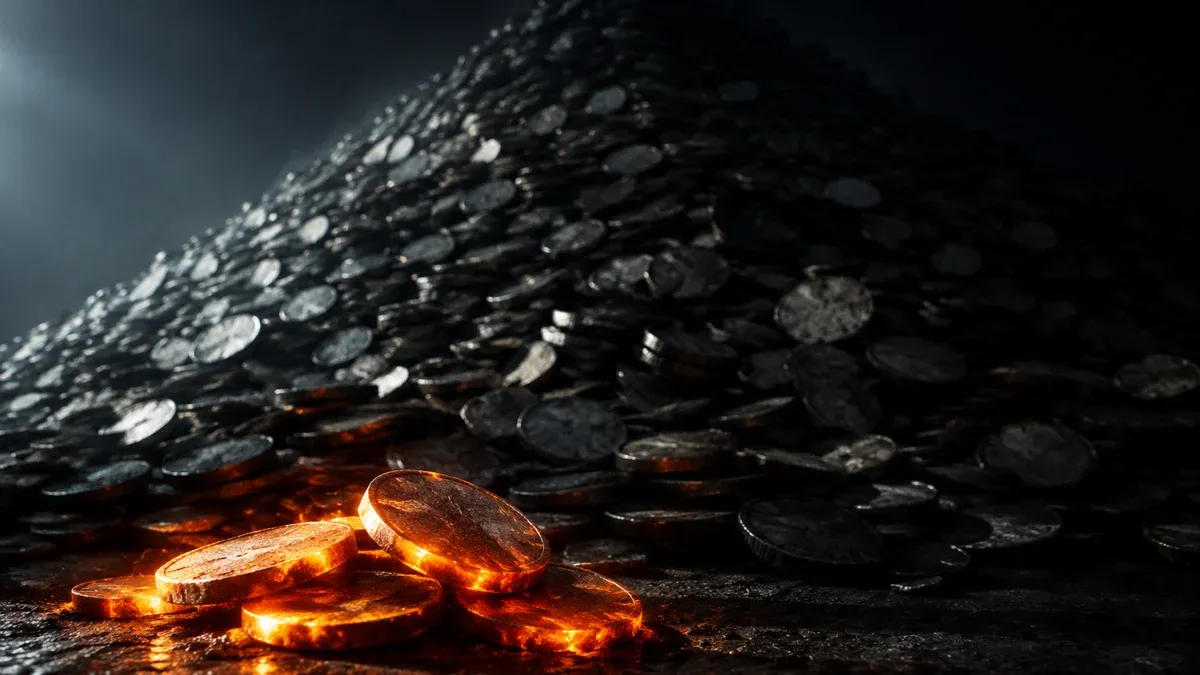
Set the monthly balance against the circulating supply and the order of magnitude becomes visible. In circulation are 585,475,632,329,593 SHIB, and total supply stands at 589,155,533,341,966 tokens. The 384,044,752 SHIB of the past 30 days equal 0.0000656 percent of the circulating supply.
Extrapolated over twelve months, that is 0.0008 percent a year. At this pace the network would need some 1,250 years to cut the circulating supply by a single percent. Even the disputed 20 billion of a peak day equal 0.0034 percent of the float.
That settles an expectation that runs through many forecasts: the ongoing burns are no driver of the price. As a signal about network activity they remain interesting, but as a lever on the price they do not work. Anyone expecting a squeeze that carries the price is calculating past reality. What has moved the price in recent months has been market conditions, inflows and news, not the supply side.
ShibTorch and Shibarium: the burn hangs on network load
ShibTorch is the automatic sluice of Shibarium, the project's own layer-2 network. The sluice collects the base fees of transactions there, which accrue in BONE, swaps them into SHIB and sends those tokens to a burn address. Because the amount hangs directly on fees, a rise in the burn rate is first a statement about utilisation and only then one about supply.
Utilisation is the sore point. Shibarium's block explorer shows 612,814,563 transactions in total. On a recent day some 1,005 of them came together, which is 0.00016 percent of all transactions ever processed. Capital locked in applications on Shibarium stood at $56,677 in early October. For comparison, daily turnover in the token itself runs above $100 million.
This mismatch is the real finding. A network that locks less than $60,000 in capital generates no fees from which a meaningful squeeze could arise. As long as nothing changes in usage, the burn mechanism remains a footnote.
SHIB on Solana since October 4: $514,000 in opening liquidity
The bigger change of recent days lies elsewhere. On Sunday, October 4, SHIB went officially live on Solana. The gateway is called Sunrise and works with Wormhole's Native Token Transfers standard. The contract address on Solana had already been created on October 3, with the release following on the afternoon of October 4. Sunrise announced the step with the line: “$SHIB is now listed on @Solana via Sunrise.” The official Shiba Inu account confirmed five minutes later with the words: “$SHIB has landed on Solana. Make yourselves at home SHIB Army.”
The start ran up quickly. Within 20 minutes roughly $514,000 of liquidity sat in the pools. In a five-minute window shortly afterwards, observers counted 3,005 trades worth about $300,000 across 1,401 wallets, with around 1,500 addresses holding the token at that moment. It was tradable within minutes on nine venues, among them Jupiter, Raydium, Phantom, Kamino Swap and Mayan. The details are documented in a log of the launch at Solana Compass.
What a canonical token is
Canonical means, in this context, that there is exactly one officially recognised representation of the token on the new network, not several competing replicas. The Native Token Transfers standard locks or burns the token on the origin chain and mints it anew on the destination chain, so that total supply stays constant across both chains.
One point matters for context: SHIB is not leaving Ethereum. The Solana version sits alongside it and replaces nothing. For the price it counts as an additional trading venue and as access to a user base that has barely come into contact with the token so far. That is a real, if small, lever on demand, and it weighs considerably more than the burn figures from the sections above.

Two contract addresses, one token: how to proceed when you switch chains
From now on SHIB exists in two places, and that is the practical question of this article. On Ethereum the contract address reads 0x95aD61b0a150d79219dCF64E1E6Cc01f0B64C4cE. On Solana the canonical address reads shib5gSoVKPjwkXrxRk7SbQFzb2R9rQB3TgQWYX4RwW. Three points decide whether the switch costs you money.
First, the address itself. Check it against an official source before every purchase and every transfer, for instance the project's own channels or an established data service. New trading venues regularly attract replicas with similar names. A token that shows up on a decentralised venue is not genuine by virtue of carrying the right name.
Second, the chain. An Ethereum wallet and a Solana wallet are different systems with different address formats. If you send SHIB from an exchange to an address on the wrong chain, the tokens are as a rule lost, and no party can reverse that. In the withdrawal dialogue, always check the network first and the address second. If you hold your own coins, it is worth looking at which chains your device supports at all, because not every model carries Ethereum and Solana side by side.
Third, the route. You do not have to switch in order to benefit from Solana's liquidity. Anyone buying through a centralised exchange and holding there has nothing to do with either contract address. Changing chains only pays off if you actually want to use the applications on Solana.
Holding period and the exemption limit: the tax catch on the bridge
Here lies the point most international analyses leave out, and it can be the most important part of the whole affair for investors in Germany. Gains from the sale of crypto assets fall under private disposal transactions in the sense of section 23 of the German Income Tax Act. If you hold a token for longer than one year, the gain is tax-free. Below that, an exemption limit of 1,000 euros has applied since the 2024 assessment period, covering all private disposal transactions in a year taken together. Once it is exceeded, the entire amount is taxable, not only the part above the limit.
The open question is this: what does a bridging transaction do to that clock? With a procedure that destroys the token on one chain and mints it anew on the other, there are good grounds for arguing that a swap, and therefore a disposal, has taken place. The one-year clock would then start again on the new chain, and any gain accrued up to that point would fall into the year of the switch. A binding position from the tax authorities specifically for native token transfers has not been published so far.
In practice that means: document every change of chain with date, amount and value in euros before you carry it out. A tax tool with a portfolio tracker takes that record-keeping off your hands and tracks holding periods per position. And if your holding is large enough that the deadline decides a noticeable sum, settle the case with a tax adviser before the switch rather than after it.
Levels to the upside: $0.0000060, then $0.0000067 and $0.0000072
The next hurdle is the round level at $0.0000060, currently 2.2 percent above the price. Analysts point to weekly resistance at $0.00000596 as the first stop. The area between $0.0000060 and $0.0000061 has been approached several times over the past two weeks without becoming a load-bearing support.
If a breakout succeeds on volume, the same analyses name $0.0000067 as the next target, then $0.0000072. That would be 14.1 and 22.7 percent above today's level respectively. For a sense of scale: at $0.0000072 the market value would stand at around $4.2 billion. The record high would require roughly $50 billion.
These price targets come from external analysts and are not a statement by this newsroom. Treat them as what they are: reference points from chart analysis that describe a market move without explaining it.
Levels to the downside: $0.0000055 as a cushion
On the downside, the area between $0.0000055 and $0.0000056 counts as a cushion, around 6.3 percent below the current price. If the token falls durably through it, analysts name the zone between $0.0000051 and $0.0000052 as the next catch line, a good 13 percent lower.
For a position that means one thing above all: the distance to the next target above and the distance to the next catch line below are roughly equal. Anyone working with leverage should calculate their own liquidation threshold before entering, because with a token of this volatility 13 percent falls inside a handful of trading days.
Buying route and custody under MiCA: two networks, two wallet types
Since the European markets in crypto-assets regulation MiCA took full effect, providers targeting customers in Germany need authorisation as a crypto-asset service provider. For you that is the first check before every purchase: does the provider work with an authorisation in the EU, and is it listed in the register of the competent supervisor? Authorisation says nothing about fees, so the second look belongs to the price list.
On custody, the Solana route shifts the picture slightly. Until now a wallet that manages ERC-20 tokens on Ethereum was enough for SHIB. Anyone who wants to move on both chains in future needs either a wallet that handles both networks or two separate access points. For larger amounts, custody on your own hardware remains the safest route, because the private key never leaves the device.
What argues against a position
For completeness the other side belongs here too. The network locks less than $60,000 in capital, the burn mechanism moves nothing in arithmetic terms, and the token trades 93.2 percent below its high. The Solana connection is progress on reach, but it creates no new utility. Anyone investing here is betting on attention and market sentiment, not on cash flows. That is a legitimate decision as long as it is taken consciously and the position size fits it.
Shiba Inu price prediction: what to take away
- Measure burn reports against the circulating supply, not against the previous day. 384 million SHIB in 30 days are 0.0000656 percent of the float. Check the absolute amount on a counter of your choice before you take a percentage headline seriously, and hold your own positions against it in a portfolio tracker.
- Match network and contract address before every transfer. Since October 4 SHIB exists on two chains. A transfer to the wrong chain is final. Which devices carry both networks is shown by the hardware wallet comparison.
- Document the holding period before you change chains. Record the date, the amount and the euro value, track the one-year clock per position, and clarify larger sums with a tax adviser in advance. The buying route itself you choose through an authorised provider from the crypto exchange comparison.
(As of October 5, 2026. This article is not investment advice. Prices and fee structures change; check the terms with the provider before you buy.)
0
0


 Manage all your crypto, NFT and DeFi from one place
Securely connect the portfolio you’re using to start.


