
Bitcoin’s 64-Day Coinbase Discount Is Mostly a USDT Basis, Not US Selling

0
0

Bitcoin traded at $75,768.94 on Coinbase’s BTC-USD market at 03:28 UTC on 8 November. In the same minute, Binance printed $75,884.30 on its BTCUSDT pair. The $115.36 gap, 15.2 basis points, has closed negative every session since 4 September, and it is normally read as a measure of US demand. That reading is wrong by a factor of ten.
Coinbase’s own USDT-USD market quoted $0.99862 at that moment, according to the exchange’s public market data. Convert Binance’s price into dollars at that rate and it is $75,779.58. Coinbase was $10.64, or 1.4 basis points, below it. Bitstamp quoted $75,769.00, Gemini $75,788.26, and Kraken $75,771.20. Four venues settling in actual dollars agreed with each other to within $20. Almost all of the “discount” is the price of the token the offshore quote is denominated in.
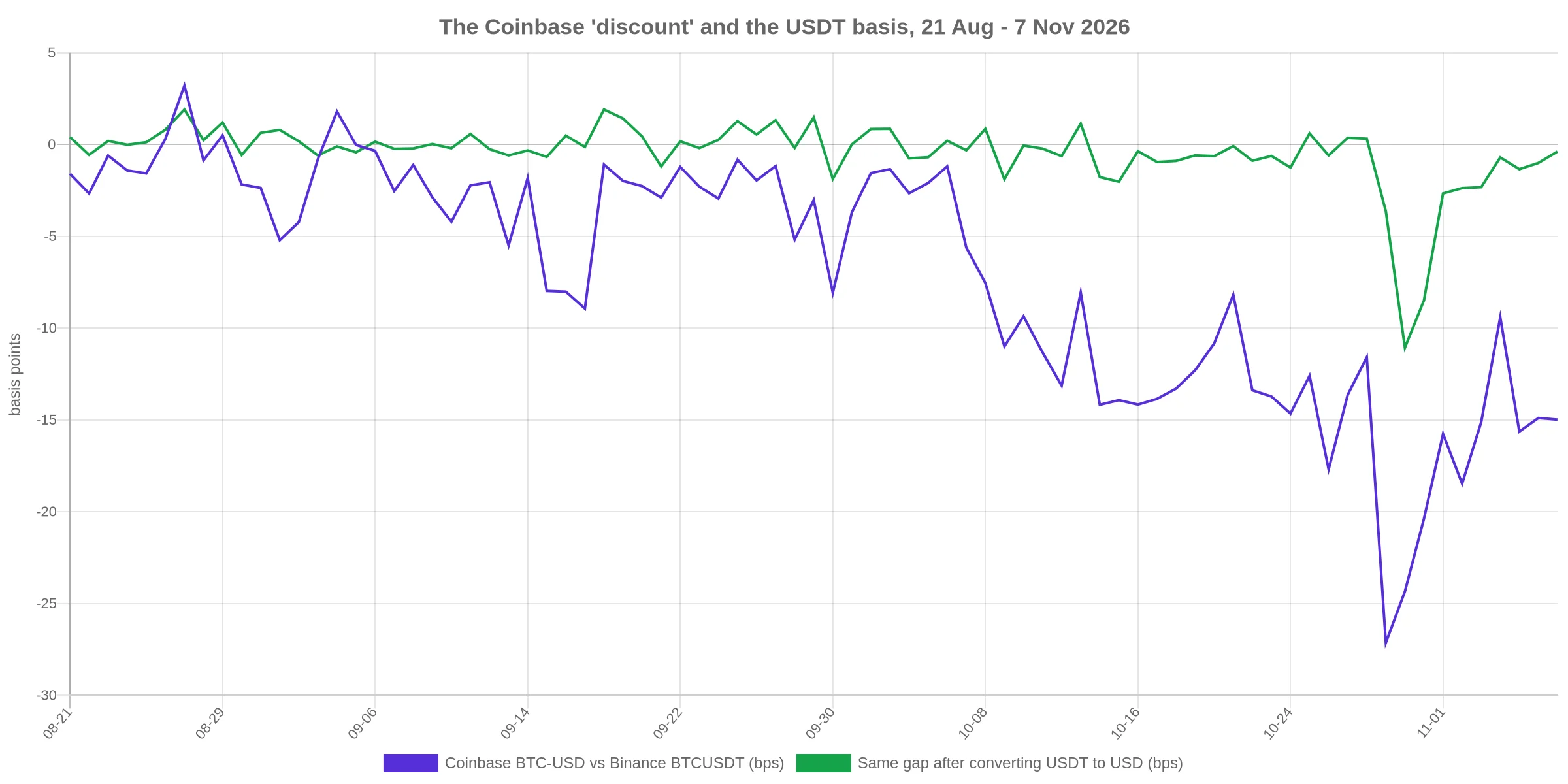
That distinction matters for anyone reading the metric as a demand signal. The gap is real, and it is measurable, but 94% of its movement over the past eleven weeks is explained by the USDT-to-dollar rate rather than by American selling. The residual, about 1.5 basis points, is smaller than the fee on a single retail trade.
Two Prices, Two Dollars
A bitcoin quote is a ratio between two assets. Coinbase lists BTC against USD, a bank dollar that can be wired to a US bank account. Binance lists BTC against USDT, a token issued by Tether that usually trades within a few basis points of a dollar but is not obliged to. When the token slips below par, every BTCUSDT quote mechanically rises relative to a BTC-USD quote, because the denominator shrank.
The arithmetic is simple enough to run on a phone. Take the raw premium, (Coinbase price ÷ Binance price − 1) × 10,000, and it prints minus 15.2 basis points this morning. Divide the same ratio by the USDT-USD rate of 0.99862 and the residual is minus 1.4 basis points. The first number describes two markets. The second describes one market and one currency conversion.
Coinbase is the natural place to look for this effect because it runs the deepest regulated dollar book and it also lists USDT-USD directly, so both legs of the calculation are quoted by the same venue at the same time. Its USDT-USD pair turned over $1.07 billion in the thirty days to 8 November, which is deep enough that the 0.99862 print is a market price rather than a stale quote.
What 79 Sessions of Venue Data Show
Comparing daily closes from Coinbase, Binance and Kraken between 21 August and 7 November gives 79 overlapping sessions. Over that window the raw premium averaged minus 6.99 basis points with a standard deviation of 6.51. Adjusted for the USDT-USD rate on the same day, the mean falls to minus 0.45 basis points and the standard deviation to 1.82. Measured against Kraken’s dollar pair, the mean is minus 0.32 basis points with a standard deviation of 1.17.
| Month (2026) | Raw premium vs Binance | Adjusted for USDT/USD | USDT discount to par |
|---|---|---|---|
| 21-31 August | -0.84 bps | +0.40 bps | 1.24 bps |
| September | -3.03 bps | +0.13 bps | 3.16 bps |
| October | -11.23 bps | -1.07 bps | 10.17 bps |
| 1-7 November | -14.89 bps | -1.54 bps | 13.36 bps |
The two series move together almost one for one. The correlation between the raw premium and the USDT discount across those 79 sessions is -0.969, and a simple regression puts the slope at -1.15 basis points of premium for every basis point of stablecoin discount. In other words, when USDT cheapens, the Coinbase gap widens by slightly more than the move in the token, and US spot demand has to do almost none of the work.
The monthly averages also show where the story actually changed. In August the raw gap was under a basis point. It widened to 3 basis points in September, 11 in October and 15 in the first week of November. On the adjusted basis the same months read plus 0.40, plus 0.13, minus 1.07 and minus 1.54 basis points. There is a real drift toward cheaper US dollars, but it is a tenth of the size the headline number implies.
Sixty-Four Days, Ten Days, or Zero
The same dataset answers the “how long” question three ways. Against Binance’s USDT quote, the premium has not closed positive since 4 September, a run of 64 sessions that includes 41 days wider than 3 basis points and a worst reading of minus 27.13 basis points on 29 October. Adjusted for the stablecoin, the negative run is ten sessions to 7 November, averaging minus 0.63 basis points, and only three of those ten were wider than 3 basis points. Against Kraken’s BTC-USD pair the sign has alternated through the whole window, so the longest run is zero.
All three numbers are correct. They describe different things: a cross-currency spread, a cross-venue spread, and a two-venue spread in the same currency. The version that circulates is the widest of the three, and it is the one least suited to the claim it is used to support. When the gauge turned positive in April, BlockchainReporter reported it as a sentiment shift rather than as a forecast, which is the treatment the gauge deserves in either direction.
The Basis Widened as Stablecoin Supply Shrank
The USDT discount is not an isolated curiosity. It has widened alongside a contraction in the stablecoin complex that BlockchainReporter reported on 8 November: total supply fell $6.66 billion in the week to 7 November to $292.31 billion, the steepest weekly decline of 2026, with USDT and USDC accounting for $4.40 billion of it.
USDT traded at 0.99847 to 0.99889 against the dollar on Coinbase over the 24 hours to 03:28 UTC, a narrow band that never touched par, and Binance priced USDC at 1.0012 USDT, which is the same relationship recorded on the other side of the market. A token trading below a dollar while its supply is contracting is consistent with holders converting out of it or with the tokens already sold sitting in inventory. The data here does not establish which of those is happening, and it does not establish that the stablecoin market is the cause of anything in the bitcoin price.
What it does establish is a measurement problem. Any premium series that divides a USD price by a USDT price inherits the stablecoin basis. When that basis is 3 basis points, the noise is tolerable. At 13 to 23 basis points, which is where it has sat since late October, it dominates the reading.
Where US Demand Does Show Up
The dollar-based venues give a cleaner read on American appetite. Coinbase turned over 1,979 BTC, about $150 million, in the 24 hours to 03:28 UTC. Binance’s spot book did $403 million in BTCUSDT over the same period, roughly 27% of the combined pair, while Kraken traded about 669 BTC, Bitstamp 460 BTC and Gemini 88 BTC. Coinbase carries the largest dollar book of the four dollar venues compared here, and it is pricing within a few dollars of all of them.
US spot bitcoin ETFs, which settle in dollars and are bought by US accounts, produced a clearer negative signal on 6 November: $411.9 million of net redemptions, with BlackRock’s IBIT accounting for $403.0 million of the total, according to Farside Investors. That is a dollar outflow from a dollar product, and it needs no stablecoin conversion to interpret. It extends the run BlockchainReporter tracked on 7 November, when the same data showed $842.1 million leaving across 5 and 6 November.
Bitcoin itself was $75,768 at the snapshot, down 2.57% over seven days and 7.62% over thirty, with a market capitalisation of $1.52 trillion, per CoinGecko. The drawdown is real. The question is only whether a 15 basis point Coinbase gap is evidence of it, and on this data it is not.
What Would Make the Discount Real
Three observations would change the read, and each has a test attached. First, an adjusted premium that stays below minus 5 basis points for five consecutive sessions would put the US discount outside the range seen in the past eleven weeks, where only three sessions of 79 were that wide after adjustment. Second, a raw discount that persists while USDT returns to parity would leave no currency explanation standing. Third, a sustained fall in Coinbase’s share of dollar bitcoin volume below its recent level would show fewer dollars arriving rather than dollars priced differently.
The invalidation runs the other way too. If the adjusted premium returns to its August and September range of roughly plus or minus 1 basis point while the raw number stays near minus 15, the metric will have demonstrated that it is tracking the stablecoin and nothing else. Anyone quoting the single figure should then say which dollar they mean.
For institutional desks the practical consequence is narrower than the headlines suggest. A 1.4 basis point cross-venue gap is inside transaction costs for most size, so the arbitrage that would normally close a genuine US discount is not worth putting on. When the raw gap blows out to 27 basis points, as it did on 29 October, the trade is a stablecoin basis trade dressed as a bitcoin trade, and the two have different funding, custody and settlement requirements.
Frequently Asked Questions
What is the Coinbase premium index?
It is the percentage difference between bitcoin’s price on Coinbase in US dollars and its price on an offshore venue, usually Binance, quoted in USDT. A negative reading means Coinbase is cheaper. Because the two legs are denominated in different dollars, the reading contains both US spot demand and the USDT-to-USD exchange rate.
Is bitcoin cheaper on Coinbase right now?
By 15.2 basis points against Binance’s USDT price, yes. Against Kraken, Bitstamp and Gemini, which quote in dollars, Coinbase was within 3 basis points at 03:28 UTC on 8 November. In dollar terms the adjusted gap was $10.64 on a $75,769 asset.
Why does USDT trade below one dollar?
Stablecoin prices are set by supply and demand for the token itself, not only by the issuer’s redemption promise. Coinbase quoted USDT at $0.99862 on 8 November, and Binance priced USDC at 1.0012 USDT, which is the same relationship seen from the other side. The data here does not establish the reason for the discount.
How long has the Coinbase discount lasted?
It depends on which dollar you use. Against Binance’s USDT price the gap has been negative for 64 consecutive sessions, from 5 September to 7 November. Convert Binance into dollars and the negative run is 10 sessions and averages 0.63 basis points. Against Kraken’s USD pair the sign has alternated, so there is no run at all.
What would confirm that US buyers are actually leaving?
A gap that survives the stablecoin conversion: five or more consecutive sessions with the adjusted premium below minus 5 basis points, or a persistent raw discount while USDT trades at par. Outflows from US spot bitcoin ETFs and a falling Coinbase share of dollar volume would point the same way. On 6 November ETFs did redeem, $411.9 million net, which is the cleaner US signal.
This article is for information only. It is not investment advice, and no price level in it is a recommendation to buy or sell.
Data: Coinbase, Kraken, Gemini, CoinGecko, Farside Investors.
This article is for information only and is not investment advice. Market data is a snapshot taken at the times stated and will change.
0
0


 Manage all your crypto, NFT and DeFi from one place
Securely connect the portfolio you’re using to start.
 Where will Bitcoin trade next?
Live Polymarket and Kalshi odds on Bitcoin price targets, compared side by side.
See Bitcoin price odds


