
What Is Alpenglow? Solana's 150ms Finality Explained

0
0
How Does Alpenglow Make Solana Finalize Blocks in 150ms
What is Alpenglow, and why does Solana News today keep mentioning it? Alpenglow is the new voting system that replaced TowerBFT on the Solana mainnet on October 21, 2026.
It aims to cut the wait for final settlement from about 12.8 seconds to roughly 150 milliseconds. Finality simply means a transaction is done and can’t be undone.
This Solana Alpenglow upgrade is the first big rewrite of the network’s consensus layer, so traders, builders, and new readers keep searching for it.
Below, the Alpenglow consensus protocol is explained step by step, along with what the early data shows and where the risks sit.
What Is Alpenglow? Key Features in Simple Points
Alpenglow changes how Solana validators agree on what’s in the chain. The Solana Foundation says it went live in epoch 1064, at slot 459,653,000.
Anza shared the design in May 2025, and validators backed it with about 98% approval that September.
Faster finality: the target is 100 to 150 milliseconds, down from about 12.8 seconds.
Votor: handles voting and proves blocks final with bundled certificates.
Rotor: sends block data through strong, well-connected validators.
Fault tolerance: the chain keeps running with up to 20% bad stake and 20% offline stake.
Open testing: red teaming, penetration tests, and migration rehearsals ran before launch.
Why Did Solana Introduce the Alpenglow Upgrade?
TowerBFT had run the network since 2020. It needed many voting rounds, and it stuffed vote transactions into regular blocks. That left finality near 12.8 seconds and ate up a lot of block space.
For payments, trading, and bots, the wait felt too long. This Solana tower BFT replacement was built to fix both problems, based on the official Alpenglow page and Anza’s research paper.
How Does Solana’s 150ms Finality Work?
It runs on stake-weighted voting. If validators holding at least 80% of the stake vote in the first round, a block is final right away. If only 60% to 80% vote in time, a second round finishes the job.
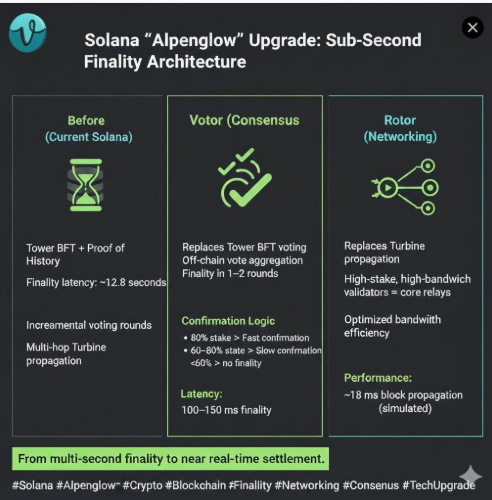
Below 60%, finality waits. The alpenglow protocol is explained in one line: quick agreement when the network is healthy, a safe pause when it isn’t. That’s how its transaction finality can drop to the 100 to 150 millisecond range.
Understanding Alpenglow’s Core Components
What is Alpenglow built from? Two parts. Votor deals with consensus, which is how validators agree on blocks. Rotor deals with networking, which is how block data moves between nodes.
Together they form the Alpenglow consensus protocol. Votor replaces TowerBFT voting, and Rotor replaces the older turbine system.
What Is Votor and Rotor in Alpenglow?
Votor keeps votes out of blocks. Validators sign votes and pass them around directly, and bundled certificates prove a block is final. The fast path needs 80% of the stake in one round, and the slow path needs 60% across two.
Rotor picks validators with high stakes and strong bandwidth to act as relays, which cuts the number of hops. Simulations show block spread in about 18 milliseconds, though live numbers may differ.
Why Is 150ms Finality a Major Breakthrough for Solana?
Alpenglow went live on October 21, 2026. It cuts final settlement from about 12.8 seconds to a target of 150 milliseconds, a drop of nearly 99%. Here’s why that matters.
One-step finality: two confirmation steps become one. Validators send votes straight to each other and bundle them into certificates.
Less vote clutter: with votes out of the blocks, an estimated 75% of block space opens up for real user and app transactions.
Faster payments: a stablecoin tap-to-pay or shop purchase could settle quicker than a blink, so merchants don’t wait at checkout.
Trading and bots: decentralized exchanges and automated agents can count on near-instant settlement that can’t be reversed.
Nothing else changes: the Solana Virtual Machine, transaction formats, and fees stay the same.
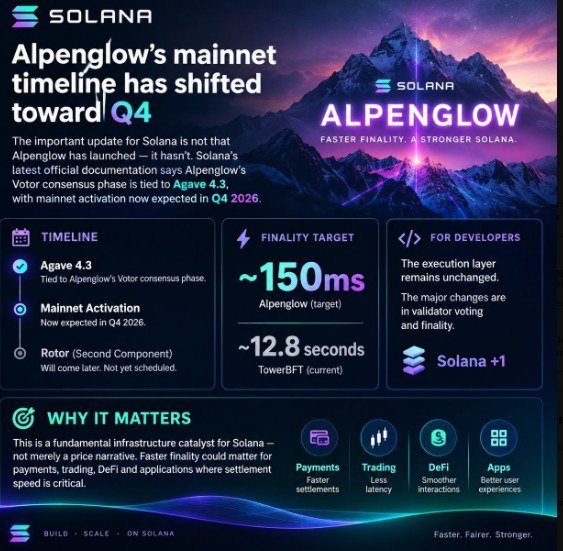
So what is Alpenglow in practical terms? Less waiting, more block space, and the same setup underneath. Real numbers still sit above the target, though.
What Does Alpenglow News Say About Price and Real Speed?
Recent Solana news is more careful than the headline target. One early dashboard reading showed 6.6 seconds of finality soon after activation.
An independent study published on October 23 found a median near 404 milliseconds, against about seven seconds before. That’s a big jump, but it’s not 150 milliseconds.
On price, Solana Alpenglow price coverage has mostly linked SOL moves to wider market and political pressure. No reliable report ties the upgrade alone to a price move.
What Changes for Validators and Developers?
Validators now run updated client software with Votor. Two prep steps came first in July 2026: BLS key management in vote accounts on July 8 and the Validator Admission Ticket on July 22.
The ticket is a requirement for validators that vote. Developers face bigger changes. Indexers and RPC providers must read certificates instead of vote transactions, and the gap between confirmed and finalized shrinks. Wallet holders don’t need to do anything, since balances and tokens stay put.
What Are the Main Causes and Risks of This Solana Network Upgrade?
TowerBFT was slow and crowded with blocks with votes, which was the cause. Risks are less simple. A new consensus layer touches every validator, and It has a history of outages, so stability is the main question.
Migration also brought breaking changes for indexers and integrations, and live finality still sits above the target. Client diversity is another point to watch, because the rollout was built mainly on Agave, the software Anza maintains.
Expert Take: What Should Readers Watch Next?
Stronger signals come first: public testing, red teaming, and migration rehearsals all happened before launch. Another point is the gap between the 150 millisecond target and the measured results, which remains the main concern.
Heavy load and validator outages are the biggest unknowns. Readers who still ask what is Alpenglow in market terms should remember that a faster protocol doesn’t guarantee a higher SOL price.
Conclusion: What to Take From Alpenglow
What is alpenglow in short? It’s the protocol that replaced TowerBFT on October 21, 2026, and it reshapes the Solana consensus mechanism around faster voting and lighter blocks.
The 150 millisecond goal is a target, while early measurements show real but smaller gains. Stability, validator support, and live data deserve the closest attention. The official upgrade page, Anza’s research, and the its documentation are the best places to check next.
Disclaimer
This article is for information only, not financial advice. Crypto is risky, and prices can fall. Readers should research on their own before deciding.
0
0

 Manage all your crypto, NFT and DeFi from one place
Securely connect the portfolio you’re using to start.


