
Best Crypto to Buy Now: BTC Slips Below $83K as Aptos Surges on Block-STM v2

0
0

Aptos Is the Coin to Watch Today — $0.82, Up 8.46% in 24 Hours
Aptos (APT) trades at $0.8222, up 8.46% in 24 hours, the largest single-day gain among large-cap layer-1s on Oct. 20. The token has climbed 50.3% from its Sept. 15 close of $0.5496, per CoinGecko data through 19:35 UTC. Bitcoin sits at $82,431, just below $83,000, while APT leads the altcoin tape.
Two supply-and-throughput shifts are behind the move, and neither is a one-day story. On Oct. 12 the network finished its four-year insider and investor unlock, which cut monthly token emissions by roughly 60%. On Oct. 15, Aptos Labs flipped Block-STM v2 on by default. The first event changes how much new APT enters the market; the second changes how much the chain can process.
- The move: APT is up 8.46% in 24 hours to $0.8222 and up 50.3% from its Sept. 15 close.
- The supply catalyst: the four-year unlock ended Oct. 12, cutting monthly emissions roughly 60%.
- The tech catalyst: Block-STM v2 now runs by default, lifting peak throughput to 1,308 TPS.
- The risk: stablecoin liquidity on Aptos fell 17.5% to about $910 million — the rally is supply-led, not demand-led.
Market Snapshot: Cross-Coin Comparison, Oct. 20, 19:35 UTC
| Asset | Price | 24h Change | Market Cap |
|---|---|---|---|
| Bitcoin (BTC) | $82,431 | +0.66% | $1.66T |
| Ethereum (ETH) | $2,430.51 | +1.42% | $296.9B |
| Solana (SOL) | $105.59 | +1.58% | $62.3B |
| Monero (XMR) | $618.57 | +4.62% | $11.6B |
| Zcash (ZEC) | $1,197.42 | +6.35% | $20.4B |
| Aptos (APT) | $0.8222 | +8.46% | $726.2M |
Prices from CoinGecko, timestamped 19:35 UTC Oct. 20, 2026. APT’s 24-hour range is $0.7507 to $0.8338, so the token is closing the session near its daily high, not fading it.
The Supply Flip: Unlock Ends, Emissions Drop 60%
APT’s price history is a dilution story. The token peaked at $19.92 in January 2023 and now trades 95.87% below that, not because the network failed but because a four-year vesting schedule steadily expanded supply. Circulating supply now stands at 883.2 million APT, with total supply at 1.21 billion and a hard cap of 2.1 billion, per CoinGecko.
That schedule ended on Oct. 12. Monthly emissions dropped from roughly 11.3 million tokens to 4.5 million — a 60% cut — as we covered in Aptos Insider Vesting Ends, Issuance Drops 60%. The math matters. At $0.8222, the removed supply equals 6.8 million tokens a month, or about $5.59 million in monthly sell pressure that no longer needs to be absorbed. Annualized, that is roughly $67 million less new supply at current prices.
The market priced the end of the unlock for weeks, which is the classic pattern: traders front-run a known supply cut. The data shows it. APT closed at $0.5496 on Sept. 15 and at $0.9042 on Oct. 11 before the unlock date, a 64.5% run into the event, then pulled back to $0.7702 by Oct. 18. The 8.46% gain on Oct. 20 is the market re-pricing after the supply event actually cleared.
Block-STM v2 Runs by Default
Block-STM, developed by @AptosLabs researchers, has run parallel execution on Aptos since mainnet. Other chains build on it, and Block-STM v2 now runs by default on Aptos. The idea: run transactions in parallel, redo only what conflicts.
— Aptos (@Aptos) October 15, 2026
The second leg of the catalyst is technical. Block-STM is Aptos’s parallel execution engine — it runs transactions concurrently and re-executes only the ones that conflict, rather than processing the whole block in sequence. Block-STM v2 now runs by default on mainnet, which Aptos Labs frames as a throughput and scalability upgrade. It builds on earlier speed work: Aptos reached sub-50ms block times in late 2025, and Block-STM v2 is the execution-layer follow-through on that promise.
Aptos Labs co-founder Avery Ching put it in supply-side terms. “Dynamic parallelism is based on two things: Block-STM and pipelined infrastructure, both of which we pioneered,” Ching said in the Aptos Foundation’s technical roadmap. “Today, with the arrival of Block-STM v2, we’re reinforcing our commitment to advancing parallelism and scaling Web3.”
On-chain numbers back the upgrade’s immediate effect. Peak transactions per second hit 1,308 after the rollout, with real-time throughput around 174 TPS, according to on-chain data cited in coverage of the launch. The distinction between the theoretical peak and the sustained number is the difference between what the engine can do and what demand actually asks of it — a gap the market has not yet closed. NEAR co-founder Illia Polosukhin, who discussed the upgrade with Aptos Labs’ head of research, summed the technical deep-dive up in three words: “It was a good deep dive.”
Price Levels and Where the Basis Sits
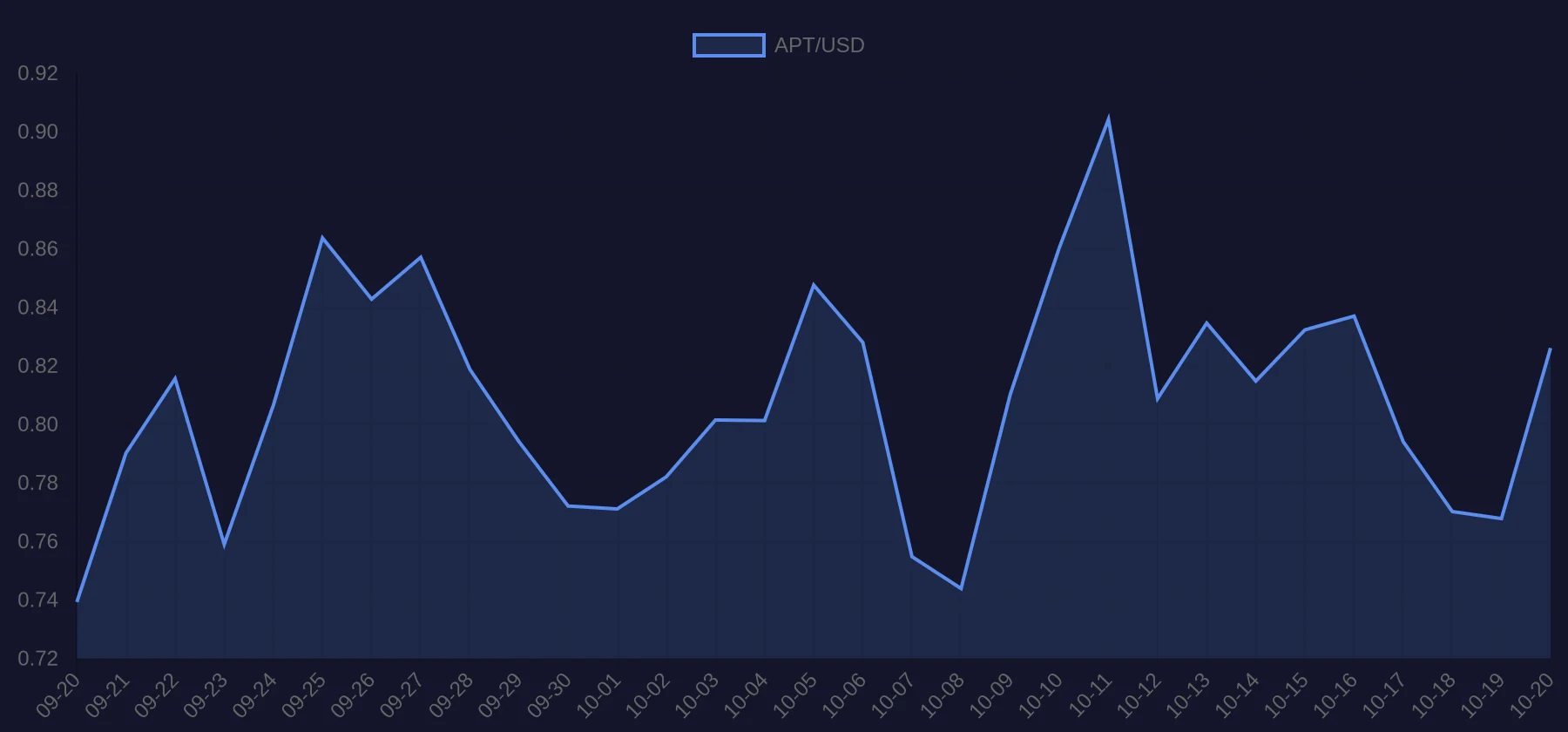
The 30-day chart above, built from CoinGecko data, shows the structure. APT’s late-August low of $0.511 is the floor the whole rally started from — the token is up 60.8% from that level. The Oct. 11 swing high of $0.9042 is the first resistance a sustained move has to clear, and the 24-hour high of $0.8338 is the near-term level to watch.
Support sits at the 24-hour low of $0.7507, which lines up with the Oct. 17-18 consolidation around $0.77 to $0.79. A daily close below $0.75 would invalidate the immediate rebound and reopen the $0.51 range. Above, a confirmed daily close over $0.83 opens the way to retest $0.90.
Put the market-cap math on top of those levels. At $0.8222 and a $726.2 million market cap, a 2x to $1.64 implies a $1.45 billion valuation — a move that is supply-constrained, not demand-constrained, because total supply already sits at 1.21 billion against a 2.1 billion cap. To return to the $19.92 all-time high from January 2023, APT needs a 24x move from here, not the simple price gap the headline suggests. A $1,000 position at $0.8222 buys about 1,216 APT; a return to $2 turns that into about $2,432, and a return to the 2023 peak turns it into about $24,227. Those are the numbers, not a price target.
The Countercase: Liquidity Is Moving the Other Way
Here is where the data disagrees with the price. While APT has rallied, stablecoin liquidity on Aptos has fallen about 17.5% over the same stretch to roughly $910 million, per DefiLlama. DeFi total value locked remains low. That is the tension the data analyst has to name: the price is being carried by a supply reduction, not by an expansion in on-chain usage.
This is the difference between a supply-driven trade and a vote of confidence in the ecosystem. A supply cut raises the price mechanically if demand holds flat — fewer tokens chasing the same dollars. A usage-led rally shows up in stablecoin balances and TVL rising alongside price. Right now the first is true and the second is not yet visible. The 51% four-week figure that has circulated in coverage overstates the case from some trackers; the honest number from CoinGecko’s own close-to-close data is a 50.3% gain from Sept. 15 to Oct. 20, and it has come with liquidity leaving, not arriving.
What to Watch Next
The next observable signals are specific. First, watch the stablecoin balance on DefiLlama: if it stabilizes or turns up while APT holds $0.80, the rally gets a second, demand-driven leg. Second, watch sustained transactions per second after Block-STM v2 has settled — the upgrade only matters if real throughput, not peak throughput, moves higher. Third, watch the next monthly emission print to confirm the 4.5 million-token run rate holds. If APT loses $0.75 on a daily close, the supply story is not enough to hold the price, and the trade unwinds toward the $0.51 base.
Frequently Asked Questions
Why is Aptos (APT) up today?
APT is up 8.46% in 24 hours on the combination of a completed four-year token unlock (which cut monthly emissions roughly 60% from 11.3 million to 4.5 million tokens) and the default rollout of the Block-STM v2 parallel execution engine on Oct. 15.
Is Aptos a good crypto to buy right now?
That depends on the thesis. The supply cut is a real, verifiable tailwind — about $67 million a year less new supply at current prices. The risk is that stablecoin liquidity on Aptos has fallen 17.5% to roughly $910 million, so the price move is supply-driven rather than usage-driven so far.
What is Block-STM v2?
Block-STM is Aptos’s parallel execution engine, which runs transactions concurrently and re-executes only conflicting ones. Block-STM v2 now runs by default on mainnet, aiming to increase throughput while handling dependencies more efficiently.
How much has Aptos gained in a month?
APT has gained about 50.3% from its Sept. 15 close of $0.5496 to $0.8222 on Oct. 20, per CoinGecko data. It remains about 95.9% below its January 2023 all-time high of $19.92.
What price level matters for APT next?
$0.75 is the near-term support (the 24-hour low and the Oct. 17-18 consolidation), and $0.83 is the first resistance from the Oct. 11 swing high of $0.90. A daily close below $0.75 would invalidate the rebound; a daily close above $0.83 opens a retest of $0.90.
Prices and market data are from CoinGecko and DefiLlama as of 19:35 UTC on Oct. 20, 2026. The author holds no position in APT.
Disclosure: This article does not represent investment advice. The content and materials featured on this page are for educational purposes only.
0
0


 Manage all your crypto, NFT and DeFi from one place
Securely connect the portfolio you’re using to start.
 Where will Bitcoin trade next?
Live Polymarket and Kalshi odds on Bitcoin price targets, compared side by side.
See Bitcoin price odds


