
stUSDS Liquidity Crunch Leaves Sky Depositors Waiting to Redeem USDS

0
0
How the stUSDS Liquidity Crunch Started at Sky Protocol
Crypto news update: the stUSDS liquidity crunch on Sky Protocol has left depositors stuck. On-chain analyst kirbycrypto said on November 18, 2026, that the lending pool sits at 100% utilization, so no USDS can be redeemed right away.
Depositors must wait for borrowers to repay their loans or for fresh funds to enter the pool before sufficient liquidity becomes available for withdrawals.
The report says a wallet allegedly linked to MakerDAO founder Rune Christensen deposited about $185 million worth of SKY as collateral and borrowed roughly 77 million USDS. It describes that loan as nearly 48% of all borrowing in the pool. The analyst adds that the wallet has not voluntarily repaid in about six months, so the debt keeps growing.
These points are allegations from on-chain analysis. The link between the wallet and Christensen is not confirmed in the sources reviewed, and official pages do not comment on specific wallets. What the protocol documents do confirm is how the pool behaves when nearly every deposited dollar is lent out.
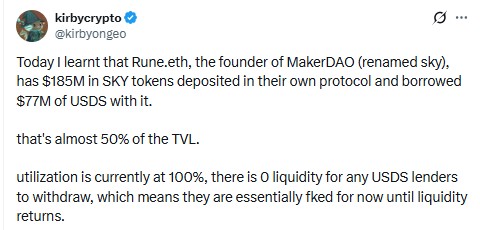
Source: Kirbycrypto Official X Post
Key Numbers Behind the Lending Pool Squeeze at Sky
The figures below come from the on-chain report and the Sky data it cites, as of November 19, 2026. They are rounded and have not been independently checked.
Item | Reported figure |
SKY collateral posted | About $185 million |
USDS borrowed by the wallet | About 77 million |
Share of pool borrowing | Nearly 48% |
Pool total value locked | About $162 million |
Utilization | 100% |
Immediately available liquidity | Zero |
Time since voluntary repayment | About six months |
Dividing 77 million USDS by 48% gives roughly 160 million USDS of total borrowing. That sits close to the reported $162 million pool value, which fits a pool lent out to its limit. This is a rough check on rounded figures, not an on-chain audit.
Who Is Affected and How Redemption Works at Full Utilization
Only people who supplied USDS to the expert module and hold its receipt token are affected. Holders of plain USDS or the savings token sUSDS are a separate group, because those products are built differently, according to the official explainer.
For affected holders, the practical change is timing. Funds are not reported lost in the sources reviewed. The money is lent out, so an exit in full depends on borrowers repaying or on new deposits arriving.
The token belongs to the protocol’s expert lending module. Users supply USDS, which funds borrowing by SKY stakers, and receive stUSDS tokens in return, as the official explainer describes. Idle capital earns the Sky Savings Rate, and the design targets utilization of about 90%.
Redemption depends on that utilization level. The protocol states that no mechanism liquidates borrower positions early to free up cash, so a full exit during high utilization may mean waiting for repayments or new supply.
The technical docs call the token a risk capital product. It is built to absorb a greater share of system risk in exchange for a larger share of protocol rewards.
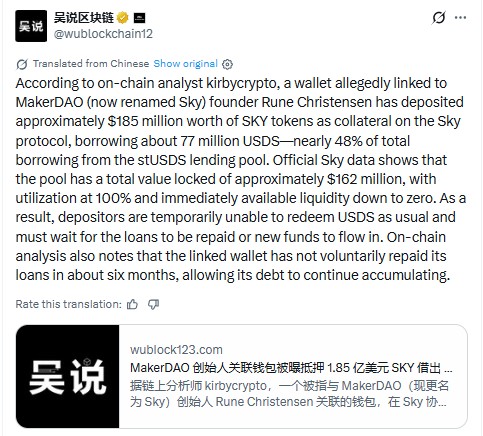
Source: @wublockchain12 Official X Post
Risks Behind the stUSDS Liquidity Crunch for Depositors
The open-source code repository explains the math. Users can redeem only the withdrawable amount, which is total value minus existing stake engine debt and any USDS currently in auction. At 100% utilization, that amount is zero.
The same README tells depositors they fully trust governance. It also says operators appointed by governance can set rates in a way that lets all funds be borrowed, so governance must aim to allow withdrawals over time.
The explainer adds concentration risk. Supplied capital is exposed to one borrower type, SKY-backed borrowers, instead of a diversified revenue base.
What Depositors Should Check Before Taking Any Action
The sources do not say when liquidity will return. Holders can check current utilization and available liquidity through the official product page and should verify the network and contract before any transaction.
The Sky.money interface also publishes user risk documentation covering its products.
Readers following stablecoin lending stress can find more crypto market updates as new data appears.
The stUSDS liquidity crunch comes down to one fact: a single borrower holds nearly half the loans, and the pool has no spare cash. A repayment, a fresh deposit, or an official statement could each change that. Until one arrives, readers can track the latest crypto updates for any movement.
Disclaimer: This article is for information only and is not financial advice. DeFi lending involves risk, including loss of funds. Do your own research before using any protocol.
0
0


 Manage all your crypto, NFT and DeFi from one place
Securely connect the portfolio you’re using to start.


