
US sanctions 45 more Prince Group targets over scam network finances

0
0

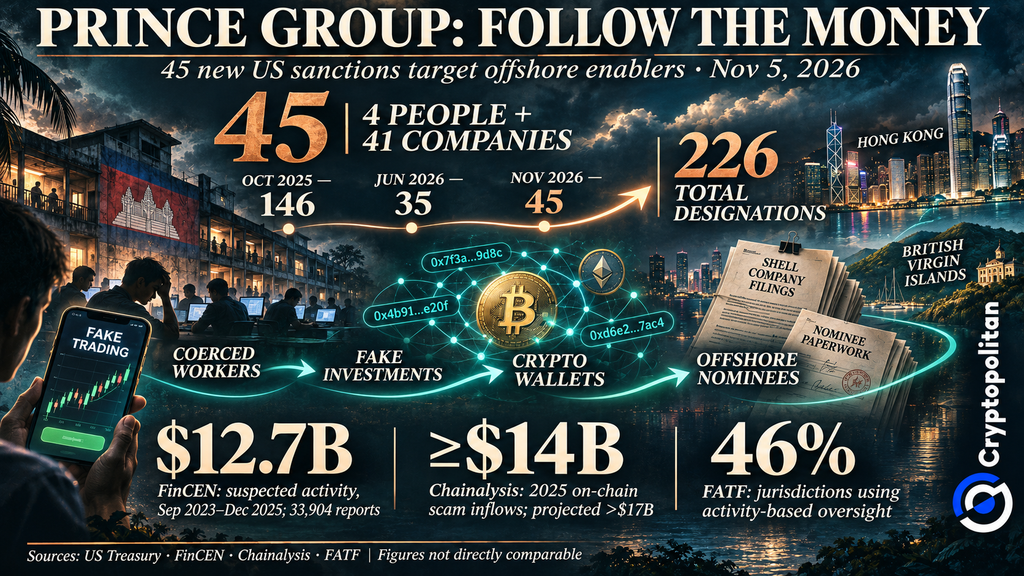
The United States Treasury Department sanctioned four individuals and 41 firms connected with Prince Group of Cambodia on November 5. The firms that were targeted are engaged in offshore businesses and finance, which are believed to have been involved in the group’s alleged fraudulent business activities.
As stated by the Office of Foreign Assets Control (OFAC), which is the arm of the US Treasury that enforces economic and trade sanctions, the sanctions regime has revealed companies operating behind the scenes that help in hiding ownership, transferring assets, and preserving access to global finance.
Going after the enablers, not just the operators
The Treasury’s latest sanctions target Qiu Yong, who allegedly controls moneylending and other companies in Hong Kong and the British Virgin Islands. His assistant, Zhao Mengyao, was also named. Two other targets, He Yujing and Visal Pang, allegedly held property for or shared company directorships with Chen Bo, a previously sanctioned Prince Group executive.
The latest action comes after two earlier rounds of sanctions. In October 2025, Washington sanctioned 146 entities. In June 2026, an additional 35 entities were sanctioned. With the 45 added yesterday, the total number of sanctions has reached 226. These repeated actions point to the challenge: sanctions against top executives will not prevent their associates and offshore companies from moving their assets.
These business connections are important because US sanctions can also apply to businesses owned or controlled by sanctioned individuals. Under OFAC rules, property within US jurisdiction or held by US persons must be blocked. The restrictions generally also cover businesses owned at least 50%, directly or indirectly, by one or more sanctioned parties.
How Chen Zhi’s empire reached courts on two continents
In October 2025, Prince Group chairman Chen Zhi was charged in Brooklyn with wire fraud and conspiracy to launder money. U.S. prosecutors said that workers in their Cambodian compounds were subjected to “pig butchering” schemes. The workers would gain their victims’ trust before persuading them into fake cryptocurrency investments and taking their money.
Besides this, the Justice Department has brought a civil case to recover around 127,271 Bitcoins, which were worth about $15 billion at the time. The allegations are yet to be proven, and the Prince Group is claiming innocence. In other developments, Cambodia extradited Chen to China in January 2026 amid yet another criminal investigation. According to Cryptopolitan, courts in Cambodia subsequently imposed restrictions on Prince Group assets.
The fraud numbers behind the crackdown
The charges against Prince Group point to a much wider problem. The US Financial Crimes Enforcement Network (FinCEN) identified $12.7 billion in suspected financial activity linked to cryptocurrency investment scams. The findings were based on 33,904 reports filed between September 2023 and December 2025. The figure covers suspected activity across multiple cases, not confirmed losses or Prince Group alone.
Meanwhile, Chainalysis traced at least $14 billion in on-chain crypto scam proceeds in 2025. It forecast the figure could be above $17 billion if more wallets are identified by investigators.
Why offshore loopholes make sanctions hard to land
While US sanctions can impede access to funds and block assets deemed within American jurisdiction, tracing money across borders is much harder. The Financial Action Task Force (FATF), which establishes international standards for anti-money-laundering activities, found that only 46% of jurisdictions regulate offshore crypto service providers according to the nature of services offered in their territories. At the same time, criminal organizations can exploit these weaknesses to move money through intermediary wallets and across different blockchains.
Furthermore, not all transfers go through a blockchain. A different FATF report focused on hawala, an informal, trust-based method of transferring value outside of traditional banking. There are instances in informal banking that went beyond €500 million in a matter of a few months.
The challenge for banking institutions and cryptocurrency exchanges is knowing who is behind offshore businesses and tracing dubious funds across countries. Failure to create tighter international cooperation may result in sanctions merely shifting the flow of illegal funds towards less regulated avenues.
If you're reading this, you’re already ahead. Stay there with our newsletter.
0
0

 Manage all your crypto, NFT and DeFi from one place
Securely connect the portfolio you’re using to start.


