
Bitcoin in November: What Ten Years of Monthly Returns Show After the Weakest October

0
0

Bitcoin ended October 2026 down 7.3%, its weakest October since at least 2016. The price fell from the September close of $83,556 to $77,424 on 31 October. In the ten years before, October finished higher eight times, by 17.8% on average. For November, the same record gives no clear signal: five years up, five years down. In the years that most resemble this one, November was red. Here is what the monthly returns show and which dates matter in November.
Bitcoin in October 2026: key points
- Monthly result: down 7.3%, from $83,556 to $77,424 (daily closes on 30 September and 31 October).
- Range: high of $87,249 on 2 October, low of $76,141 on 30 October.
- Year to date: down 11.5% from the 2025 close of $87,498.
- Distance to the record: about 38% below the all-time high of $126,296 set on 6 October 2025.
- October in the past: up in 8 of 10 years (2016 to 2025); 2026 is the weakest October in the series.
- November in the past: up in 5 of 10 years, ranging from minus 36.9% (2018) to plus 53.6% (2017).
Bitcoin in October 2026: down 7.3% instead of Uptober
The month started at its peak. On 2 October bitcoin climbed to $87,249, then slid lower in stages. The last week settled it: on 28 October the Federal Reserve held rates at 3.75% to 4.00%, but two members already voted for a hike. On the evening of 29 October attackers drained around $6.3 billion from Binance's hot wallets, and on 30 October the Nasdaq lost 2.86%. The same day, $643 million flowed out of the US spot bitcoin ETFs, and the price hit the monthly low of $76,141.
Crypto traders call October "Uptober" because it has risen in most years. In 2026 the pattern did not hold. October 2025 had already closed down 4.0%, so this is the second red October in a row. The details of the final week are in our weekly recap for week 44, and the latest on the hack is in our report on Binance reopening withdrawals.

Bitcoin monthly returns since 2016: October mostly green, November split
The table shows every month since January 2016, measured from the previous month's final daily close to the month's final daily close. Green means a gain, red a loss, and the stronger the colour, the bigger the move. The bottom row counts how many of the ten years from 2016 to 2025 the month finished higher.
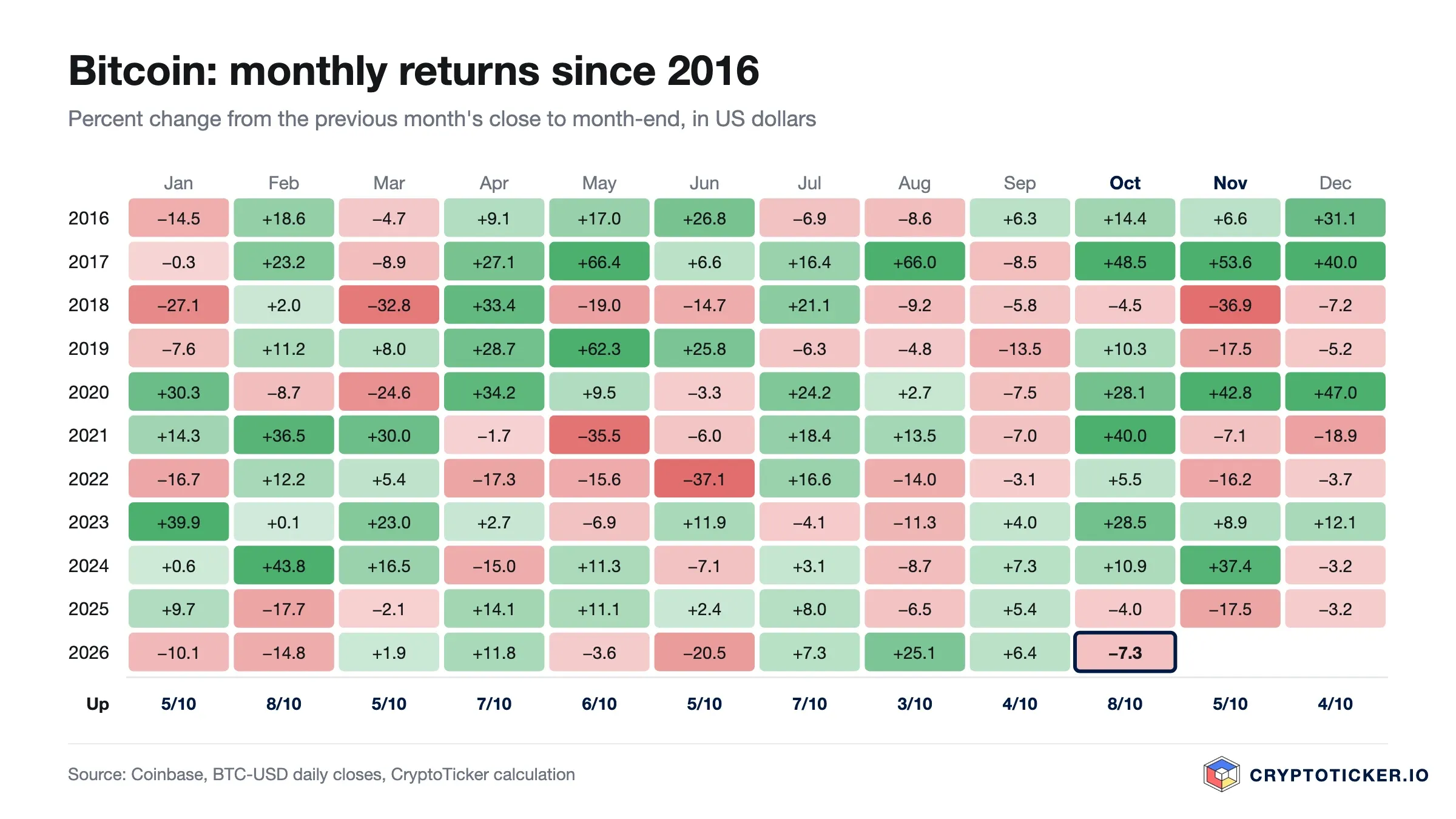
Two things stand out. With eight up years, October is one of the strongest months, together with February. November, by contrast, swings hardest in both directions: plus 53.6% in 2017, plus 42.8% in 2020 and plus 37.4% in 2024 against minus 36.9% in 2018, minus 17.5% in 2019 and 2025, and minus 16.2% in 2022. Anyone betting on November's average of plus 5.4% is betting on a number that hardly any single year came close to.
| Year | October | November |
|---|---|---|
| 2016 | +14.4% | +6.6% |
| 2017 | +48.5% | +53.6% |
| 2018 | −4.5% | −36.9% |
| 2019 | +10.3% | −17.5% |
| 2020 | +28.1% | +42.8% |
| 2021 | +40.0% | −7.1% |
| 2022 | +5.5% | −16.2% |
| 2023 | +28.5% | +8.9% |
| 2024 | +10.9% | +37.4% |
| 2025 | −4.0% | −17.5% |
| 2026 | −7.3% | open |
Bitcoin in November after a weak October: what past years show
The short answer: in both years when October was already red, a clearly red November followed. In 2018 bitcoin fell another 36.9% after a 4.5% drop in October; in 2025 it fell another 17.5% after a 4.0% drop.
A second lens leads to the same result. 2026 is the second year after the last halving in April 2024 and also a US midterm election year. Both were true of 2018 and 2022 as well, and in both years November was red, at minus 36.9% and minus 16.2%. The strong Novembers of 2020 and 2024 came in presidential election years that were also halving years.
We read these patterns as a warning sign, not a forecast. Each rests on two cases, and two cases are not statistics. They do show, though, that in years like this one November is not a month to count on for a rebound. How we assess the price targets for the coming months is set out in our Bitcoin price prediction.

Bitcoin price at the start of November
At midday on Sunday, 1 November, bitcoin trades at $77,835, according to CoinMarketCap at 11:57 UTC. That is 0.4% higher than a day earlier and almost 10% lower than 30 days ago. Since the start of the year bitcoin is down 11.5%, and it sits about 38% below its all-time high of $126,296.
The next level that matters is the 200-day moving average. On 30 October it stood at $73,125, a little over 6% below today's price. Above it, the long-term trend is still formally intact; below it, that trend would break as well. Ether, the second-largest cryptocurrency, trades at $2,267 and has lost 17.5% in 30 days, more than bitcoin.
Bitcoin in November 2026: the key dates
November has no Federal Reserve rate meeting, but a busy data calendar. US statistics are released at 8:30 am New York time, which is 1:30 pm UTC after the clocks change.
| Date | Event | Why it matters |
|---|---|---|
| Mon, 2 November | Binance plans to publish its proof of reserves | Shows whether customer funds are fully backed after the hack |
| Tue, 3 November | US midterm elections | The majorities in Congress decide the next crypto bills |
| Fri, 6 November, 8:30 am ET | US jobs report for October | Shapes rate expectations for December |
| Tue, 10 November, 8:30 am ET | US inflation (CPI) for October | The most important data point before the next Fed meeting |
| Thu, 26 November | Thanksgiving, US stock markets closed | Thin trading, larger swings possible |
| Fri, 27 November | Monthly bitcoin options expiry | Expiring positions can move the price in the short term |
| 8 and 9 December | Next Fed rate decision | A hike was about 80% priced in on 30 October |
The dates come from the release schedules for the Employment Situation and the Consumer Price Index, and the meetings from the Federal Reserve calendar. Ethereum has no date to watch: the Glamsterdam upgrade has been postponed without a new date, as we explain in our Ethereum price prediction on the delay.
Our view: seasonality is no roadmap for the bitcoin price
October 2026 showed what a monthly statistic is worth when the news runs against it. A stricter Fed, the largest hack in crypto history and a sell-off in tech stocks outweighed eight green Octobers. For November, the record argues for caution rather than a quick recovery. What will decide it, though, is the inflation data on 10 November and whether Binance completes its reimbursement as promised.
If you buy regularly, you don't have to pick the right month. A savings plan spreads your entry across red and green months. Which providers offer this cheaply and with an EU licence is shown in our comparison of bitcoin savings plans. If you want to switch exchanges after the Binance hack, our overview of Binance alternatives lists checked providers.
Selling bitcoin at a loss: what applies for tax
Tax rules depend on where you live. In Germany, a loss on bitcoin sold within a year of buying can be offset against gains from other private sales, under section 23 of the Income Tax Act, and a sale after more than a year is tax-free. Whether that holding period survives is open; our article on Germany's two tax models for crypto sets out the plans. How much tax your own sales trigger can be worked out with our free crypto tax calculator.
This article is not investment advice. Cryptocurrencies are highly volatile, and a total loss is possible.
0
0

 Manage all your crypto, NFT and DeFi from one place
Securely connect the portfolio you’re using to start.
 Where will Bitcoin trade next?
Live Polymarket and Kalshi odds on Bitcoin price targets, compared side by side.
See Bitcoin price odds


