
Kimber Digital Securities Receives Broker-Dealer License for Tokenized Assets
0
0
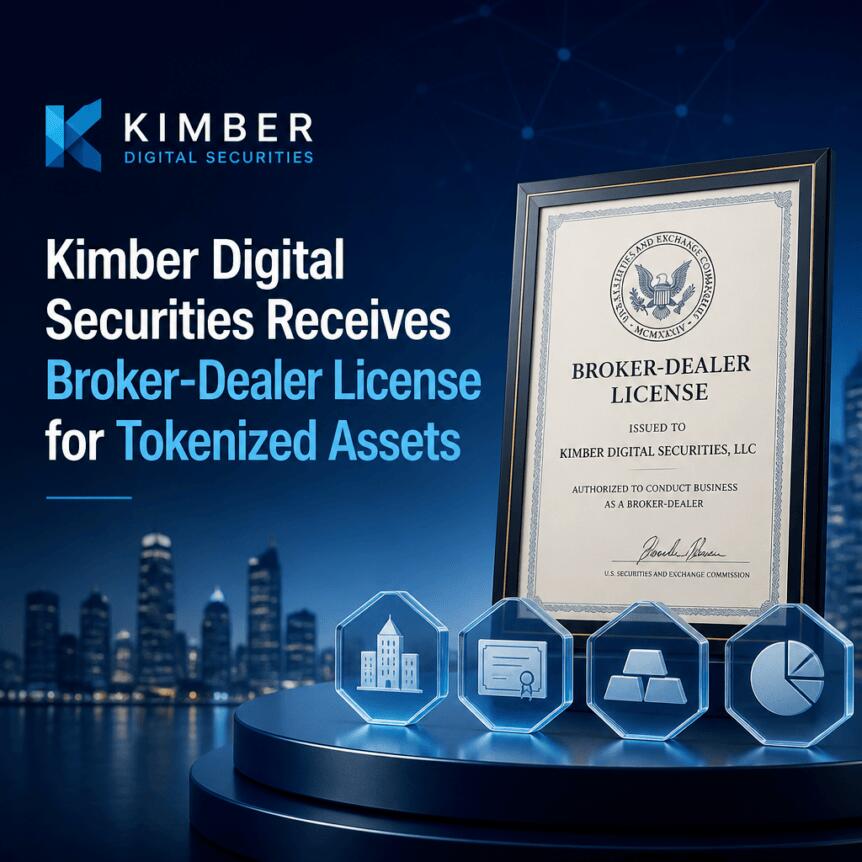
Kimber Digital Securities, an affiliate of the blockchain network Plume, said Tuesday that it has registered with the U.S. Securities and Exchange Commission as a broker-dealer and joined the Financial Industry Regulatory Authority (FINRA). The firm also outlined plans to bring tokenized versions of traditional U.S. securities to onchain custody models—potentially widening access to brokerage assets through self-custodial wallets.
In its announcement, Kimber Digital Securities said it intends to offer tokenized U.S. stocks, exchange-traded funds (ETFs), and bonds. The company did not provide a launch date. If realized, the move would position Kimber in a growing segment of “real-world asset” (RWA) infrastructure aimed at making regulated securities available for transfer on public or permissioned blockchain networks.
Key takeaways
- Kimber Digital Securities registered as a broker-dealer with the SEC and joined FINRA, a key compliance milestone for tokenized securities offerings.
- The firm plans to tokenize stocks, ETFs, and bonds for investors who want to hold eligible assets in self-custodial wallets.
- Kimber’s proposal emphasizes that the tokenized instruments would be backed by existing ownership records through the Depository Trust Company (DTC), rather than functioning purely as “wrapped” representations.
- The company also plans yield-bearing products for stablecoin users, including tokenized fund exposure tied to major U.S. asset managers.
- Regulated tokenization initiatives are accelerating alongside plans for around-the-clock trading of tokenized securities.
A broker-dealer push toward self-custodial securities
According to Kimber Digital Securities, its tokenized securities approach is designed around how ownership is represented and transferred. The company describes tokenized stocks as digital tokens that correspond to company shares or rights tied to those shares, with token transfers recorded on a blockchain.
Where Kimber’s plan differs from some earlier tokenization models is in its stated relationship to existing custody and ownership mechanisms. Instead of issuing wrapped securities—where onchain tokens may reflect an offchain asset through a separate representation—Kimber said the proposed tokens would represent existing ownership rights recorded through the Depository Trust Company (DTC).
The company also said investors would retain dividend and voting rights. It further claimed that eligible tokenized holdings could be transferred between traditional brokerage accounts and onchain wallets. For investors, the practical significance is straightforward: the value proposition depends not only on moving a digital token, but on ensuring the legal and economic rights typically associated with securities remain intact across transfer pathways.
Tokenized yield products for stablecoin holders
Beyond securities trading, Kimber Digital Securities said it intends to offer yield-bearing investment products to stablecoin users. These would include tokenized shares in funds managed by major U.S. asset managers.
While the company did not provide additional product details in the announcement shared in the source material, the direction aligns with a broader pattern across the RWA sector: combining tokenized exposures with yield mechanics that can be accessed by users already active in stablecoin-based ecosystems. For readers, the key question is how such products will be structured, particularly around custody, settlement, and redemption—areas that determine whether “yield” is operationally robust or merely marketing language.
Tokenized equities momentum and the 24/7 trading race
Kimber’s registration lands as other firms move toward launching platforms aimed at continuous trading of tokenized U.S. securities. Earlier this week, Formation Securities announced plans for a Solana-based trading venue for tokenized shares of Galaxy Digital, Exodus Movement, and Forward Industries, with a launch targeted for early 2027. The same broader thrust is visible among U.S. market operators.
The New York Stock Exchange is developing a 24/7 tokenized securities platform using Avalanche for settlement, according to earlier coverage cited in the source. Nasdaq, meanwhile, said it is targeting the second quarter of 2027 for a tokenized equity initiative in partnership with Payward, the parent company of Kraken.
These efforts share a central thesis: tokenization and blockchain settlement could allow securities to trade outside traditional market hours—at least for products and venues that meet regulatory and operational requirements. For traders and institutions, the potential benefits include greater scheduling flexibility and the ability to integrate securities workflows into existing onchain infrastructure. For regulators and compliance teams, the challenge is ensuring that continuous trading does not weaken investor protections, custody standards, or market integrity.
Where the numbers stand for onchain tokenized stocks
The source material also points to a sharp rise in the footprint of tokenized stocks onchain. According to data cited from RWA.xyz, the value of tokenized stocks increased to $3.87 billion from $643.3 million in November 2025—an increase of more than sixfold over the period.
That growth matters for two reasons. First, it suggests that market demand for tokenized securities is not confined to niche pilots. Second, it implies that infrastructure providers and regulated entities are racing to build capabilities that can handle higher activity—especially as more players prepare to support around-the-clock trading ambitions.
Still, the metric highlights growth in value, not necessarily liquidity depth across venues, or how seamlessly tokenization translates into day-to-day execution quality for investors. As these initiatives move toward launches, the industry will likely shift from “can we tokenize?” to “can we trade reliably at scale while maintaining compliance?”
Investors and builders should watch what Kimber ultimately launches, particularly how it handles eligibility criteria, custody transitions between brokerage and self-custody, and the operational design of its yield-bearing stablecoin products. With multiple major initiatives targeting 2027 and tokenized stock values climbing quickly, the next phase will likely hinge on whether continuous trading and onchain custody can be implemented with consistent settlement, rights management, and investor protections.
This article was originally published as Kimber Digital Securities Receives Broker-Dealer License for Tokenized Assets on Crypto Breaking News – your trusted source for crypto news, Bitcoin news, and blockchain updates.
0
0

 Manage all your crypto, NFT and DeFi from one place
Securely connect the portfolio you’re using to start.


