
22 million ADA for a copper reserve: Cardano's treasury vote runs to November 15

0
0
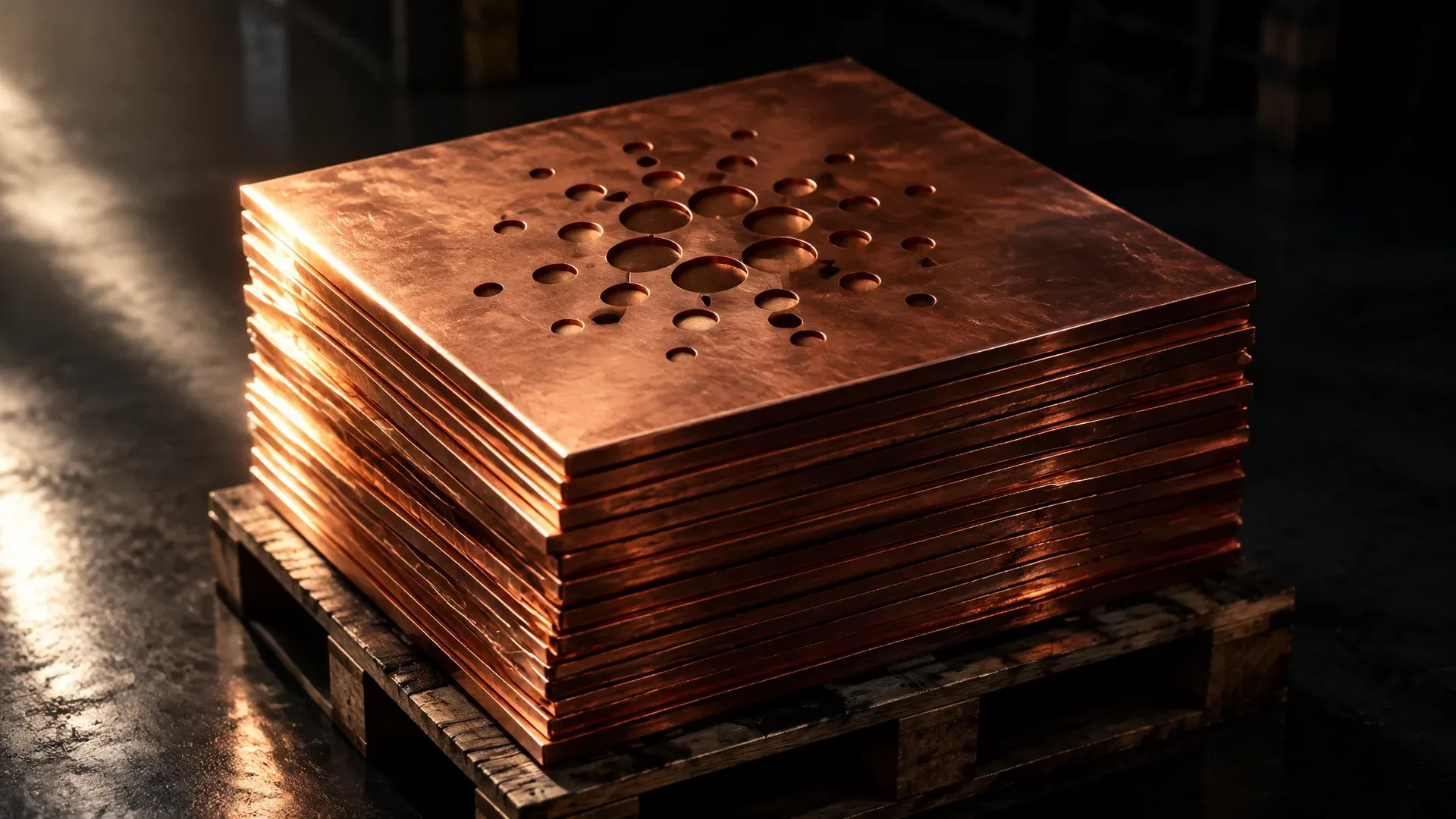
Cardano's treasury is to swap 22 million ADA for copper. That is the core of a proposal put to the vote by the company Toto Finance: around two thirds of the sum would buy copper cathodes stored in an approved warehouse near New Orleans and represented by a token called CuTT. The metal is to be held for 18 to 24 months and sold the year after. The vote is already running and closes around November 15, 2026.
For holders of Cardano, this is no distant governance footnote. Anyone who has delegated their ADA to a representative helps decide this proposal, and does so even by doing nothing at all. That is where the second half of the news lies: one of the better-known representatives gave up the post a few days ago, and the voting power delegated to him has not counted since.
The proposal: 22 million ADA for a tokenised copper reserve
The plan goes by the name "Cardano Strategic Copper Reserve". The applicant is Toto Finance Inc., a company registered in Delaware that converts physical commodities into tokens. It was founded and is run by Monty Metzger; according to Crypto Briefing, the firm launched a marketplace for tokenised precious metals in 2023 and received support from the Cardano Foundation's accelerator.
The requested sum of 22 million ADA was worth about five million dollars at the time of reporting on October 23. CoinDesk gives that order of magnitude; individual accounts differ slightly. One publication puts the proposal at 22.4 million ADA, and several name a dollar value of 4.9 rather than 5.0 million. The ADA amount itself is the same order of magnitude in every version; the dollar figure moves with the price.
What a withdrawal proposal in Cardano actually is
Cardano's treasury is a pot filled from transaction fees and a share of newly issued coins. Money leaves it only through a withdrawal proposal, voted on by the network's representatives. A representative is called a DRep in Cardano jargon, short for Delegated Representative: a person or group to whom other holders hand their voting power without transferring the coins themselves.
The procedure is young. Only since the Chang upgrade has the community decided this way about its own funds, and the results are mixed. In June it rejected a proposal for 7.8 million ADA; on October 11 two further measures failed for lack of support, among them a cut to the minimum fee for stake pools. A proposal on the table at Cardano, then, does not mean it passes.
CuTT: how a token is meant to represent a pound of copper
According to Crypto Briefing, the purchase would cover inspected COMEX Grade 1 copper cathodes. COMEX is the New York commodity futures market where industrial metals trade; "Grade 1" denotes a defined purity there that counts as exchange-deliverable. Every verified pound is to be represented by a token with the ticker CuTT.
Technically the route has two stages, and for assessing the risk that matters more than the metal. On CoinDesk's account, the tokens are first created on Ethereum, locked there in a bridge, and only that triggers the matching tokens on Cardano. A bridge is a construction that mirrors value between two blockchains by locking on one side what it issues on the other. Contracts and security audits for this setup are still outstanding.

Two thirds metal, one third technology, storage and oversight
Of the requested sum, 66.93 percent goes into the metal, which on Crypto Briefing's calculation is 14.72 million ADA. The rest covers development of the technology, custody, insurance and independent oversight.
CoinDesk puts a number on what of that can end up with the applicant itself: up to roughly 3.36 million ADA, or about 15 percent of the sum. That includes 2.64 million ADA for technology and project management, an execution fee of 441,732 ADA and up to 278,291 ADA from a margin on third-party invoices for storage and insurance. Metzger is quoted as saying that Toto takes no profit from this proposal; the company keeps the commercial rights to its own copper business and, by its own account, finances them separately.
The commitment is to return 100 percent of net sale proceeds together with any unspent funds, no later than 36 months after the start. CoinDesk notes explicitly that there is no guarantee the treasury gets its original ADA back.
The withdrawal cap: 457.4 of 500 million ADA are committed
The real conflict lies not in the copper but in the room the proposal takes up. For the current period to around July 2027, Cardano caps withdrawals at 500 million ADA. Of that, on the figures CoinDesk gives for October 16, 457.4 million ADA were already used. That leaves 42.6 million ADA.
We wrote this state of affairs up on October 17 in a piece of its own on the spending cap being reached: 91.5 percent committed, 42.6 million ADA free. Nothing has moved on the cap since, but the pressure on it certainly has. If the copper proposal claims 22 million ADA, that is 51.6 percent of the entire remaining room. Everything else still to come before July 2027 would then share the other half.
Break-even: copper would have to rise by 49.4 percent
The proposal documents assume a purchase price of $6.73 per pound and a sale at about $10.06. Our own analysis of the proposal shows that the copper price has to rise by roughly 49.4 percent for the treasury to recover its outlay. That holds under two assumptions: the budget is spent in full, and the dollar price of ADA stays unchanged.
Metzger bases the expectation on the demand side. He points to electrification and the build-out of data centres as possible price drivers and is quoted at CoinDesk judging that copper has considerable upside, with optimistic scenarios of around 30 percent appreciation a year. As a longer-term goal he names $5 billion in tokenised copper assets. These figures are the applicant's expectations, not measured market data.
Why the leverage works in both directions
A commodity position in a treasury that counts in ADA hangs on two prices at once. If copper rises and ADA falls, the treasury gets back more ADA than it spent. If copper falls and ADA rises, it loses twice over. The 49.4 percent describe only the one case in which the ADA price stands still, and that case is the least likely of them all.

Epoch 661 to 668: how the vote proceeds
According to Crypto Briefing, the voting window runs from epoch 661 to epoch 668. An epoch at Cardano is a fixed period of five days, in which staking rewards are settled among other things. Eight epochs make around 40 days, and the window ends around November 15, 2026.
What counts in the vote is voting power. Each DRep brings in the amount of ADA delegated to them, and there are additionally the fixed options "always abstain" and "no confidence". A withdrawal proposal needs a majority of the voting power cast and must at the same time reach a participation minimum. If too much voting power sits idle, a proposal can fail simply because nobody objected.
DRep resignation: why delegated voting power does not count right now
On October 22 a representative known under the name Crypto Pundit, listed in the reports as Chris O, made his resignation from Cardano governance public. He explained the step in his post with the competition between networks, praised the technology and adoption of Sui, and stated that he still owns ADA. Charles Hoskinson thanked him publicly for the time he had given.
For the copper vote the consequence is tangible. The reports agree that the voting power delegated to him no longer counts on coming measures, and that he has therefore asked his delegators to reassign their voting power. How far that reaches is described differently by the sources: one account speaks of votes becoming invalid for coming budget decisions, while others describe the voting power as dormant until the holder acts. Which reading applies cannot be settled conclusively from the reports; what counts are the entries on the blockchain.
In practice both come to the same thing: if you delegated to this DRep and change nothing, you do not vote on the copper proposal.
ADA at $0.2045, and what that changes about the proposal
On October 24 ADA trades at $0.2045, down 5.10 percent within a day. Over a week it is 6.84 percent lower, over a month 17.81 percent. Market value stands at $7.68 billion, rank 18, on a circulating supply of 37.57 billion ADA and daily turnover of $283.5 million. The session low was $0.2008, the session high $0.2161.
That produces a number not yet found in the reporting on the proposal. At the October 24 price, 22 million ADA are worth roughly $4.50 million, not the about $5 million of the day before publication. The copper share of 14.72 million ADA comes to a good $3.01 million, and the entire remaining room of 42.6 million ADA to about $8.71 million. The treasury spends a fixed quantity of coins, and the lower ADA stands, the less copper the same quantity buys.
For the levels that means: on the downside, $0.2008 is the point at which the session either turns or does not. On the upside, the session high at $0.2161 comes first, and above it the $0.2439 mark, which broke on October 15 and has not been reclaimed since. The all-time high of $3.09 from September 2021 is a long way off.
What ADA holders in Germany can check now
The first point concerns delegation, and it costs nothing but a look in the wallet. The governance settings show which DRep your voting power is assigned to and whether that DRep is still active. If a resigned representative is listed there, the voting power can be reassigned within the current window or set to "no confidence". The coins stay where they are; a delegation transfers no ownership.
Staking runs separately from this. Delegating voting power to a DRep and delegating to a stake pool are two different processes that do not cancel each other out. What Cardano actually yields is something we broke down in an overview of its own on staking returns. To compare where staking is offered on what terms, the providers are in our comparison of staking platforms.
For tax, what counts on crypto assets in Germany is the one-year holding period: once it has run, a disposal gain from a private sale stays tax-free, and before that it is taxed as a private disposal. Staking income has to be looked at separately. Neither reassigning voting power nor the outcome of a vote changes your holding period, because neither process is a sale. Without a gapless record of acquisition dates, you need a tool that carries purchases properly; what is binding in the end is the advice of a tax adviser.
On the buying route, the usual standard applies. Providers addressing retail clients in the EU need authorisation as a crypto service provider under the MiCA regulation; which exchanges can show that, and at what cost they trade, can be checked before buying. For custody of larger holdings, your own wallet remains the option with no counterparty in between. The current range of movement argues against leveraged positions on ADA: with a daily range from $0.2008 to $0.2161, the liquidation threshold of a tenfold leveraged long sits inside the normal daily move already.
Cardano copper reserve: the delegates decide by November 15
- Check in your wallet which DRep your voting power is assigned to. If the representative has resigned, reassign it while the window to November 15 is open. How to earn a yield on your ADA alongside is shown by the comparison of staking platforms.
- Keep the vote separate from your investment decision. The proposal commits treasury funds, not your coins. For the buying route and the fees, the exchange comparison remains the yardstick.
- Record your acquisition dates before you shift anything. The one-year rule decides the tax, and the tools for it are in the comparison of tax and portfolio tools.
(As of October 24, 2026. This article is not investment advice. Prices and fee structures change; check the terms with the provider before you buy.)
0
0

 Manage all your crypto, NFT and DeFi from one place
Securely connect the portfolio you’re using to start.


