
Solana price prediction: 3.38 longs per short, the widest gap in two weeks

0
0

Solana trades at $93.78 on Friday evening, down 6.7 percent within a day. Bitcoin gave up 4.9 percent over the same period, Ethereum 4.2 percent. Solana is therefore falling markedly harder than the two largest assets, and the daily low of $92.64 sits only a good one percent below the current level. Market capitalisation stands at $55.33 billion.
The documented fact: in the futures market of the OKX exchange, every account holding a short position is matched by 3.38 accounts holding a long position. On October 18 that ratio still stood at 2.24. Our own assessment follows further below: the imbalance leaves the price exposed to the downside, because leveraged long positions are not sold voluntarily when prices fall, but by force.
Where the price can point over a horizon of months is set out in our Solana price prediction. This article takes the short road: who is positioned how in the futures market right now, which mechanism turns that into a move lower, and which levels count over the next few hours.
Where Solana stands on Friday evening
In the 24 hours to Friday evening the range ran from $92.64 to $100.55. That is 8.5 percent between the day's highest and lowest value, one of the widest daily ranges of the month for Solana. Solana worth $5.9 billion changed hands in that period, as recorded on the Solana price page at CoinGecko.
The gap to the large assets is the striking part. Bitcoin stands at $76,670 on Friday evening, 4.9 percent lower than the day before, Ethereum at $2,228 and 4.2 percent lower. At 6.7 percent, Solana is losing roughly a third more than Bitcoin. Looking at the price level alone does not explain that difference. The futures market does.
The round hundred mark, which the price had been working at since October 22, now sits 6.6 percent above the current level. The mark broke on Thursday evening and was not recovered on Friday. That leaves the price without the orientation to the upside it had held on to for two weeks.
The imbalance in the futures market
We analysed positioning in Solana futures contracts at the OKX exchange over 14 days, from October 17 to October 30, 2026, taking the daily value in each case. The basis is the exchange's public statistics on open interest, trading turnover and the account ratio. cryptoticker.io compiled this analysis itself on October 30, 2026.
The ratio of accounts holding long positions to those holding short positions rose over those 14 days from 2.24 on October 18 to 3.38 on Friday. It is the highest value of the period, and it did not appear in a single day: since October 21 the value has climbed almost without interruption, from 2.57 through 2.96, 3.18 and 3.21 to 3.37 and 3.38 most recently. Three in four futures accounts are now betting on rising prices.
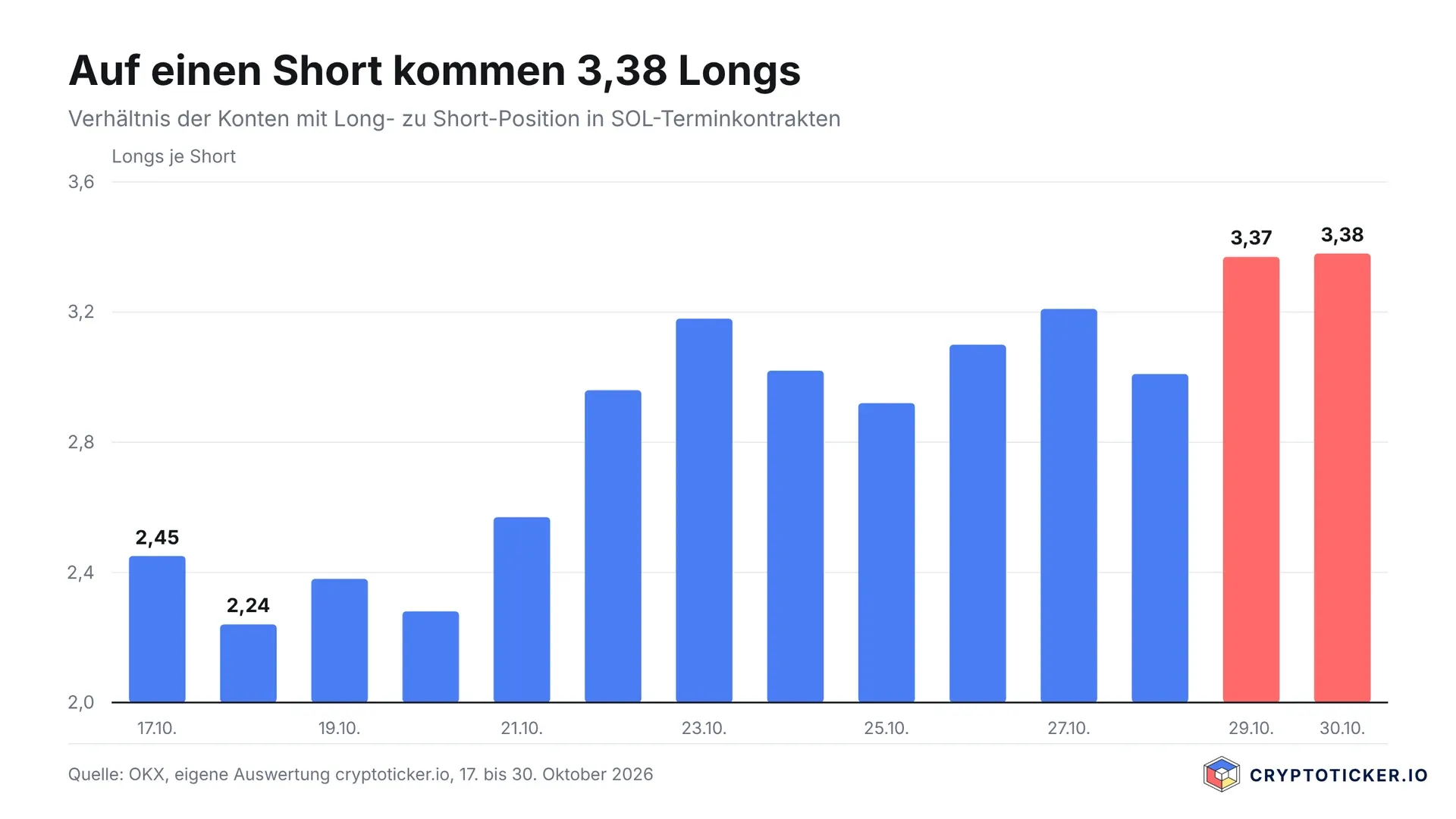
Two further figures from the same day belong with it. Trading turnover in Solana futures contracts jumped on Friday to $2,127 million, after $959 million on Thursday and $634 million on Wednesday. Open interest, meaning the sum of all contracts not yet closed, fell only slightly over the same period, from $377 million to $371 million.
That combination says more than either figure on its own. Triple the turnover at almost unchanged open interest means positions were closed on a large scale and new ones opened immediately. The market reshuffled, then, rather than reduced. Anyone who was long on Thursday and got liquidated found a successor on Friday who takes the same bet once more.
The ratio of aggressive orders fits that picture. Of the futures orders that reached straight into the order book on Friday, $1,096 million went to buys and $997 million to sells. For every dollar sold aggressively there were $1.10 of aggressive buying, and that on a day with a 6.7 percent price loss. Buyers were stepping into the falling price.
How many longs turn into a move lower
A leveraged long position works like this: the trader puts up collateral and with it controls a larger position. At tenfold leverage, $1,000 of stake covers a position of $10,000. If the price falls by ten percent, the collateral is used up on paper, and the exchange closes the position automatically. That forced sale hits the same order book as any other sale.
From this follows the cascade effect the market shows on days like this one. Every liquidated position produces a sale, every sale pushes the price a little lower, and the lower price reaches the liquidation threshold of the next position. On Wednesday those forced closures added up across the market to $1.54 billion within a single day. The more one-sided the positioning, the longer the chain.
This is exactly where the difference between 2.24 and 3.38 longs per short lies. With balanced positioning, a forced sale finds buyers on the other side who have to close their shorts, and the move steadies itself. At 3.38 to 1 that other side is largely missing. The shorts that would cushion the fall are simply too few. The cushion beneath the price has grown thinner while the price itself has fallen.
The funding rate shows the same tilt. The value stood at 0.0025 percent per settlement period on Friday evening and therefore in positive territory. Positive means the long side pays the short side. Anyone betting on rising prices is carrying running costs in this situation, on top of the paper loss. That raises the pressure to give up positions as soon as the price gives way further.
What has changed since yesterday evening
On Thursday evening Solana stood at $100.29, and at this point we examined the monthly close and the hundred mark. Since then the price has lost 6.5 percent, the mark has broken, and October is therefore closing not narrowly above the round number but clearly below it.
Capital on the blockchain itself has changed too. Solana applications still held $5.70 billion on Thursday; on Friday it is $5.32 billion. That is a decline of 6.5 percent within a day and corresponds almost exactly to the price loss. The outflow is therefore mostly a valuation effect and not an additional withdrawal of capital, which in this situation is the better of the two pieces of news.
What has stayed unchanged, by contrast, is the direction of the futures accounts. The ratio already stood at 3.37 on Thursday and rose to 3.38 on Friday, despite the slump. Anyone who bet on rising prices yesterday has therefore not cleared the position today, but held it or bought more.
These levels carry to the downside
The first level is the daily low at $92.64. That value sits a good one percent below the current price and is the point at which the market first found buyers on Friday. If it does not hold, there is no intermediate step from the past 14 days before the round 90 mark, because Solana has not stood that low recently.
To the upside, the daily high at $100.55 counts first, which is also the broken hundred mark. A daily close above it would defuse the situation in the futures market, because it would pull the long positions out of loss territory. That is 7.2 percent away. In between lies the range from $100.34 to $102.74, in which the price moved from October 24 to 29 and which now stands as resistance above the price.
For investors that means: the range between $92.64 and $100.55 is the frame within which the next few hours are decided. Both edges are grounded in this day's trading and not in a line on a chart.
Our assessment
In the view of the editorial team, positioning is currently the greater risk than the price level itself. Three pieces of evidence speak for that: the account ratio of 3.38 to 1, the highest value since at least October 17; the tripled futures turnover at almost unchanged open interest, which points to reshuffling rather than reduction; and the positive funding rate, which costs the long side money on an ongoing basis. As long as those three values stand together like this, every further setback carries the potential of a cascade.
Against it stands the fact that aggressive buyers predominated on Friday, at $1,096 million against $997 million. There is demand stepping into the falling price, then, and the capital held on the blockchain has fallen in dollar terms only in step with the price, not beyond it. This is an assessment of the situation, not a recommendation to buy or sell: anyone holding Solana or looking to buy carries the risk of a total loss.
How to work out your own liquidation price
Anyone holding a leveraged position often knows their own liquidation price only roughly. The approximation for it is simple: entry price times one minus one divided by the leverage. At fivefold leverage and an entry at $100, the threshold therefore sits around 20 percent lower, at $80; at tenfold leverage around 10 percent lower, at $90. Fees and financing costs shift the point somewhat higher again. At a level of $93.78, a tenfold leveraged position from Wednesday is thus already within reach of the threshold.
Anyone holding Solana without leverage does not have that worry, but does have a tax question. After a holding period of one year, a gain from a sale is tax free in Germany; within the year it counts as a private disposal transaction. A sale at a loss within the period, by contrast, produces a loss that can be offset against gains from other private disposal transactions in the same year. How far the announced reform of this period has progressed is tracked in our status of the crypto holding period reform.
The third point concerns the trading venue. Anyone whose Solana sits at an exchange that suspends withdrawals can neither sell nor move it in a move like this. Which providers are authorised under MiCA and what they cost is set out in our comparison of crypto exchanges.
Solana at $93.78: below $92.64 the long side turns thin
The futures market became more one-sided on Friday even though the price fell. 3.38 long accounts per short account, a tripled turnover without any reduction in open positions, and a positive funding rate together describe a market that is not giving up the bet on rising prices. That supports the price as long as $92.64 holds, and amplifies the move as soon as that level goes. Both can be watched at the same value: if the account ratio tips back below 3.0, the one-sidedness has been worked off.
(As of October 30, 2026. This article is not investment advice. Prices and fee structures change; check the terms with the provider before you buy.)
0
0

 Manage all your crypto, NFT and DeFi from one place
Securely connect the portfolio you’re using to start.


