
What Is Tron (TRX)? The Blockchain Holding More Than Half of All USDT

0
0
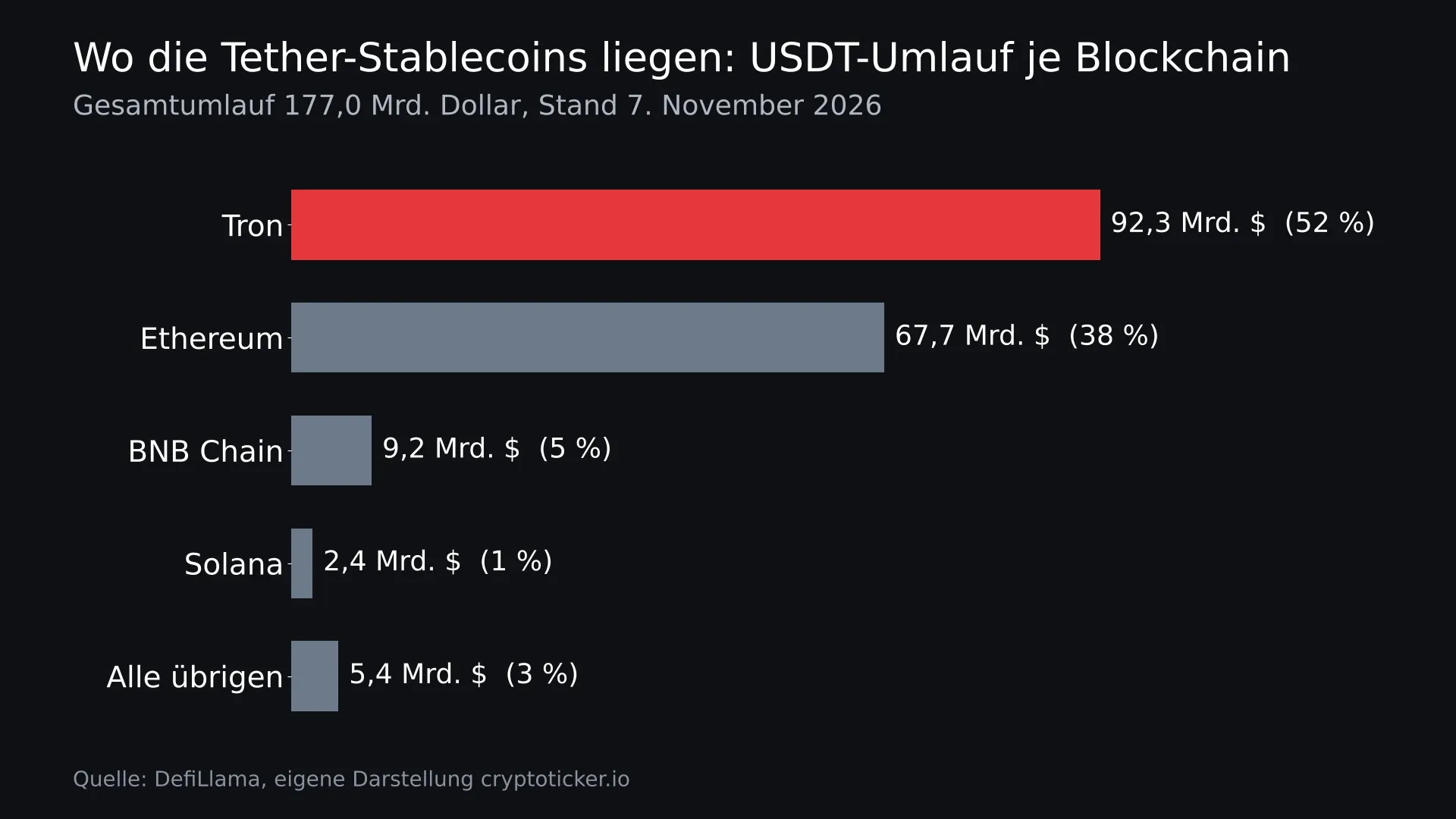
Tron is a blockchain platform with its own cryptocurrency, TRX, whose main job is moving digital dollars. According to data provider DefiLlama, around $92.3 billion in Tether's stablecoin USDT sat on the Tron network on November 7, 2026, or 52 percent of all USDT in circulation. No other network holds more. Anyone moving crypto between exchanges or sending Tether to friends therefore often ends up on Tron, even without knowing the name.
This profile explains how the network works technically, who controls it, why transfers there cost energy rather than gas, and what the TRX token has to do with it. For investors in Germany, it also covers how to buy, custody, tax and the risks. For a view on the price, see our Tron price prediction. TRX traded at around $0.317 on Saturday morning, ranking eighth by market value.
What is Tron? Blockchain platform, TRX token and TRON DAO in brief
Tron consists of three parts that are often mixed up. The Tron network is the blockchain itself, the public ledger in which every transaction is recorded. TRX is this blockchain's native cryptocurrency. You use it to pay fees, it serves as collateral for staking and as voting power in the election of block producers. The TRON DAO is the organisation that represents the project publicly today and supports its development.
A short definition: Tron is a layer-1 blockchain using delegated proof of stake that runs smart contracts and is built for cheap, fast transfers. Layer 1 means that Tron is a standalone blockchain and does not sit on top of another network. The ticker TRX goes back to the earlier name Tronix.
Tron originally set out to build a decentralised internet for content: creators were to sell music, videos and games directly to their audiences, without platforms such as app stores in between. Little of that vision remains in practice. The largest use of Tron today is the exchange of stablecoins, tokens designed to track a fixed value in dollars.
Founded by Justin Sun: Tron Foundation, mainnet and TRON DAO
Tron was founded in 2017 by Justin Sun, an entrepreneur from China who built up the Singapore-based Tron Foundation. The same year, the project sold its tokens in a public token sale. TRX initially ran as a token on the Ethereum blockchain. In 2018, Tron launched its own mainnet and the tokens moved to the new blockchain. Also in 2018, Justin Sun acquired the file-sharing service BitTorrent, which has been part of the Tron ecosystem ever since.
At the end of 2021, Tron dissolved the foundation and handed its role to the TRON DAO. A DAO, short for decentralised autonomous organisation, is an organisation whose rules and votes run at least partly on the blockchain. Justin Sun remains the project's best-known face. Investors should be aware of this: as with hardly any other large network, the perception of Tron hinges on a single person.
Delegated proof of stake: how 27 Super Representatives run the Tron network
Tron uses a consensus mechanism called delegated proof of stake, or DPoS. A consensus mechanism is the rule by which all computers in a network agree on the same state of the ledger. In classic proof of stake, any participant with enough collateral can produce blocks. Under DPoS, holders instead elect a small group of representatives who do this work for everyone.
On Tron these representatives are called Super Representatives. According to Tron's developer documentation, the 27 candidates with the most votes produce the blocks. The ranking is recounted every six hours. For each block, the producing Super Representative receives 8 TRX, plus 128 TRX per block shared among the 127 highest-ranked candidates. Positions 28 to 127 are called Super Representative Partners. These candidates do not produce blocks, but they receive a share of the rewards and may submit proposals to change network rules.
Anyone who stakes TRX can vote. Staked TRX generates TRON Power, the voting weight in the election. Many holders give their vote to a Super Representative who passes part of its rewards on to voters. That is where staking yield on Tron comes from.
The model's advantage is speed: Tron produces a block roughly every three seconds, and the project itself cites throughput of around 2,000 transactions per second. The price is greater concentration. Twenty-seven block producers are far fewer than the thousands of validators on Ethereum, and anyone who gathers enough votes has considerable influence over who produces blocks.
Tron Virtual Machine and TRC-20: smart contracts and DApps on Tron
Smart contracts are programs stored on the blockchain that execute automatically once their conditions are met. On Tron they run in the Tron Virtual Machine, or TVM. According to the Tron documentation on the resource model, the network charges for their execution in its own resources. The TVM is largely compatible with the Ethereum Virtual Machine. Developers therefore write their programs in the same language, Solidity, and can port applications from Ethereum with little effort.
Tokens on Tron follow the TRC-20 standard, the counterpart to ERC-20 on Ethereum. A token standard defines how a token is transferred, counted and displayed by wallets. When an exchange offers "TRC20" as the network for a USDT withdrawal, this is the standard it means. Tron also hosts decentralised applications, or DApps, such as token exchanges and crypto lending platforms. Compared with Ethereum or Solana, this DeFi offering is small. Most of the activity consists of plain token transfers.
Energy and bandwidth: the Tron blockchain's fee model
On Ethereum, you pay gas in ether for every transaction. Tron works with two resources of its own. Bandwidth covers the storage space a transaction takes up and is enough for simple TRX transfers. You need energy as soon as a smart contract is executed. That also applies when sending USDT, because every TRC-20 token is a smart contract.
According to the Tron documentation, every activated account receives 600 units of bandwidth a day for free, which replenish over 24 hours. Energy is not free. You get it by staking TRX, or you have energy delegated to you by another account. If you have neither, the network burns the required amount of TRX directly from your balance.
We measured on the blockchain ourselves what that means in euros: on November 1, a USDT transfer without your own energy cost 6.43 TRX to an address already holding USDT and 13.03 TRX to a new address. At the price at the time, that was around 1.74 and around 3.53 euros. How to lower the fee and how to spot the right network is explained in our guide to sending USDT via TRC20. For holders, this leads to a simple rule: anyone wanting to send USDT on Tron always needs some TRX on the same address, otherwise the transfer gets stuck.
Tron and USDT: the network behind most Tether transfers
Tron owes its size to Tether. The issuer of USDT puts its stablecoin on several blockchains, and Tron has overtaken Ethereum in the process. According to DefiLlama, $92.3 billion in USDT sat on Tron on November 7 and $67.7 billion on Ethereum. In total, around $177 billion in USDT is in circulation. Almost all the other stablecoins on Tron are USDT as well: of the network's $93.6 billion in stablecoin holdings, only a small remainder is in other tokens.
It is used mainly for payments and exchange transfers, especially in countries with weak local currencies. In our October analysis, Tron processed stablecoin payments of around $2.2 trillion in the third quarter of 2026. What lies behind USDT, how Tether evidences its reserves and where the weaknesses are is explained in our profile What is Tether (USDT)?.
For readers in the EU, the situation changed this autumn. On October 8, 2026, the European Securities and Markets Authority, ESMA, required licensed crypto service providers to stop enabling new purchases of stablecoins not authorised under MiCA. USDT is one of them. Remaining holdings are to be wound down by January 8, 2027. What that means for your balance is covered in our article on the ESMA stablecoin deadline. For Tron this is a headwind in the European market, even though most Tron users are outside the EU.
TRX tokenomics: 95 billion tokens in circulation and no fixed maximum supply
Tokenomics describes how many tokens exist, how new ones are created and how old ones disappear. According to CoinGecko, around 95.03 billion TRX were in circulation on November 7, with a market value of just over $30 billion. Unlike Bitcoin with its 21 million, TRX has no fixed maximum supply.
Two forces determine the supply. New TRX are created with every block as a reward for Super Representatives and their voters. At the same time, the network burns TRX when users pay fees without staked resources. Which side prevails depends on usage. In our October burn balance, supply grew every day from July 1 to mid-October because less was burned than newly issued. Annualised, that equated to growth of just over one and a half percent.
That is an important figure for a token's value: if supply rises faster than demand, each individual TRX is diluted. TRX hit its record price of around $0.431 on December 3, 2024. On November 7, 2026, the price was about 26 percent below that.
Staking TRX: Stake 2.0, TRON Power and a 14-day waiting period
Staking means locking up tokens for a certain period to secure a network and receive rewards in return. On Tron, staking delivers three things at once: energy or bandwidth for your own transactions, TRON Power as voting rights and, if you use it to vote for a Super Representative, a share of its rewards.
The current procedure is called Stake 2.0. You lock TRX directly in your wallet and choose whether it generates energy or bandwidth. If you withdraw the tokens, a waiting period of 14 days applies according to Tron's developer documentation. The Super Representatives set this value by vote, so it can change. Resources you have delegated to another account must be reclaimed first.
The yield fluctuates with the number of staked tokens and with the share the elected representative passes on. It is not a fixed interest rate, and it is paid in TRX, whose supply is growing. If you do not want to vote yourself, you can also stake TRX via exchanges and staking services; their terms and fees then apply.
Buying and storing TRX: crypto exchange, software wallet or hardware wallet
In Germany, the easiest way to buy TRX is through a crypto exchange or a broker that lists the token. Look for a licence under the EU's MiCA crypto regulation, the fees for buying and withdrawing, and whether the platform allows TRX withdrawals on the Tron network. A broker often only shows you the price, while an exchange also lets you withdraw the tokens.
For self-custody you need a wallet that supports Tron. A software wallet is an app on your phone or computer, quick to set up and practical for small amounts and frequent transfers. Which apps properly support Tron and TRC-20 tokens is shown in our software wallet comparison. For larger sums a hardware wallet is safer, because the private key never leaves the device. The major manufacturers support TRX. Here too, the seed phrase, the word list for recovery, belongs on paper or metal and never in a cloud.
One mistake is particularly common with Tron: sending USDT on the wrong network. A Tron address starts with a capital T. Anyone sending USDT from an exchange on BNB Chain or Ethereum to such an address risks losing it. Before every transfer, check that sender and recipient use the same network.
Tron and tax in Germany: holding period, exemption limit and staking income
For tax purposes, the German tax office treats TRX, like other crypto assets, as a private asset. If you sell TRX at a profit within one year of buying it, that is a private disposal under Section 23 of the German Income Tax Act. Gains remain tax-free as long as all private disposal gains in a year total less than 1,000 euros; this exemption limit has applied since 2024. After a holding period of more than one year, the sale is tax-free. Swapping TRX for USDT or another token also counts as a sale.
Staking rewards are other income under Section 22 No. 3 of the Income Tax Act, valued at the price on the day they are received. A separate exemption limit of 256 euros a year applies here. The Federal Ministry of Finance's letter of March 6, 2025 makes clear that staking does not extend the holding period for the locked coins to ten years. The details are explained in our guide to staking and taxes. You should also document TRX burned for fees, because every outflow changes the calculation under the first-in, first-out principle.
Tron risks: centralisation, USDT dependence and MiCA
Four risks stand out with Tron. First, centralisation: 27 block producers and a vote distribution that favours large holders make the network more vulnerable to collusion than more widely distributed blockchains. Second, dependence on a single product. If demand for USDT on Tron declines, for instance because Tether moves to other networks or users switch to EU-authorised stablecoins, TRX loses its main reason for use.
Third, regulation. ESMA's stablecoin rules hit precisely the product that generates most of the traffic on Tron. Fourth, the link to one person: decisions and headlines around the founder noticeably affect how Tron is perceived. On top of that comes the general price risk of any cryptocurrency, up to and including total loss.
Does Tron have a future? The bull case and bear case for the network
Whether Tron has a future is a matter of judgement, not fact. Optimists point to the documented figures: no network holds more USDT, fees are low for payments, and the network has run stably for years. If global demand for digital dollars keeps rising, Tron benefits as the existing rail, and more fees mean more burned TRX.
Sceptics see the flip side of the same numbers. Tron lives almost entirely off stablecoin traffic, and that traffic can migrate as soon as other blockchains become cheaper or more reliable in the eyes of regulators. The growing token supply also weighs on the value of each TRX. Nobody can seriously predict where Tron will stand in 2030. Analysts' price targets are opinions, not guaranteed forecasts; our Tron price prediction page offers an overview with scenarios.
Tron and TRX: without USDT traffic, the token lacks its engine
Tron is above all a payment rail for Tether, and TRX is the fuel for it. Anyone buying the token is betting on whether this traffic stays and grows. Three steps help with the decision:
- Choose a provider: compare licensed platforms that list TRX and allow withdrawals on the Tron network in our comparison of the best crypto exchanges.
- Weigh up staking: check whether locking up TRX makes sense for you, and compare yields and terms on the staking platforms.
- Document for tax: record purchases, staking income and fees from the start, most easily with one of the crypto tax tools.
(As of November 7, 2026. This article is not investment advice. Prices and fee structures change; check the terms with the provider before you buy.)
0
0


 Manage all your crypto, NFT and DeFi from one place
Securely connect the portfolio you’re using to start.


