
Bitcoin Crash Warnings Fact-Checked: Tether's Buffer, Kraken's Glitch and the 'Worst Monday of 2026'

0
0

Warnings of a market collapse are going viral on X this weekend. "MONDAY WILL BE THE WORST DAY OF 2026," reads a post that more than 535,000 people have seen; others claim that Tether could lose its backing and that bitcoin can be bought for $27,000 on Kraken. We checked nine of the most widely shared claims against primary sources and market data. Several are true, several are exaggerated, and the most important number does not appear in any of the posts: at Saturday night's gold and bitcoin prices, Tether's safety buffer has shrunk from $7.95 billion to an estimated $2.8 billion to $3.6 billion, by our calculation. Bitcoin (BTC) traded at $60,056 at 10:58 pm UTC on Saturday, according to CoinGecko, after falling to $55,711 overnight.
The posts come at the end of a week in which bitcoin lost its July low, US tech stocks gave up their gains for the year and spot bitcoin ETFs saw billions in outflows. Our bitcoin crash live updates follow the market minute by minute, and our overview of the seven reasons why crypto is crashing explains the causes. This piece asks a different question: which of the alarming claims doing the rounds before Monday hold up?
Bitcoin crash warnings on X: nine claims checked
| Claim on X | What the data shows | Verdict |
|---|---|---|
| Tether becomes under-collateralized if gold and bitcoin fall about 16% (BLADE, 142,000 views) | Buffer $7.95bn on Sept. 30; at today's prices an estimated $2.8bn to $3.6bn; S&P rates USDT "weak" | Plausible scenario, not a fact today |
| You can buy 1 BTC for $27,000 on Kraken (greb, 1 million views) | True on the BTC/CAD pair, low of C$24,250; Kraken: trades stand, no security breach | True, limited to Canadian-dollar pairs |
| Paper bitcoin exposure is "practically infinite" (0xNobler, 295,000 views) | Open derivatives at the biggest venues: 751,252 BTC, 3.7% of all bitcoin | Exaggerated |
| Monday will be the worst day of 2026 (0xNobler, 536,000 views) | No scheduled event on Monday; the big options expiry is on Friday | Forecast, not verifiable |
| Nvidia has crashed 40% | $125.53 on Nov. 20, 47.5% below its record close | True, the fall is even larger |
| The S&P 500 suffered the fastest crash ever | 6,910 points, 11.6% below its record close of Oct. 6 | A correction, not a record crash |
| Japan and China are preparing to dump billions in US Treasuries | September data: Japan −$5.2bn, China −4.5% to an 18-year low | The trend is real, a planned dump is not documented |
| Trump's midterm defeat fuels instability | Democrats won both chambers of Congress on Nov. 3 | True |
| $8.34 billion in bitcoin options expire in seven days (Alex Mason, 93,000 views) | Deribit: 112,323 BTC, about $6.8bn, on Nov. 27 at 08:00 UTC | Date true, amount depends on venue and price |
As of Saturday, November 21, 2026, 10:58 pm UTC. View counts as shown on X on Saturday night, rounded. Sources and calculations below.
Is Tether safe? What the buffer looks like after the crash
The claim that worries holders most comes from the account BLADE: if gold and bitcoin fall about 16% further, Tether's USDT would no longer be fully backed. The starting figures are correct. According to the attestation by the audit firm BDO as of September 30, 2026, Tether held assets of $191.45 billion against liabilities of $183.50 billion, a buffer of $7.95 billion or 4.3%, as our analysis of Tether's third-quarter figures shows. About $19.1 billion of the reserves sat in physical gold, valued at $4,157.41 an ounce, plus 100,060 bitcoin worth $8.37 billion at $83,621.23 each, as crypto.news reported from the attestation.
What the posts leave out is what has happened to those prices since. Gold trades at about $3,545 an ounce, measured by the gold-backed tokens PAX Gold and Tether Gold on CoinGecko, 14.7% below the September 30 value. Bitcoin is 28.2% lower. Revalued at Saturday night's prices, the gold holding has lost about $2.81 billion and the bitcoin holding about $2.36 billion. If nothing else had changed, the buffer would have shrunk to about $2.78 billion, a coverage ratio of 101.5%. Tether earned around $1.5 billion in the third quarter, mainly from US Treasury bills. If profits continued at that pace, about $0.85 billion would have been added between October 1 and November 21, which brings our estimate to about $3.6 billion.
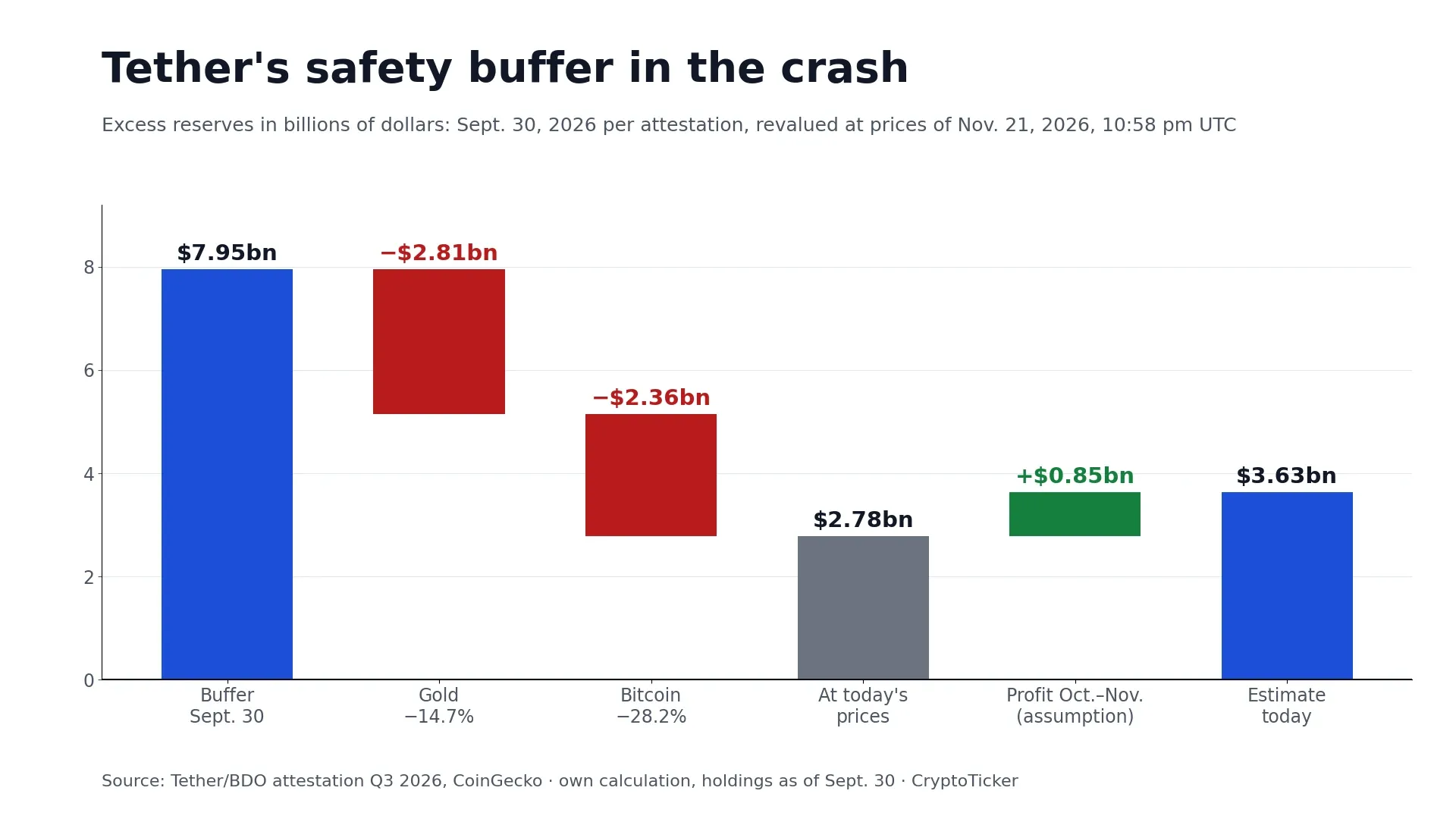
Our calculation uses the holdings reported for September 30. Tether publishes its reserves only once a quarter, so purchases or sales since then are not visible; the next report covers December 31. With that caveat, the math looks like this: at today's prices, gold and bitcoin on Tether's balance sheet are worth about $22.3 billion together. Another fall of 12.5% would wipe out the buffer without new profits, about 16% with the assumed profits. BLADE's threshold is therefore roughly right, but measured from today's level, not from September. Secured loans of $14.2 billion and other investments, whose market value is not published, add further uncertainty.
S&P Global Ratings kept USDT at its weakest stability score of 5 ("weak") in an assessment dated November 18. Higher-risk assets such as bitcoin, gold, secured loans and other investments made up 28% of the reserves as of September 30, up from 24% a year earlier, and a sharp fall in their value could leave USDT under-collateralized, the agency warned, according to crypto.news. Tether rejects the assessment and says the weakness lies in S&P's methodology, not in its reserves. S&P itself acknowledges that USDT has a strong record of holding its dollar peg.
Under-collateralized would not mean that USDT stops working. About 72% of the reserves are in lower-risk assets such as Treasury bills, cash and repos, which can be sold quickly, and redemptions are paid from them. That is happening right now: USDT's market value has fallen to $174.5 billion according to CoinGecko, about $9 billion below the tokens outstanding at the end of September, while the token trades at $0.9985. The real risk is a loss of confidence that triggers redemptions faster than the liquid reserves can be turned into cash. For investors in the EU there is a second point: USDT is no longer traded on licensed exchanges in the European Economic Area because Tether has not obtained authorization under the MiCA regulation.
Kraken: bitcoin for C$24,250, and the trades stand
The Kraken story is true, with one important qualification. On the exchange's Canadian-dollar market, bitcoin traded far below its price elsewhere from Friday afternoon onwards. On Saturday, the BTC/CAD pair touched C$24,250, about 71% below the converted market price, CryptoSlate reported based on Kraken's public trading data. Converted, that is roughly $16,900. The X user greb wrote that he had bought at the equivalent of $27,000 and withdrawn the coins; his post has been viewed more than a million times.
Kraken said orders were processed correctly, its security team found no sign of a breach or compromised accounts, and executed trades would stand, according to CryptoSlate. The exchange attributed the dislocation to heavy selling across its Canadian-dollar pairs. Bitcoin's US-dollar price did not fall below $55,711 that day, according to CoinGecko. The lesson for traders: on smaller currency pairs, order books can be thin, especially at weekends, and a market order can be filled far from the fair price in either direction. A limit order sets the worst price you are prepared to accept.

Paper bitcoin: is the supply really unlimited?
The longest of the posts, from the account 0xNobler, argues that ETFs, futures, perpetual swaps, options and lending have broken bitcoin's two founding principles: the hard cap of 21 million coins and the absence of rehypothecation, meaning the reuse of the same collateral for several claims. Paper bitcoin exposure has become "practically infinite", the post says. DigiByte founder Jared Tate shared a similar thread with the comment that the original bitcoin thesis is dead.
The numbers do not support "infinite". On Saturday evening, open derivatives positions at Deribit, Binance, CME, Bybit and OKX added up to 751,252 BTC, or 3.7% of the 20.1 million bitcoin mined so far, as we calculated in our analysis of the November 27 options expiry. The count misses over-the-counter swaps and loans, which are not published, so the true figure is higher. Spot ETFs, however, hold real coins in custody, and futures are bets in which every long position is matched by a short one. They do not create new coins.
Where the posts have a point is price formation. With leverage, far more money can bet on the price than coins actually change hands, and forced liquidations amplify every move. Jim Bianco, founder of Bianco Research, has called this a "pseudo-fractional reserve system", while Shresth Agrawal of Pod Network counters that derivatives are zero-sum bets and not an unlimited supply, both quoted by Cointelegraph Magazine. The same leverage works upwards too: on Saturday, bitcoin climbed back above $60,000 within hours of its low.
Monday warning: what is true in the macro claims
The second 0xNobler post lists eight crises that, it says, are merging into the biggest financial collapse in history. Several of the individual facts check out:
- Nvidia: The stock closed on Friday at $125.53, down 14.0% on the day, after Reuters reported, citing two people briefed on the matter, that SEC enforcement staff are examining possible accounting issues. The SEC declined to comment, and an investigation is not evidence of wrongdoing. That leaves Nvidia 47.5% below its record close of $239.24 on October 6, more than the 40% in the post. Details are in our report on Nvidia and the memory chip crash.
- S&P 500: The index fell 3.7% to 6,910 points on Friday, 11.6% below its record close of about 7,819 on October 6, according to InvestmentNews. That is a correction, not the fastest crash in history: in early 2020 the S&P 500 lost about a third of its value in just over a month (overview). The Nasdaq has erased its entire gain for 2026, as our AI bubble report shows.
- US Treasuries: According to the TIC data for September, published by the US Treasury on November 18, Japan's holdings fell by $5.2 billion to $1.063 trillion, the fifth monthly decline in a row, and China's by 4.5% to $563.9 billion, the lowest level in more than 18 years. The selling has been going on for months. There is no evidence of a coordinated dump planned for next week. The October figures are due on December 15, and the yen side of the story is covered in our piece on the Bank of Japan and bitcoin.
- Midterms: Democrats won control of both chambers of Congress on November 3, as the Washington Examiner summarizes. Trump has said he will use his veto against Democratic bills.
- Iran: The war that began on February 28 continues. In mid-November Trump said the US does not need a deal with Iran, and oil swung between roughly $86 and $96 a barrel, according to Energy Connects.
- Asia: On Friday, Taiwan's main index fell 6.2%, Korea's Kospi 5.2% and Japan's Nikkei 5.1%. Shares of China's star AI companies have lost up to 70% from their highs, TechNews reported, but that applies to individual names, not to the market as a whole.
Our assessment: the facts describe a real sell-off across several asset classes, from chip stocks to gold. The conclusion that the largest financial crisis in history has begun does not follow from them. In the 2008 financial crisis, the S&P 500 lost more than half its value; today it is 11.6% below its record. Whether Monday will be a bad day cannot be known in advance. Anyone who claims to know is making a forecast, not reporting a fact.
Bitcoin this week: what is actually on the calendar
- Monday, November 23: Wall Street opens after Friday's sell-off, and ETF flows resume after a month in which US spot bitcoin ETFs lost more than $3.4 billion, as our analysis of the ETF outflows shows. Deribit's daily expiry is small at 4,042 BTC.
- Thursday, November 26: US stock exchanges are closed for Thanksgiving, according to the NYSE, so there are no ETF flows that day.
- Friday, November 27: At 08:00 UTC, options on 112,323 BTC, worth about $6.8 billion, expire on Deribit. Max pain sits at $73,000. The CME's November bitcoin futures expire the same day, and the NYSE closes early at 1 pm ET.
The post by Alex Mason puts the Friday expiry at $8.34 billion. The difference comes from the time of measurement, the bitcoin price used and which venues are counted; the date is right.

How to read crash warnings on X
Several of the posts follow the same pattern: capital letters, "you MUST read this", the claim that 99% of people will lose everything, the assertion that the author has called every top and bottom for a decade, and a request to follow and turn on notifications at the end. Posts like these are written for reach. That does not make every warning wrong: BLADE's Tether figures come from Tether's own report and are backed by S&P's assessment, and the Kraken story was real. The test is always the same: is there a primary source, a number with a date and a calculation you can follow? Without them, a post is an opinion.
For USDT holders, the most useful number is the buffer, not the headline. It is smaller than in September and shrinks further with every fall in gold and bitcoin. In the EU, licensed exchanges list stablecoins authorized under MiCA, such as USDC and EURC. Where to trade them, with fees and regulation, is shown in our crypto exchange comparison and our crypto broker comparison.
0
0


 Manage all your crypto, NFT and DeFi from one place
Securely connect the portfolio you’re using to start.
 Where will Bitcoin trade next?
Live Polymarket and Kalshi odds on Bitcoin price targets, compared side by side.
See Bitcoin price odds


