
Starshield disruptions in Ukraine test Europe's bid to rival Starlink

1
0

When Starshield connections slowed down this month, Ukrainian commanders said that armed drones fell out of the sky. The failure also revealed a problem for Europe. It wants to lessen its dependence on American satellite services but does not yet have its own systems that would be able to replace them.
When the drones fell from the sky
Oleh, one of the commanders, stated in an interview with The New York Times that he witnessed many of the drones crashing after the pilots lost contact with the machines. He claimed that they lost more than $1 million. The unit he commanded reduced operations for three days.
Brig. Gen. Andriy Biletsky said drones that previously maintained connections at 250 mph now lose them above roughly 100 mph. This has affected Ukraine’s ability to intercept fast Russian attack drones.
It is unclear who gave the command to restrict access to Starshield in Ukraine. President Donald Trump claimed that he had nothing to do with that. Secretary of State Marco Rubio insisted that SpaceX controls the access. Meanwhile, President Volodymyr Zelensky described what happened as a premeditated move.
A gap Europe cannot close quickly
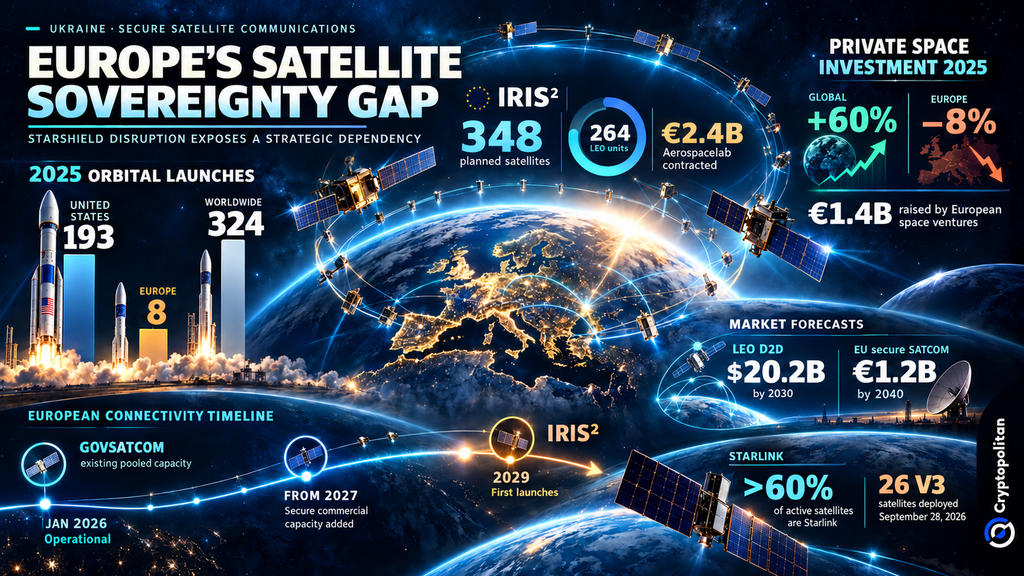
The closest option for Europe is GOVSATCOM, which was launched in January 2026. It integrates existing satellite capacity of European countries.
However, full access to GOVSATCOM is not yet available to Ukraine. The EU made a decision to start negotiations on this in March, but the issues related to sensitive military services are still unresolved.
Secure commercial capacity is expected to join GOVSATCOM from 2027. The European Commission has stated this is not a direct replacement for Starlink. They also could not verify the information about Starshield outages.
IRIS² is still years from orbit
Europe’s long-term response is IRIS². In August, an agreement was made for the creation of 348 satellites. The first launches will occur in 2029, and secure services will come later.
Manufacturing is already starting. Aerospacelab in Belgium has successfully acquired a contract for the production of 264 low-earth orbit satellites for €2.4 billion.
Sending them into orbit is an entirely different difficulty. While Europe produced 8 of the 324 space launches globally in 2025, the United States made 193.
Creotech Instruments’s chief executive, Grzegorz Brona, raised concerns that Europe could be in a position to create thousands of satellites but fail to find adequate space rockets to transport them.
The money problem behind the sovereignty pitch
Funding presents another obstacle. ESA reported a 60% surge in global private space investment in 2025. European ventures, meanwhile, raised €1.4 billion, down 8%.
SpaceX continues expanding. On September 28, it deployed 26 Starlink V3 satellites.
Four European telecom companies are exploring a joint spectrum bid that would leave spacecraft to an outside partner. Europe could retain control over ground operations while remaining dependent on another satellite provider.
The market offers room for growth. Gartner expects the global direct-to-device market to reach $20.2 billion by 2030. EUSPA projects nearly €1.2 billion in annual secure satellite communications revenues from EU users by 2040.
But market demand alone cannot deliver independence. Europe still needs the investment and launch capacity to turn its satellite plans into working infrastructure.
If you're reading this, you’re already ahead. Stay there with our newsletter.
1
0

 Manage all your crypto, NFT and DeFi from one place
Securely connect the portfolio you’re using to start.


