
XRP price prediction: Swell week starts at a 30-day low of $1.29

0
0

What is documented: Ripple holds its in-house Swell conference in New York from October 27 to 29, 2026, by its own announcement with more than 80 sessions, over 100 speakers and more than 1,500 attendees. On Wednesday, October 28, the US Federal Reserve publishes its rate decision at 7 p.m. German time. XRP trades at $1.29 on Monday morning, around 1.15 euros. Our assessment of that follows further below: the conference delivers headlines, the rate decision moves the entire market on the same day, and at the last Swell in November 2025 XRP lost 12.6 percent within two days.
If you hold XRP, you have two dates in the calendar this week, and both fall on the same Wednesday. Where the price can point over a horizon of months is set out in our XRP price prediction. This piece stays with the next three days and with the figures that can be measured today.
Swell 2026 in New York: 80 sessions from October 27 to 29
Swell is Ripple's own industry conference, where the company has brought together banks, payment providers and supervisors since 2018. This year's venue is The Shed in Hudson Yards in Manhattan. On the official event page Ripple names three stages, more than 80 sessions and over 100 speakers, among them Brad Garlinghouse as well as representatives of BNY, Robinhood and ICE.
The agenda lists capital markets and settlement, stablecoins, tokenisation, payments, regulation, privacy and the utility of XRP. For October 28 a conversation is announced between David Schwartz, CTO Emeritus at Ripple, and Ayo Akinyele of RippleX, which is to turn on privacy, artificial intelligence and institutional DeFi.
Important for the context: Ripple has so far confirmed no product announcement for the three days. Historically, new services have been presented at Swell on several occasions, but there is no guarantee of that this year. Price in an announcement and you are trading on an expectation, not on a fact.
XRP at $1.29: the day's low sits at $1.27
On Monday morning, October 26, XRP stands at $1.29. Over the past 24 hours the price moved between $1.27 and $1.31, leaving it down 0.6 percent. On a weekly view 1.8 percent is missing, over 30 days it is 16.9 percent. The high of the past 30 days came on September 26 at $1.57, and today's level is at the same time the 30-day low. Market capitalisation stands at $81.7 billion, daily turnover at $1.09 billion, and XRP ranks fifth by market value. In circulation are 63.35 billion of the 99.99 billion XRP created in total. All figures come from CoinGecko.
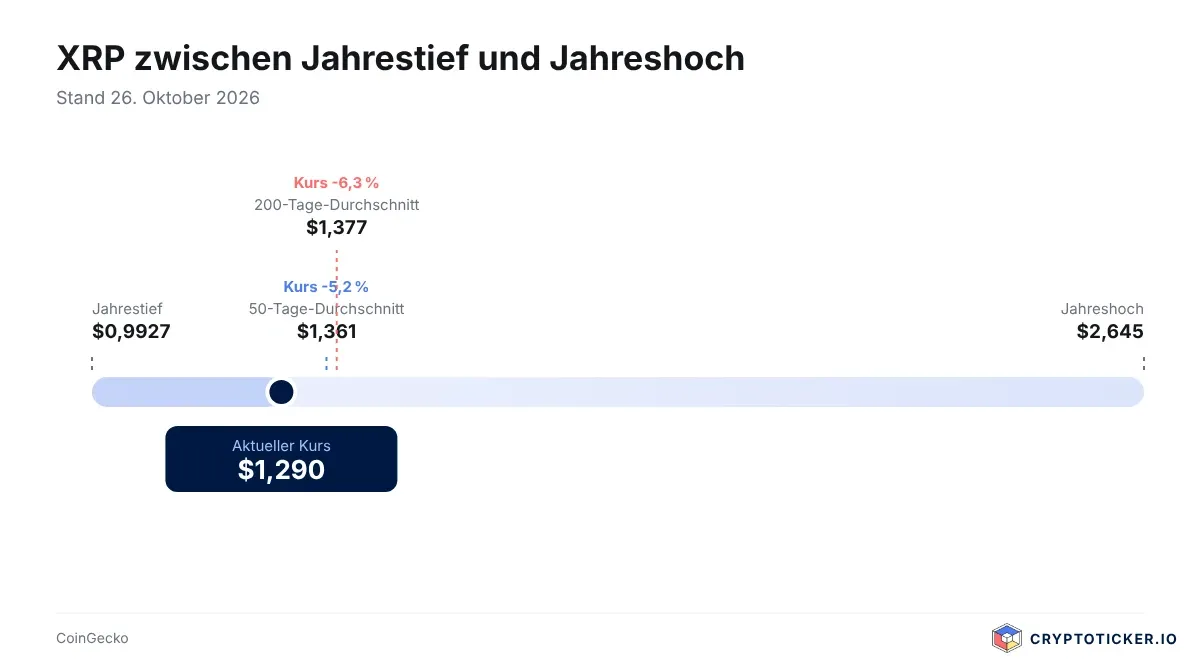
Two levels matter more for the coming days than today's price. On the downside the day's low sits at $1.27, a good 1.5 percent below the current price. Should that zone withstand the rate decision, the tight range of the past week stays intact. On the upside the 200-day average runs at $1.38 and the 50-day average at $1.36. Both lie above the price, which is therefore 6.3 and 5.2 percent below them. As long as XRP stays under those two lines, every recovery is technically a counter-move in a falling market.
A look at the full year puts that in order: the low for the year is $0.99, the high for the year $2.65. From the record of $3.65, reached on July 17, 2025, XRP is 64.6 percent away. The chart below shows where the current price sits between those two ends.
What has changed since Sunday
On Sunday, our XRP analysis of October 25 centred on the shrunken daily range: 1.54 percent between high and low, a figure that speaks for calm ahead of a date. That calm is over. Between $1.27 and $1.31 lie around 3.1 percent today, so the range has doubled within a day.
The environment has shifted as well. Bitcoin trades at $80,271 on Monday morning, 0.2 percent lower than the previous day, Ethereum at $2,329. The broad market therefore enters the week weak, and XRP is holding marginally better than the two larger assets. The price itself, at $1.289, is only 0.7 percent below Sunday's level.
Fed decision on Wednesday at 7 p.m.: two dates on one day
The Federal Open Market Committee meets on October 27 and 28 according to the official meeting calendar. The decision is published on the second day at 2 p.m. New York time, which is 7 p.m. in Germany. The statement therefore lands in the middle of the second conference day of Swell.
The link to XRP runs through interest rates and not through the blockchain. If the policy rate falls, fixed-income investments become less attractive and capital tends to move into assets without a running yield. If the rate stays high or the central bank signals a pause, the calculation reverses. Crypto does not react to the resolution alone, but to the deviation from what was expected. That deviation cannot be measured beforehand.
In practice, that means two streams of news meet on Wednesday evening, one monetary and one corporate. For the price it is an hour with thinner order books and larger jumps, and that holds even when both pieces of news turn out friendly taken on their own.

Swell 2025: XRP lost 12.6 percent in two days
A look back helps with the context, even though a single case makes no rule. Swell 2025 took place on November 4 and 5, 2025 at Convene Hudson Yards in New York. By our analysis of CoinGecko daily data, XRP cost $2.53 on November 3, 2025, the day before the conference. On November 5, the second conference day, it was $2.21. That is a loss of 12.6 percent in two days.
A week later, on November 12, 2025, XRP traded at $2.39 and thus 5.4 percent below the level of the day before the conference. The price made up part of the decline without reaching its starting level. The market was weak overall at the time, and the fall cannot be attributed to the conference alone. As a guide to expectations it still serves: an in-house conference did not carry the price last year.
Sell the news: how a conference works on the price
Sell the news describes the case in which an expected event is priced in before it happens and the price falls afterwards, even though the news itself turns out positive. The mechanism is simple: whoever speculates on an announcement buys in advance. Once it arrives, the buyers who would carry the next step are missing, and the first profit-taking meets a thin order book.
With a conference a further feature comes in. The announcements almost always concern the commercial side of Ripple, meaning payment settlement, custody or the RLUSD stablecoin. Whether such business generates demand for the XRP token depends on whether XRP is genuinely needed as a bridge currency in settlement. A partnership that builds on RLUSD uses the blockchain but touches the token itself only indirectly. That distinction is worth reading for on Wednesday.
RLUSD and MiCA: the stablecoin is missing from the ESMA register
RLUSD is the stablecoin issued by Ripple, pegged one to one to the US dollar and running both on the XRP Ledger and on Ethereum. Ripple puts the market capitalisation at more than $2.5 billion, of which over $1 billion sits on the XRP Ledger. That is a company figure and not an independently audited one.
According to statements by Ripple and Cross River Bank on October 15, the US bank is embedding RLUSD into its own core banking system so that payment providers can switch between dollars and RLUSD without operating a blockchain connection themselves. The service is available at first in a portion of the US states. In October, Standard Chartered additionally started institutional custody of RLUSD on the XRP Ledger, supervised by the financial regulator in Dubai.
For investors in Germany the decisive point is a different one. In our stablecoin overview, with the register as at September 30, 2026, RLUSD is absent from the register of the European securities regulator ESMA, as are USDT and PYUSD. Under MiCA an e-money token may be offered in the EU only if an authorised issuer stands behind it and a whitepaper has been notified. Concretely: on an exchange with a MiCA licence you will not currently find RLUSD on offer, and a piece of news from New York does not change that in the short term.
How to check your XRP position before Wednesday
Ahead of a date with a known time, three things can be looked up concretely without you having to predict a direction.
First, the order type. A market order in the minute after 7 p.m. is executed at the price then standing in the book, and with thin books that sits noticeably away from the one last seen. A limit order names the price at which you are willing to buy at most or to sell at least. Second, leverage. If you hold XRP on leverage, you should know the liquidation price of your position and hold it against the day's low of $1.27. Leverage of five liquidates arithmetically on a decline of 20 percent, and earlier still once a safety buffer and fees are deducted. Third, the trading platform itself. A provider with a licence under MiCA is subject to obligations on custody and on complaint handling that a provider without EU authorisation does not carry. Where German investors trade and at what cost is shown by our comparison of crypto exchanges.
A fourth point concerns custody. Holders who want to keep XRP for longer do not need to leave the balance sitting on the exchange. A wallet of your own costs fees on withdrawal, but in exchange it takes the provider's risk out of the calculation. The XRP Ledger requires a minimum reserve per account, which you should plan for before the transfer.
Holding period and tax: what applies in Germany after one year
Gains from the sale of XRP count in Germany among private disposal transactions under section 23 of the Income Tax Act. If more than a year lies between purchase and sale, the gain stays free of tax. Within the year an exemption threshold of 1,000 euros applies to all private disposal transactions together. Once it is exceeded, the entire gain becomes taxable and not only the part above it. For allocating acquisition costs the first in, first out method applies, so the holding bought first counts as the one sold first.
If you are weighing a sale before Wednesday, the purchase date is therefore the first thing to look up. A sale a few days before the one-year deadline runs out can prove more expensive than the price move that triggers it. Whether the holding period survives in this form is politically contested; we track the current state of proceedings in our overview of the reform of the crypto holding period.
Our assessment of Swell week
From the point of view of the editorial team, the calendar risk outweighs the news value of the conference this week. Three pieces of evidence speak for that: at the last Swell on November 4 and 5, 2025, XRP fell by 12.6 percent; the price today, at $1.29, sits below both moving averages at $1.36 and $1.38; and the rate decision on Wednesday at 7 p.m. hits the whole market harder than any single partnership. Against it speaks the fact that Ripple has two integrations to show this year, with Cross River and Standard Chartered, which go beyond a letter of intent, and that a product announcement on stage can turn sentiment in the short term.
What follows from that is no directional bet, but a question of scheduling. If you intend to buy or sell in any case, you can avoid Wednesday evening and trade on Thursday with more information. A total loss is possible with crypto assets at any time.
Swell and the Fed: without inflows, $1.38 stays the ceiling
- Check today which platform your XRP sits on and whether it holds a licence under MiCA. The costs and licences of the large providers are set out in the comparison of crypto exchanges.
- Ahead of a possible sale, look up the purchase date and the one-year deadline. Which programs calculate holding period and exemption threshold automatically is shown by the comparison of crypto tax tools.
- If RLUSD is familiar to you from the reports: check which stablecoins are authorised in the EU at all before you use one of them as a parking spot. We track the register status in our stablecoin overview.
(As of October 26, 2026. This article is not investment advice. Prices and fee structures change; check the terms with the provider before you buy.)
0
0

 Manage all your crypto, NFT and DeFi from one place
Securely connect the portfolio you’re using to start.


