
Why a Firmware Fix Can’t Save a Weak Wallet Seed: Coldcard Lesson

0
0
A Hardware Wallet Built for Safety Still Lost Millions
A weak wallet seed can drain a hardware wallet even when the device never leaves its owner’s hands, and the Coldcard incident of 2026 showed exactly that. Attackers began emptying bitcoin wallets on July 30, 2026, after a firmware flaw from March 2021 made some recovery phrases guessable.
This article explains the flaw, the latest Coldcard hack update, and the steps that matter, using public research reviewed on October 28, 2026.
What Is a Weak Wallet Seed and Why Does It Matter?
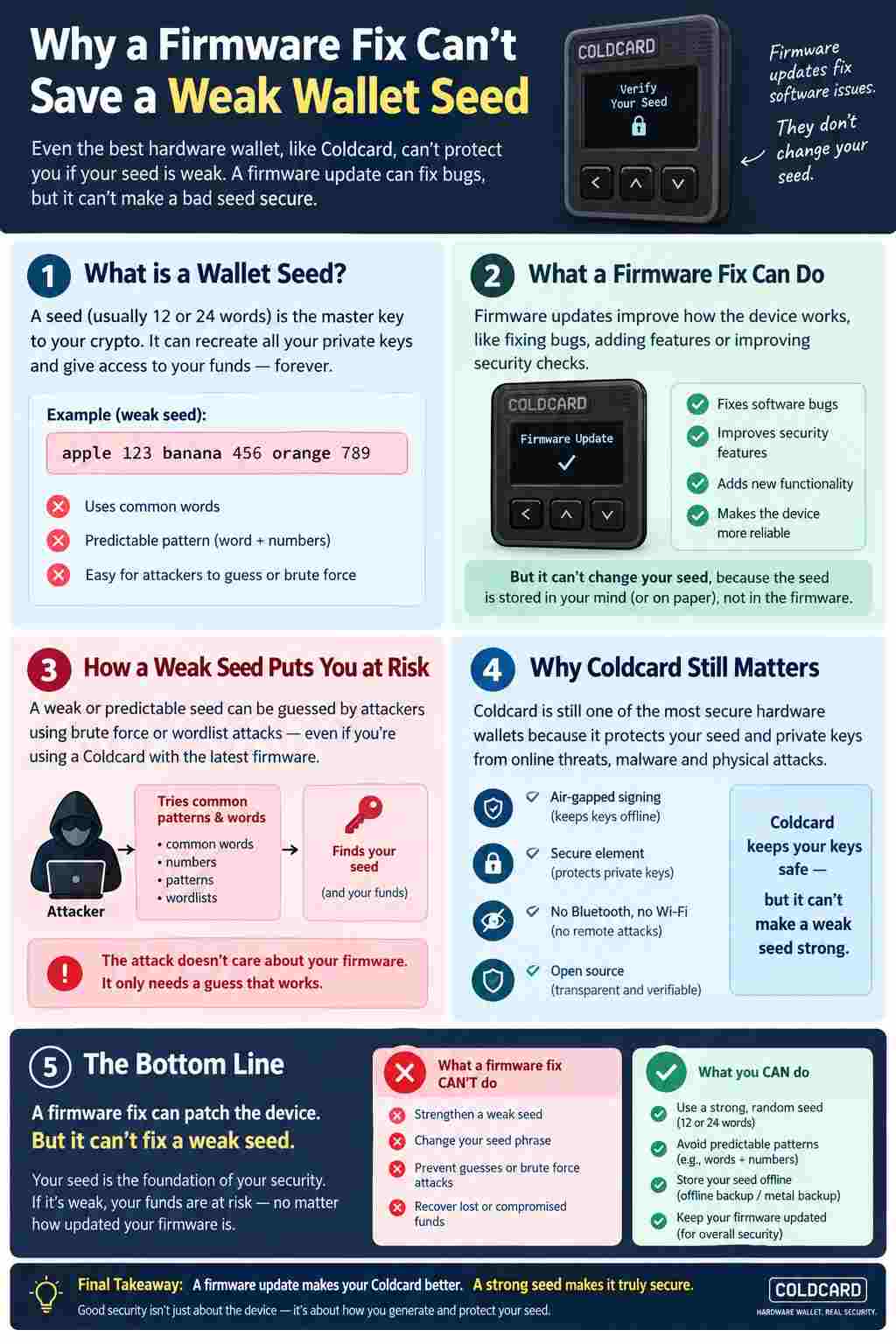
A crypto wallet seed phrase is a list of 12 or 24 words that works as the master key to every coin in the wallet, so the words must come from truly random numbers that nobody can predict.
Randomness in computing is called entropy, and a 12-word phrase should carry 128 bits of it, which is more possibilities than any computer could check. A weak wallet seed carries far less entropy than it should, so an attacker can generate every candidate phrase offline and test each one against the public blockchain.
How Did the Coldcard Vulnerability Happen?
Coldcard devices contain a dedicated chip built to produce true randomness for seed creation.
A build setting in firmware released in March 2021 left that chip out of the process, so wallet creation drew numbers from a simple software formula seeded by the device serial number and the clock.
A safety check in a supporting library tested only whether the setting existed, not whether it was switched on.
One research report estimates that effective randomness fell from 128 bits to somewhere between 32 and 40 bits, a range that ordinary computers can search without touching the physical device.
Which Seeds Were Affected?
Coinkite’s advisory says seeds created on Mk2 and Mk3 firmware from version 4.0.1 through 4.1.9 are at risk, and the list of affected models later grew, so the maker’s current advisory should be checked for the full range.
| Seed Type | Status |
| Created on affected firmware, no extras | At risk |
| At least 50 fair private dice rolls | Not affected by this flaw alone |
| Strong, unique passphrase added | Extra layer of protection |
Dice rolls are physical random numbers entered by the owner and mixed into the seed, while a BIP-39 passphrase is an optional extra word that creates a separate wallet.
What Does the Coldcard Wallet Hack Timeline Show?
The first wave on July 30, 2026, emptied roughly 1,200 addresses in about 41 minutes, according to blockchain analysts, and later waves pushed published loss estimates from about $88 million to more than $115 million, depending on the source.
One research firm says victims reported missing coins from Coldcard wallets as early as 2024, while Coinkite halted shipments after confirming the issue, and law enforcement authorities are reportedly working to identify those responsible.
Why Does a Firmware Update Not Fix a Weak Wallet Seed?
A firmware update changes how new seeds are made, but it cannot rewrite a seed that already exists. The words on paper or steel stay identical, so a weak wallet seed remains tied to the same funds, and restoring an old wallet onto a patched device does not help because the restored phrase is still the old phrase.
Coinkite’s guidance is to update first, generate a brand new seed, verify the backup and a receive address, send a small test transaction, and only then move the remaining balance, because a patch protects only wallets created afterward.
What Is the Latest Coldcard Hack Update?
Coinkite released a firmware update on August 21, 2026, after a three-week security review that went beyond the original seed flaw, and the new process asks owners to add their own randomness to the entropy produced by the device.
Later versions followed, including 5.6.1 for Mk4 and Mk5 and 1.5.1Q for the Q model, yet none of them repairs seeds created on older firmware.
Do Crypto Wallet Leaks Put a US Government Crypto Wallet at Risk?
The phrase "crypto wallet leaks" usually describes exposed seed phrases, but here the phrases were never hidden well enough to begin with.
No public report reviewed for this article ties a US government crypto wallet to the Coldcard flaw, although the US government holds bitcoin in a reserve created by executive order, which shows why any institution needs independent checks on how its keys are generated.
Expert Take: What Should Readers Watch?
The stronger signal is that the failure came from a quiet build setting, and a weak wallet seed produces ordinary words, so neither owners nor auditors could spot the problem from outside.
The biggest unknown is how many affected seeds remain unmoved, since every unmigrated wallet stays exposed until its funds leave it. Readers may want to verify three items before assuming safety:
-
The firmware version used when the seed was created
-
Whether dice rolls or a seed passphrase were part of setup
-
Whether funds moved to a freshly generated seed after patching
Conclusion: Patches Cannot Repair an Old Seed
The Coldcard case shows that a weak wallet seed is a permanent flaw rather than a bug that disappears with an update, because the damage is stored in the words themselves.
That flaw sat unnoticed for five years, and the fix helps only wallets created after it, while the final loss figure and the number of unmoved seeds remain uncertain. Owners of any hardware wallet may want to confirm how their seed was created and read the maker’s latest advisory.
Disclaimer
This article is for informational purposes only and is not financial, investment, or security advice. Crypto assets are volatile and carry a high risk of loss, so readers should research independently and consult a qualified professional before making decisions.
0
0

 Manage all your crypto, NFT and DeFi from one place
Securely connect the portfolio you’re using to start.
 Where will Bitcoin trade next?
Live Polymarket and Kalshi odds on Bitcoin price targets, compared side by side.
See Bitcoin price odds


