
HYPE Token Slumps 40% From Peak as Trump Rally Fades

0
0
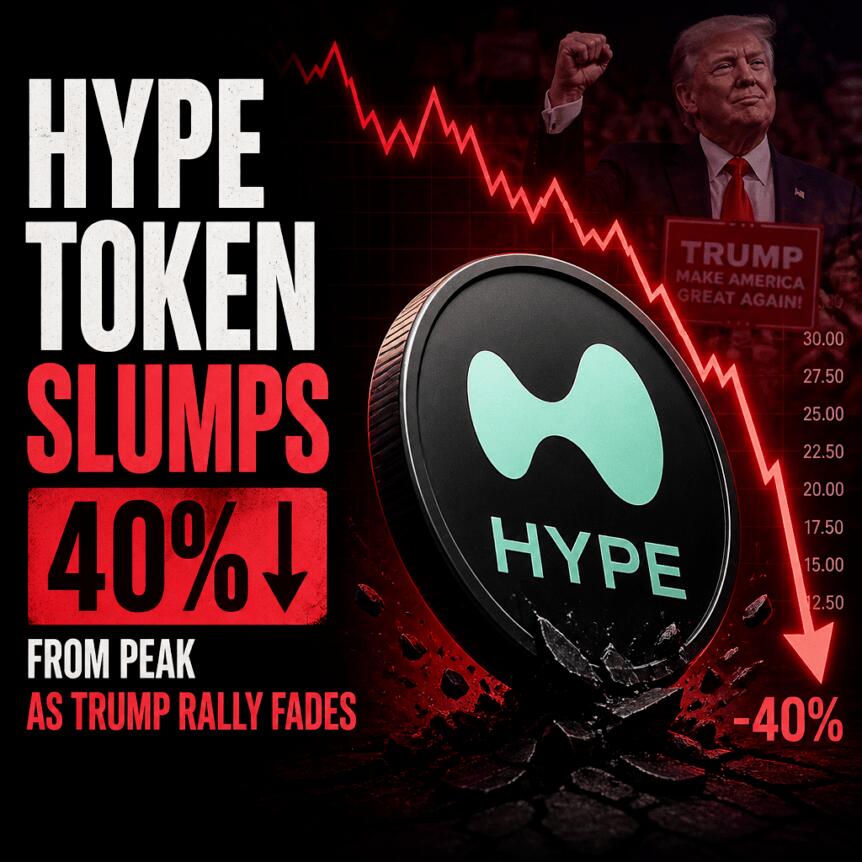
Hyperliquid’s native token HYPE dropped nearly 8% on Wednesday, slipping below its level prior to remarks from U.S. President Donald Trump about bringing Hyperliquid access to the United States. The move highlights how quickly narrative-driven momentum can fade in crypto markets, especially when it follows high-profile political signals.
According to CoinGecko, HYPE traded at $58.14 at the time of reporting, around 40% below its Sept. 23 all-time high of $97.96. Immediately before Trump’s comments, the token was trading around $62, underscoring a sharp shift in market pricing around the announcement.
Key takeaways
- CoinGecko data shows HYPE fell nearly 8% on Wednesday to $58.14, after trading around $62 before Trump’s remarks.
- HYPE remains about 40% below its Sept. 23 all-time high of $97.96, despite having surged earlier in 2026.
- Previous Trump and market-structure headlines referenced a path toward U.S. access and regulated perpetuals.
- Blockchain analytics reporting indicates wallets tied to Abraxas Capital exited Hyperliquid, selling 219,081 HYPE and buying ETH.
Trump remarks collide with a pullback in HYPE
The Wednesday decline comes after a run of attention around Hyperliquid’s potential to expand within U.S. market structure. On Aug. 19, Trump said that Commodity Futures Trading Commission (CFTC) Chair Michael Selig was working to bring Hyperliquid into the U.S. That kind of statement can quickly influence investor expectations in markets like derivatives, where regulation and venue availability matter directly to participation.
Earlier, on Oct. 29, HYPE reached toward its record high after Intercontinental Exchange (ICE)—the owner of the New York Stock Exchange—said it would seek approval for regulated Hyperliquid-based perpetual futures aimed at U.S. retail traders. Hyperliquid is widely known for its decentralized trading platform and layer-1 blockchain, particularly for on-chain perpetual futures.
While Wednesday’s price weakness doesn’t disprove the broader theme of U.S. access, it does show that traders may be re-pricing the timeline and certainty of those developments in real time. For holders, the key question is whether regulatory and venue progress continues to translate into sustained demand for HYPE or whether speculative enthusiasm fades between policy headlines.
Why U.S. access matters for Hyperliquid’s token
Hyperliquid’s product and token value proposition are tied to participation in its perpetual futures ecosystem. When discussions shift toward whether regulated perpetuals and U.S. accessibility can be achieved, traders often anticipate increased market activity, broader onboarding, and deeper liquidity—factors that can affect network usage and sentiment around the token.
The token’s recent history also helps explain the sensitivity. HYPE rallied from early-2026 lows near $20 to its September record, coinciding with Hyperliquid’s expansion beyond purely crypto-native audiences. The platform’s HIP-3 upgrade has been a central part of that narrative: HIP-3 has been live since October 2025 and allows participants who meet staking requirements to deploy perpetual markets for a wider range of assets.
In other words, the U.S. storyline isn’t only about regulatory permission; it’s about whether Hyperliquid can scale its offering within constraints that U.S. retail users face. That makes headline risk—both positive and negative—especially pronounced.
Analytics report: wallets linked to Abraxas Capital exit
Beyond political and market-structure headlines, on-chain activity also appeared to weigh on HYPE. Blockchain analytics account Lookonchain reported that wallets labeled by Arkham as belonging to Abraxas Capital exited Hyperliquid.
Lookonchain said the wallets sold 219,081 HYPE (about $13.25 million) and then bought 4,230 ETH (about $7.09 million). Such rotations can affect supply dynamics and market expectations, particularly when investors interpret wallet behavior as a signal about risk management or changing exposure levels.
Cointelegraph contacted Abraxas Capital to confirm the wallet attribution and the reported exit, but did not receive a response before publication. Attribution based on public labeling remains inherently uncertain, so readers should treat the report as indicative rather than definitive until confirmed.
Abraxas Capital Management, founded in 2002 and focused on digital assets since 2017, is London-based and is regulated by the UK Financial Conduct Authority, according to the article’s background. The firm’s institutional profile can make its trading patterns more closely watched by market participants—especially when activity intersects with a widely traded token like HYPE.
How regulation, upgrades, and capital flows are converging
Taken together, Wednesday’s price drop reflects a combination of narrative reversals and portfolio reshuffling. On one side, major U.S. political and market-structure announcements have previously helped lift HYPE. On the other, on-chain data suggests at least one institutional-linked set of wallets reduced exposure to HYPE while increasing ETH.
This convergence is important for investors because token momentum in ecosystems like Hyperliquid’s can be driven by multiple forces at once: expectations for regulatory access, product expansion via upgrades, and the real-time movement of large holders. When these factors don’t move in the same direction—say, when a headline raises expectations but wallet-level selling happens after—the result can be sharp volatility.
Hyperliquid has also faced scrutiny in its expansion efforts; a separate referenced item in the source material notes that Hong Kong regulators added Hyperliquid to a list of “suspicious” crypto platforms. While that background isn’t directly linked to Wednesday’s trade move, it illustrates that the path toward broader access is not purely technical—it involves ongoing regulatory assessments across jurisdictions.
Going forward, traders will likely watch for evidence that U.S. access developments progress from statements into concrete regulatory or venue timelines, while also monitoring whether large-holder behavior on-chain supports—or undermines—any renewed buying interest in HYPE. Until then, volatility around major announcements and wallet flows remains the most actionable signal for short-term direction.
This article was originally published as HYPE Token Slumps 40% From Peak as Trump Rally Fades on Crypto Breaking News – your trusted source for crypto news, Bitcoin news, and blockchain updates.
0
0


 Manage all your crypto, NFT and DeFi from one place
Securely connect the portfolio you’re using to start.


