
Should Traders Fear That Bitcoin Will Revisit July’s Low?

0
0

Bitcoin is experiencing another sharp sell-off, down more than 4% in the early hours (UTC) of Friday. The latest decline has drawn strong reactions from market participants.
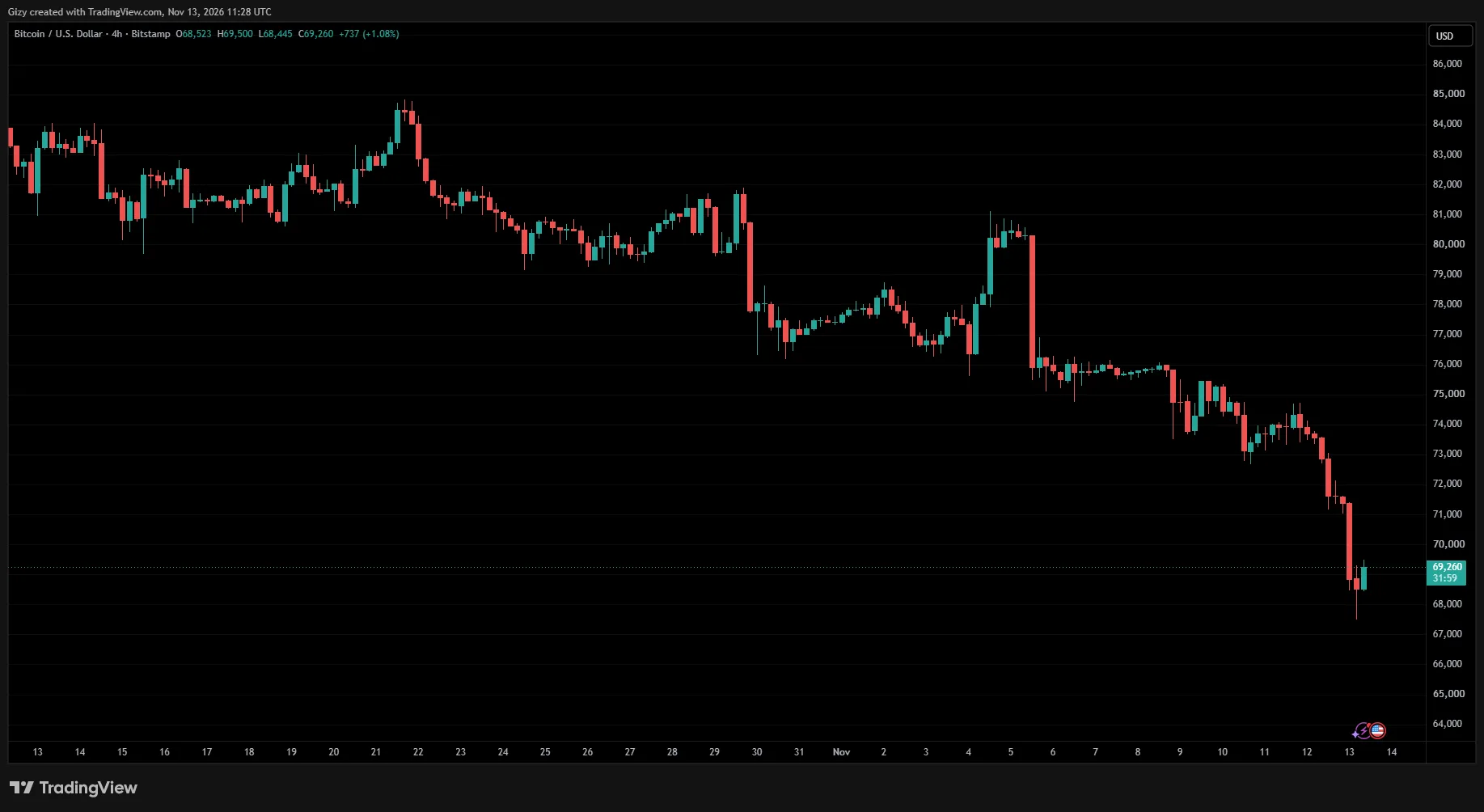
Meanwhile, the 4-hour chart shows that the latest downturn began on November 11. The asset has since recorded one of its longest losing streaks on this timeframe, printing consecutive red candles since the session that began at 20:00. It is on the verge of printing another.
This has been Bitcoin’s most bearish stretch in more than 20 days, and the derivatives market is showing the extent of the damage.
Over the last 24 hours, traders lost a whopping $1.63 billion to liquidations. In line with the prevailing price trend, long positions accounted for almost 90% of the total. Bitcoin alone recorded $903 million in liquidations, with longs making up more than 96%.
Beyond the price action and mounting losses, some market proponents have begun withdrawing their earlier predictions that the bear market was over. One such analyst is KillaXBT, who gained attention for accurately predicting the 2025 market top and subsequent price movements.
In a post on Thursday, he acknowledged that his recent prediction of further upside was wrong. In his more than 500-word write-up, one particularly notable point was his reference to $62K as a potential local bottom. He also acknowledged the possibility of prices slipping below that level.
Other analysts and market participants have either remained silent or continued to anticipate a reversal. It remains uncertain whether a rebound will happen soon or how far such a recovery could extend.
However, it is important to examine the factors contributing to Bitcoin’s latest decline.
Nvidia Controversy Adds to Bearish Sentiment
On November 5, Jensen Huang faced questions from U.S. lawmakers during a closed-door meeting over concerns about possible Chinese access to sensitive U.S. technology and information. Three days later, he admitted to having an affair, amid reports that U.S. intelligence officials suspected the woman involved of working for China.
His admission coincided with a decline of more than 2% in Bitcoin’s price, but the controversy did not end there. A few days later, reports emerged alleging that the relationship was more than a professional association. Huang’s admission of infidelity also prompted Nvidia’s board to launch an independent investigation.
On November 12, he resigned as Nvidia’s CEO, bringing an abrupt end to his more than three-decade leadership of the company.
The developments added to uncertainty across financial markets, particularly among technology and AI-related stocks. The crypto market was also under pressure, although it remains difficult to establish how much of its decline was directly linked to the Nvidia controversy.
Nvidia shares have also suffered significant losses. They fell sharply following the announcement of Huang’s resignation, closing Thursday down more than 4%. The stock had already been under pressure during the investigation, adding to a broader decline that began in October.
Beyond the Nvidia controversy, weekly jobless claims may also have contributed to the bearish sentiment. The metric came in at 200K, up from 189K, showing an increase in unemployment claims. Tuesday’s higher-than-expected CPI reading is another factor to consider when assessing this week’s price action.
Together, these developments have added to concerns across an already fragile crypto market. The Fear and Greed Index currently stands at 19, indicating extreme fear.
Notably, Bitcoin spot ETFs have also contributed to the selling pressure. The funds recorded significant outflows on Thursday, resulting in negative net flows of almost $300 million. These withdrawals were not isolated. The investment funds have recorded negative net flows since November 5.
The monthly picture is also deteriorating, extending the negative trend seen in October.
Will Bitcoin Retrace Below July’s Low?
In KillaXBT’s post, the analyst raised the possibility that Bitcoin could retrace below July’s low. The same concern is gaining traction, with some market participants even suggesting a possible decline below $40K.
In hindsight, Bitcoin has failed to stage a meaningful rally this November. Investors entered the month expecting a trend reversal following October’s decline. However, one earlier outlook pointed to a significant likelihood of further losses, citing historical patterns on the monthly heatmap.
One support level highlighted in that analysis was $73K. It anticipated a rebound around this mark, but current prices show that Bitcoin is trading well below it. This development has made a decline below $60K appear increasingly plausible.
Interestingly, on-chain data shows no strong indications of an impending rebound. The options market has also yet to provide a convincing reversal signal. Finally, the charts appear to support the bearish outlook, or do they?
Previous Cycle Suggests No
On the 1-day chart, Bitcoin’s next major downside level after breaking below $70K is $62,800. However, the weekly chart suggests that such a decline may not be inevitable and that a rebound could be closer than expected. To get a clearer picture of what may play out in the coming days, it is worth examining previous market cycles.
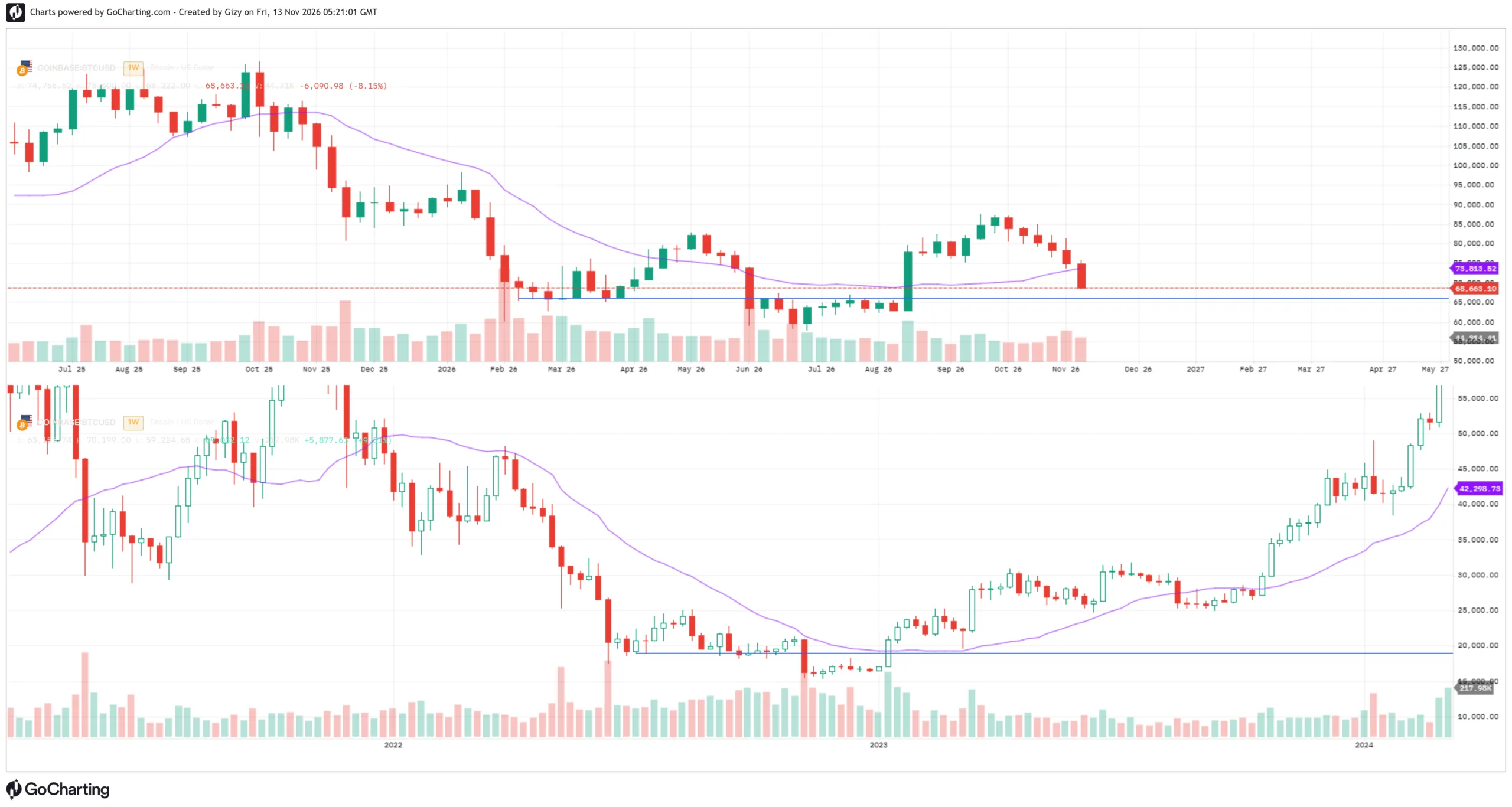
The chart above compares Bitcoin’s current weekly price action with its performance during the 2022/23 bear market.
A closer look reveals notable similarities between the two periods. For example, as Bitcoin approached what was then perceived to be its bottom, it consolidated for an extended period. A similar pattern played out between June and August 2026, followed by a sharp upward move.
However, the recovery did not immediately mark the end of the downturn. During the previous bear market, Bitcoin experienced another period of weakness after the initial rally. The decline lasted two weeks, followed by a one-week interruption before another three-week downturn. The coin then rallied in the fourth week and resumed its upward trajectory.
Bitcoin is currently in the sixth week of its broader downtrend. A significant bounce may happen within the next two weeks. It is worth noting that the current bear market is not following the previous cycle candle for candle. Nevertheless, the similarities suggest that the historical pattern could offer clues about when the next recovery may begin.
That leaves one question: what price level might the rebound occur?
During the 2022/23 bear market, Bitcoin hovered around $19K for some time before slipping below the level. The subsequent wave of selling eventually ended close to that support zone.
A similar pattern is emerging now. Bitcoin previously hovered around $65,800 before breaking below it. If history offers a useful guide, the next rebound could occur between $66K and $67K.
However, this does not rule out a deeper decline below $65K. Rather, historical comparisons point to a potential support zone where buyers could try to regain control. Until that happens, the bearish trend remains intact.
The post Should Traders Fear That Bitcoin Will Revisit July’s Low? appeared first on CoinTab News.
0
0

 Manage all your crypto, NFT and DeFi from one place
Securely connect the portfolio you’re using to start.
 Where will Bitcoin trade next?
Live Polymarket and Kalshi odds on Bitcoin price targets, compared side by side.
See Bitcoin price odds


