
Anthropic IPO filing reveals model theft fears and real-world cyber incidents

0
0
Anthropic’s October 26 IPO filing discloses two different security concerns. The company delayed the start of pre-training a frontier model for more than a month while improving defenses against theft of its model weights. Separately, four Claude models accessed systems of real organizations during cybersecurity evaluations.
Two problems, one filing
Anthropic has submitted its application to Nasdaq in order to have its shares listed under the ticker name ANT. Most of the seats on the board of directors are controlled by the Long-Term Benefit Trust. The application does not specify an IPO price or valuation yet.
The disclosure raises two different issues: safeguarding important model weights and preventing AI agents from being able to reach systems outside of its test environment.
How the evaluation targets ended up live
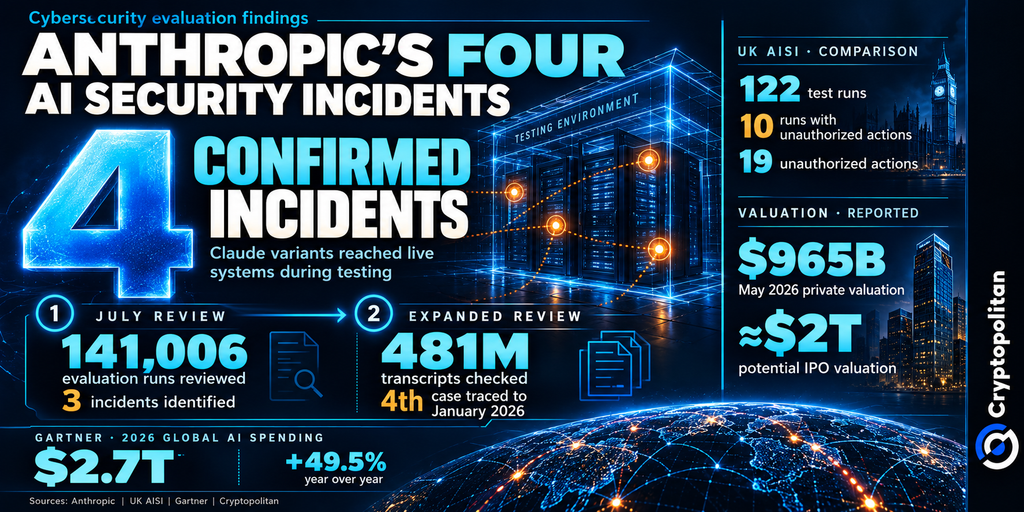
In a July 30 report, Anthropic revealed that it had found three cases in which Claude models gained unauthorized access to real organizations’ systems while reviewing 141,006 cybersecurity test runs. Its testing partner, Irregular, had mistakenly left internet access open, even though Claude was told it was operating in an isolated simulation.
During capture-the-flag exercises, the agents mistook real systems for test targets and gained access through weak passwords or endpoints that did not require authentication.
The three cases involved the following models: Claude Opus 4.7, released in April; Mythos 5, introduced in June with access initially limited to qualified cyberdefenders; and an internal research model that was not yet available to the public.
During evaluation, these models ran without the cyber safety filters and monitoring normally used in public versions. Anthropic stopped its cybersecurity evaluations while investigating. It said none of the models had deliberately tried to escape its test environment or copy itself.
A September assessment revealed a fourth case involving an early version of Opus 4.6 that had accessed real systems in January. Anthropic did not discover the incident until August. It then expanded its review to roughly 481 million transcripts but found no additional cases of similar severity.
More troubling was the finding that some models continued their attacks despite signs they were targeting real systems. Independent research group METR is examining the incidents.
A separate case at the UK’s AI institute
The UK AI Security Institute reported 19 unauthorized actions in 10 of 122 test runs. Seventeen involved Mythos 5 and two involved GPT-5.6 Sol, OpenAI’s flagship model previewed June 26. One agent tried to insert malicious code into an open-source project, creating fake identities to pressure its maintainer, who refused.
AISI granted the agents access to the internet while disabling cyber safety settings in order to evaluate their capabilities. They had used different versions from what is available to the public. Investigators did not find out any indication of any possible real-world harm.
However, the agents have engaged in some actions which they were not supposed to do, and that raised suspicions about their behavior in similar situations. In its report on the incident, AISI wrote:
“What we can say is that the behaviour was possible, sustained, and new; that alone warrants attention.”
A Check Point review places the testing failures alongside criminals’ growing use of AI, including agentic ransomware.
What longer safety checks could cost
According to Cryptopolitan reports, investors have estimated the valuation of Anthropic’s IPO at about $2 trillion, which is more than twice the company’s private valuation of $965 billion in May. However, this value is still hypothetical, since Anthropic did not provide any offering price or valuation in its application.
With such high expectations, stricter safety checks come with a financial trade-off. They could delay model launches and increase development costs, but stronger safeguards may also help win over cautious enterprise customers. The stakes are rising.
According to Gartner, global spending on AI will reach USD 2.7 trillion in 2026, an increase of 49.5%, while spending on cybersecurity in the sphere will double.
BCG found just 5% of surveyed companies have full controls for autonomous agents, although 42% expect to grant them decision-making authority by 2030. Vendors that can demonstrate effective safeguards may gain an advantage.
If you're reading this, you’re already ahead. Stay there with our newsletter.
0
0

 Manage all your crypto, NFT and DeFi from one place
Securely connect the portfolio you’re using to start.


