
Zcash vote from November 16: will 50,000 ZEC leave circulation?

0
0
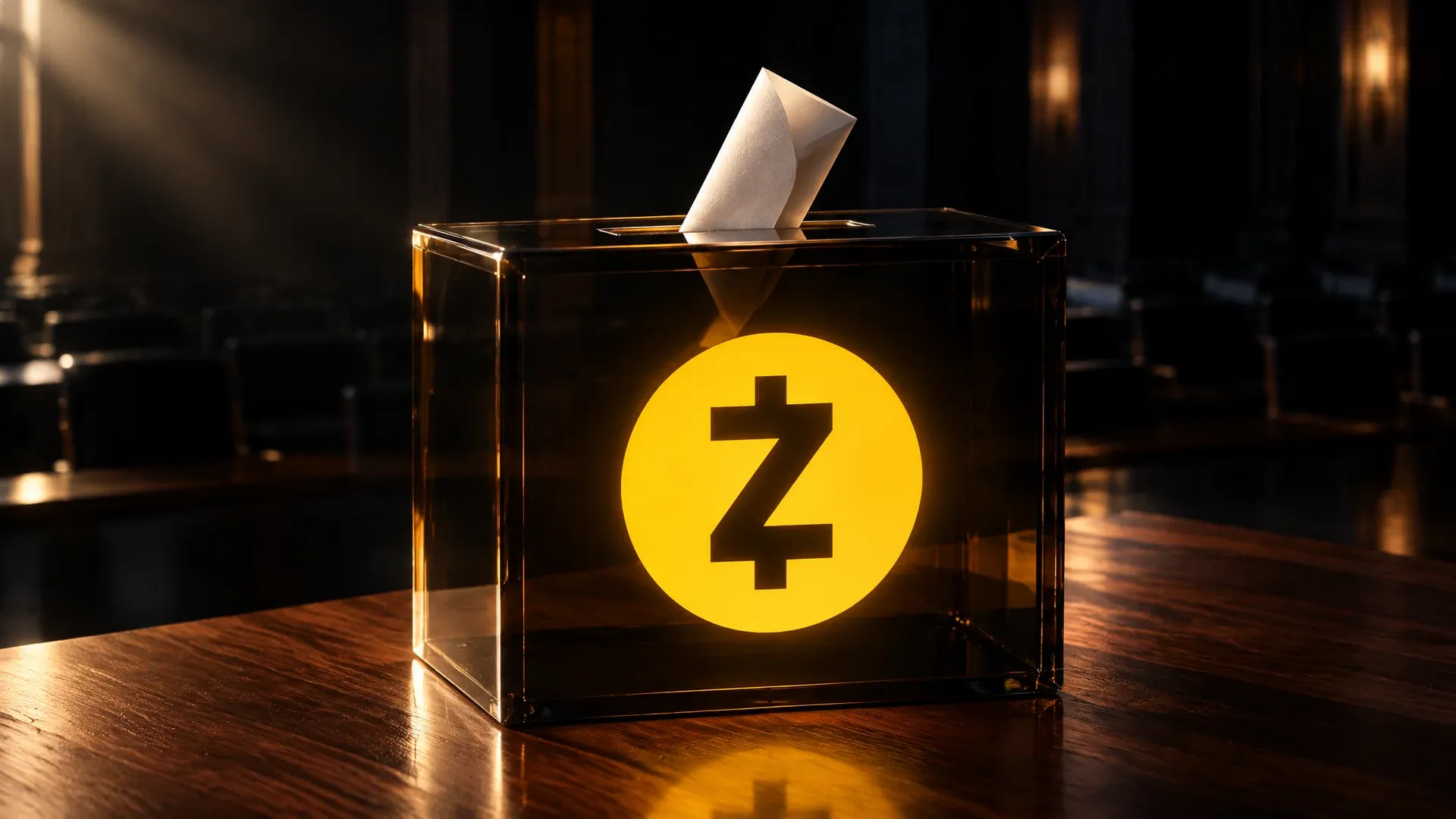
The Zcash vote on the blockchain's development funding runs from November 16 to November 30, 2026. ZEC holders with coins in a supported self-custody wallet can take part, as can several community panels. At its core, the vote concerns the Zcash Community Grants (ZCG) fund: should it stay as it is, be wound down, or hand over 50,000 ZEC that would then disappear from circulation? The result is a poll rather than a binding decision, but it will determine whether the next network upgrade, NU 7.1, happens at all.
For holders of Zcash (ZEC), the round matters in two ways. First, you can have a say as long as your coins are not sitting on an exchange. Second, the outcome changes supply: at Thursday's price of around $990, 50,000 ZEC are worth just under $50 million. This guide explains what is on the ballot, who is eligible, how voting worked in earlier rounds and what you can prepare before November 16.
What is on the ballot in the November Zcash vote?
The five organisations that jointly run the so-called coinholder voting chain set out the process on November 5 in the Zcash forum: Project Tachyon, Shielded Labs, Valar Group, the Zcash Foundation and ZODL. Proposals could be submitted until Sunday, November 8. Since then the community has been debating the questions on the ballot. Polling opens on Monday, November 16, and closes on Monday, November 30, at 23:59 UTC, which is 00:59 on December 1 Central European Time.
The organisers stress that the round only covers the ZCG share of the Dev Fund "for now". Larger changes to the protocol are out of scope. Two late proposals were therefore rejected, even though they arrived only a few hours after the deadline. The organisers say this was a matter of treating all submitters equally.
The pace is deliberate. According to the organisers, the timetable was accelerated because tensions in the community are running high and a drawn-out back-and-forth would deepen the divisions. The vote follows an open dispute: in early November, ZEC fell by double digits after the row over ZCG funding, and we covered the price drop on November 3. A day later the ZCG committee withdrew its own plan for 98,000 ZEC, as described in our report on the abandoned 98,000 ZEC plan. The November vote is meant to settle that dispute.
Dev Fund and ZCG: where the Zcash blockchain's funding comes from
The Dev Fund is the part of the block reward that does not go to miners but pays for the network's development. According to Shielded Labs, 20 percent of every block reward currently flows into this pool. Of that, 8 percentage points go to Zcash Community Grants and 12 percentage points to a programme whose allocation ZEC holders decide themselves, the retroactive coinholder grants. Under current rules this arrangement runs until the halving in November 2028.
Zcash Community Grants is an independent committee that awards grants to developers, wallet teams and projects in the ecosystem. Zcash founder Zooko Wilcox reminded the forum that for years ZCG helped fund the only working wallets as well as the technology behind coinholder voting. The problem is success: as the ZEC price rose, the fund grew so large that it became a point of contention. According to CoinDesk and the draft of the compromise proposal, the ZCG treasury held around 91,453 ZEC in October.
Why the treasury grew so large
ZCG receives its share in ZEC, not in dollars. When the price rises, the value of the treasury grows automatically, even if nothing more is spent. Critics argue that a small committee should not control a sum of this size. Supporters counter that the cushion is exactly what makes long-term projects possible. The options on the ballot sit between these two views.
Five questions on the ballot: dissolution, lockbox, ZAP, status quo and block time
On November 10 the organisers published a draft of the poll questions. Each question is answered separately with yes, no or abstain. You are explicitly allowed to support several proposals, even contradictory ones, as long as you would find each of those outcomes acceptable. The aim is to show which solution has the broadest support.
- Dissolve ZCG: the committee would be wound down, no new grants would be awarded and existing commitments would be honoured. After wind-down costs, the remaining funds would go to the Network Sustainability Mechanism. The author expanded the draft on November 11 so that the 8 percent stream would also be redirected.
- Future Dev and Legal Defense Fund: the compromise from Tachyon Group and Shielded Labs. ZCG's 8 percent stream would in future flow into a new lockbox, from which payouts are only made with community approval. ZCG would hand 50,000 ZEC to the Network Sustainability Mechanism and continue working with the rest of its treasury.
- Zcash Adoption Pool (ZAP): the treasury and the 8 percent stream would remain in place until November 2028, while the programme would get a new name and a funding focus on getting more people to hold ZEC or pay with it.
- Status quo: ZCG would keep its 8 percent share until the halving in November 2028, with its treasury and working methods unchanged.
- Shorter block time: an additional technical question on whether the target block time should fall from 25 to 20 seconds with NU 7.1.
The wording is not yet final. Several participants have criticised the descriptions in the forum as too loaded, for example the note that the compromise had prompted other authors to withdraw. A revised draft was announced for November 12. The order and number of questions may therefore still change before the start.
What the Network Sustainability Mechanism does with 50,000 ZEC
The Network Sustainability Mechanism (NSM) takes ZEC out of circulation and only pays them out to miners again later through the block reward. Think of it as a reserve that tightens supply today and helps fund network security in the distant future, when halvings keep shrinking the block reward. Holders already had a say in the NU7 round in September on when the NSM releases the coins it has collected.
For the supply question, this is the key point. 50,000 ZEC would be around 55 percent of the ZCG treasury as of October. These coins would not be sold or transferred to a recipient but retired. With around 17 million ZEC in circulation according to CoinGecko, that is just under 0.3 percent, a small share. It does carry a signal, however, because a grants fund that could sell its coins at any time is seen as a potential source of selling pressure. If part of it goes away, that concern eases.
A lockbox instead of a committee
In the Zcash context, a lockbox is a protocol-level account in which funds are collected but only paid out after a separate decision. The compromise would redirect the ongoing 8 percent stream into such a lockbox. Critics in the forum object that this only turns off one tap while the larger 12 percent stream keeps running. Supporters see precisely this as the advantage: in future, the community would decide on every payout itself.
Who can vote on Zcash: coinholders, ZCAP and community panels
There is no single vote but several parallel polls. Coinholders vote with their coins, on the basis of one ZEC, one vote. Community panels are polled as well, above all the Zcash Community Advisory Panel (ZCAP), a group of community members that the Zcash Foundation consults on governance questions. ZecHub and several regional Zcash communities also take part in such polls.
The status of the results matters. Shielded Labs stresses on its governance page that these are polls, not binding votes. Zcash has no on-chain mechanism that implements changes automatically. The results feed into rough consensus, meaning broad agreement across several groups. Forum participants pointed out that even all the polls together only reflect part of the stakeholders. In the September round, according to an analysis in the forum, around 2.4 million of roughly 3.6 million eligible ZEC cast a vote.
Voting with Zodl, Vizor or Zkool: how coinholder polling works
Since this year, coinholder polling has run directly in the wallet. According to Shielded Labs, the Vizor, Zodl and Zkool wallets currently support voting, and Keystone hardware wallets work together with the system. In Zodl, you open the settings and select the coinholder polling section, read the proposals there along with the linked ZIPs, and then cast a shielded vote. A ZIP (Zcash Improvement Proposal) is the formal document that describes a protocol change.
Your coins do not leave the wallet in the process. Votes are recorded on a separate voting chain, not as a transaction on the Zcash blockchain. According to Zcash Labs, validators can neither see how many ZEC stand behind a vote nor link an amount to an answer. Each vote is also split into 16 unlinkable sub-votes, and only the totals per answer become visible at the end. If you also want to protect your connection data, you can use Tor or a VPN, because a wallet's RPC service can see your IP address, as with any normal use.
How the previous rounds worked in detail is set out in our guide to the NU7 vote from the summer. The basic logic is likely to stay the same, but the details of the November round are still pending.
Snapshot and Ironwood pool: which ZEC counted in earlier rounds
In the NU7 vote in the summer, a snapshot applied, a fixed block height at which balances are recorded. Anyone holding spendable, shielded ZEC in the Ironwood pool at that point was allowed to vote. Afterwards the coins could be moved again. In the very first wallet round in June, ZEC even had to be held in Zodl or on a Keystone by a cut-off date, and coins transferred later did not count.
The Ironwood pool is Zcash's new shielded pool. It was created after a critical flaw was found in the Orchard pool that could in theory have allowed counterfeit coins to be created. The old pool was sealed, and balances now only leave it via a so-called turnstile, which ensures that no more ZEC come out than ever went in. Shielded means that the sender, recipient and amount of a transaction are encrypted.
As of November 12, the organisers had published neither a snapshot height nor the pool conditions for the November round. So far only the timetable and the draft questions are available. Because the snapshot in earlier rounds came before polling opened, it makes sense to prepare your balance now rather than wait for the announcement.
ZEC on an exchange: balances held on a trading platform do not count in coinholder voting
If your ZEC are held on a crypto exchange, the exchange controls the private keys. Only whoever holds the keys can vote with the coins in a voting-enabled wallet. If you want a say, you therefore need to move your ZEC to a self-custody wallet. Withdrawal terms for network, minimum amount and fee vary widely between providers, and our crypto exchange comparison shows where ZEC can be traded at all.
Many platforms pay out ZEC to a transparent address, meaning an address whose movements are publicly visible, as with Bitcoin. In the wallet you then shield the balance in a separate transaction. Allow some time for this, because the transaction needs to be confirmed and the wallet needs to sync. Close to a cut-off date, that can easily put you under pressure.
Hardware wallet or app
For larger amounts, a hardware wallet is the safer choice, because the private key never leaves the device. According to Zcash Labs, the Keystone is compatible with the voting system, so you do not need to move the coins off the hardware wallet. How common devices differ on price and handling is shown in the hardware wallet comparison. If you only hold a small amount, an app such as Zodl will do, but you should store the recovery phrase offline just as carefully.
Moving coins between your own wallets is not a sale, but the small network fee for shielding is paid in ZEC, so keep the exchange's withdrawal confirmation; how tax tools handle such records is covered in our crypto tax software comparison.
NU 7.1 and rough consensus: why the result does not apply automatically
The organisers plan to publish the results shortly after November 30 and then assess whether rough consensus is emerging for a proposal. Only then will the developer teams and miners work together on a network upgrade called NU 7.1 and set a date. The main purpose of NU 7.1 is to implement the agreed ZIP. The organisers rule out major new features and changes to the transaction format for this upgrade, although smaller improvements are possible if the teams can finish them safely in time.
There is therefore no date for NU 7.1 yet. Some forum participants are also calling for technical questions such as the block time to be implemented independently of the funding question, so that nobody gets one change only as part of a package with another. How the organisers will deal with conflicting majorities, for example if two incompatible proposals both receive strong support, is also still open.

Impact on the ZEC price: supply, funding and uncertainty
ZEC traded at around $990 on Thursday morning according to CoinGecko, roughly 895 euros. As we reported on Tuesday, ZEC lost 16 percent in less than two hours at the time and fell to $1,003. The funding dispute has been one of the reasons for the volatility in recent weeks. An agreement could reduce that uncertainty, while a narrow or contradictory result could prolong it.
Supporters of the compromise argue that a rise is supported by the fact that 50,000 ZEC would be permanently retired and that the ongoing funding stream would in future be tied to approval. Against this stands the argument of ZAP supporters that a well-funded grants pool accelerates the adoption of Zcash and is therefore worth more in the long run than a reduction in supply. Which side will be proved right cannot be predicted. ZEC holders should therefore treat the vote as an event with an open outcome and not position themselves solely for one particular result.
Zcash vote: get your wallet ready by November 16
If you want a say in the November round, do not wait until the last day. Three steps are enough to be prepared:
- Choose a wallet: install or update a wallet with a voting feature, such as Zodl, Vizor or Zkool. For larger amounts, a Keystone or another device from the hardware wallet comparison is worth considering, and for everyday use the software wallet comparison helps.
- Withdraw and shield your ZEC: transfer your balance from the exchange to your own wallet and shield it there. The comparison of regulated crypto exchanges shows where withdrawals are cheap.
- Keep records: note the withdrawal confirmation and the network fee so that your holding history stays traceable. A tool from the crypto tax software comparison does this automatically.
In the days before November 16, keep an eye on announcements in the Zcash forum. That is where the final questions and, if there is one, the snapshot for this round will be published.
(As of November 12, 2026. This article is not investment advice. Prices and fee structures change; check the terms with the provider before you buy.)
0
0

 Manage all your crypto, NFT and DeFi from one place
Securely connect the portfolio you’re using to start.


