
USDT Network Fees: Cheapest Way to Swap Quickly

0
0
If you need to exchange coins soon, the network matters as much as the coin. USDT moves on more than one network, and the fee and the wait are not the same on each: on November 17, 2026, one transfer cost anywhere from under a cent to about $2, and one block took from 0.2 to 12 seconds.
The cheapest USDT network for you is the one that is cheap enough, fast enough, and accepted by both the sending wallet and the receiving side. Check every dollar figure, including each USDT transfer fee, again on the day you swap, because a network the other side does not accept can cost you the whole transfer.
What Network Is USDT On
USDT is one stablecoin name on several blockchains, and each blockchain is a separate payment rail. Seven rails carry most swaps: TRON (TRC-20), Ethereum (ERC-20), BNB Chain (BEP-20), Solana, Polygon, TON, and Base. A wallet or a swap screen has to offer the same rail on both sides.
On November 16, 2026, 52.4% of all USDT sat on TRON and 45.5% on Ethereum, according to Tether.
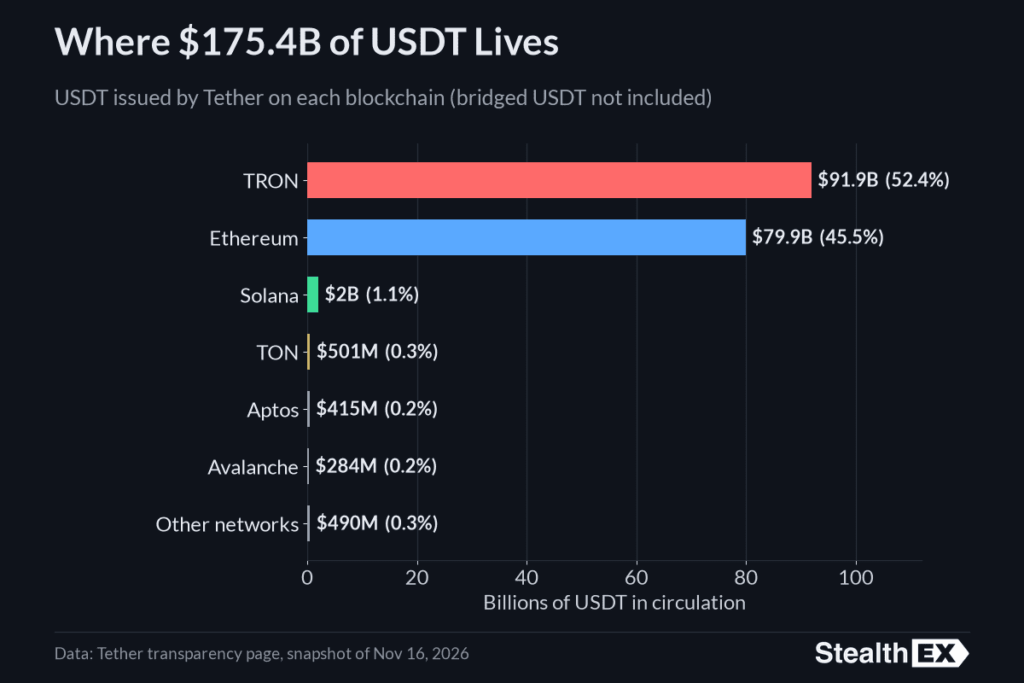
USDT supply by network. Source: Tether
The Ticker Matches. The Transfer Does Not
USDT sent on the USDT Ethereum network (ERC-20) does not arrive at an address on the USDT TRON network (TRC-20) as a normal transfer, and the reverse is also true. Solana USDT is not an Ethereum transfer with a different logo either. It is a separate token, paid for in SOL and sent to a Solana address of 32 to 44 letters and numbers.
TRON addresses start with T. Ethereum, BNB Chain, Polygon and Base addresses all start with 0x and look identical, so a BEP-20 deposit to an Ethereum address lands on BNB Chain, where an Ethereum-only wallet will not show it. Exchanges also label one rail in several ways, such as TRC20, TRON or TRX. Read the full network name in the wallet, not only the letters USDT, before you copy an address.
USDT Network Fees, Side by Side
A network fee is what the blockchain charges to write your transfer into a block. It moves with traffic and with the price of the fee token. A wallet or an exchange can add its own charge on top, so the USDT transaction fee shown in an app can be higher than the network part. The table compares only the network transfer, using medians of real USDT transfers sampled on November 17, 2026 (UTC).
| Network | USDT standard | Fee paid in | Median fee per USDT transfer | Block time | What to check before you send |
|---|---|---|---|---|---|
| TRON | TRC-20 | TRX, or energy and bandwidth | $2.08 with no energy, $0.11 with energy | 3 seconds | TRX or energy, TRC-20 on both sides |
| Ethereum | ERC-20 | ETH | $0.06 | 12 seconds | Current gas, ERC-20 on both sides |
| BNB Chain | BEP-20 | BNB | $0.002 | 0.45 seconds | BNB, BEP-20 on both sides |
| Solana | SPL token | SOL | $0.0004 | 0.22 seconds | SOL, Solana on both sides |
| Polygon | USDT0 on Polygon | POL | $0.002 | 1.5 seconds | POL, Polygon on both sides |
| TON | Jetton | TON | $0.001 | 0.37 seconds | TON, TON on both sides |
| Base | Bridged token on Base | ETH on Base | $0.0004 | 0.2 seconds | ETH on Base, Base on both sides |
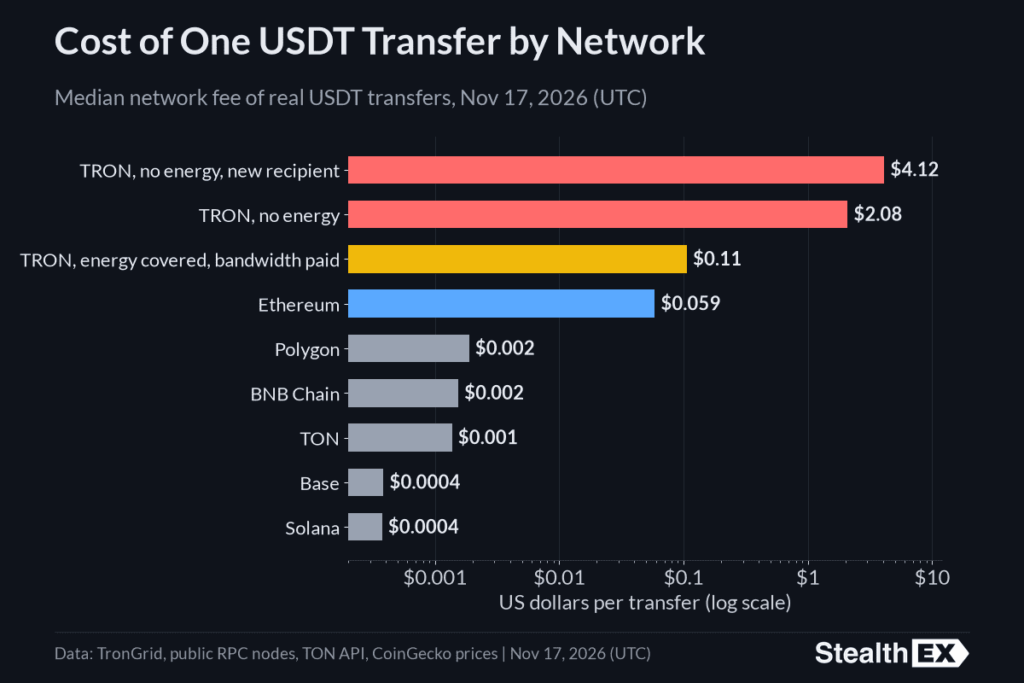
USDT transfer cost. Source: TronGrid, public RPCs, TON API, CoinGecko
What the Sender Actually Pays
A swap has up to three costs: the network fee of the chain the USDT leaves from, any charge your wallet or exchange adds, and the liquidity-provider fee of the market that fills the trade. On Ethereum, the first cost is the USDT gas fee, paid in ETH, not in USDT.
On StealthEX, the estimate for a standard crypto-to-crypto swap includes the network fee and the liquidity-provider fee. You still pay the network fee of the asset you send from your own wallet. In a quote on November 17, 2026 (UTC), 100 USDT TRC-20 returned about 98.19 USDT ERC-20, so about 1.81 USDT covered the network and liquidity-provider fees in the estimate, and the sender’s wallet still paid the TRON fee for the deposit.
Use a Fee From the Day You Send
On November 17, the Etherscan gas tracker showed $0.006 for a basic ETH transfer, while real USDT transfers paid a median of $0.06. The two differ because a token transfer is a contract call of about 41,000 gas. When you check a USDT transaction fee calculator or gas tracker, use the token-transfer figure.
The USDT network fee on TRON moves with the TRX price and with the energy price, a network parameter that TRON’s super representatives can change by vote. On Solana, a busy network adds a priority fee on top of the base fee. A fee table from 2025 carries old coin prices, so recheck before you send.
TRC-20 on TRON
TRC-20 is USDT issued on TRON, the network most people mean when they ask for a cheap USDT transfer. The USDT TRC-20 fee is not fixed. A transfer needs energy and bandwidth, and a wallet without them pays the TRC-20 USDT transfer fee in TRX: 6.77 TRX, about $2.08, from a wallet with no energy. A wallet that shows a zero fee already holds those resources.
Bandwidth, Energy, and TRX
Under the TRON resource model, bandwidth pays for transaction size, and each activated account gets 600 free bandwidth a day. A USDT transfer uses about 345, which costs about 0.345 TRX, around $0.11, once the free allowance is used up. Energy pays for running the USDT contract and has no free allowance.
Energy cost 100 sun, and a normal USDT transfer used 64,285 energy. Sending to an address that never held USDT used 130,285 energy, about 13.37 TRX or $4.12. The TRON USDT transfer fee therefore runs from about $0.11 to $4.12, depending on what the wallet holds. A TRC-20 send from a wallet with no TRX and no resources fails.
ERC-20 on Ethereum
ERC-20 is USDT on Ethereum. The fee is gas, paid in ETH, and it moves with congestion: with ETH at $1,822.81 on November 17, the median USDT ERC-20 gas fee was $0.06, and half of transfers paid between $0.02 and $0.14. People still pick it when the other wallet, the exchange or the swap accepts only ERC-20.
When Ethereum Is the Network You Have to Use
Use Ethereum when the receiving address only accepts ERC-20, for example an exchange deposit that lists no other network. A cheap TRC-20 balance cannot pay into it as a normal transfer. The ETH to USDT fee of a swap on Ethereum is gas too, because the swap is a contract call.
On a larger amount, a $0.06 fee is a small share, but that alone is not a reason to prefer Ethereum. Check the current gas right before you send, confirm the other side accepts ERC-20, and keep ETH in the same wallet. Do not send until all three are true.
Solana and the Other Low-Fee Networks
Solana, BNB Chain, Polygon, TON and Base each priced a USDT transfer below one cent on November 17, 2026. Of these, the USDT Solana network held the most supply, $2 billion. Each one works only if both wallets list it, and each needs its own fee token: SOL, BNB, POL, TON or ETH on Base.
Solana
USDT on Solana is a Solana transfer, paid for in SOL. The Solana fee documentation sets a base fee of 0.000005 SOL per signature, plus an optional priority fee when the network is busy. With SOL at $74.95, the base fee was about $0.0004. On November 17, Solana produced a slot about every 0.22 seconds.
If the receiver never held USDT on Solana, the transfer may open a token account that locks about 0.0015 SOL, around $0.11, as a deposit. A Solana address does not receive ERC-20 or TRC-20 USDT.
BNB Chain, Polygon, TON, and Base
On the USDT BEP-20 network, BNB Chain, the sender pays the fee in BNB. The receiving wallet must list BNB Chain or BEP-20, which some exchanges label BSC.
Polygon is a separate network from Ethereum, even when a wallet shows the two side by side. The sender needs POL for the fee, and the receiving wallet must list Polygon.
USDT on TON is a jetton, and the sender needs TON for the fee. The receiving wallet must list TON.
Base is its own network too. The sender pays in ETH held on Base, not ETH on Ethereum, and the receiving wallet must list Base. BNB Chain, Polygon and Base are not on Tether’s supported protocols list, so check the token contract as well as the name.
Which Network Is Cheapest When the Swap Has to Be Fast
Which USDT network is cheapest for a swap depends on three things being true together: a low fee, a fast confirmation and support on both sides. A network that is cheap and slow, or cheap and unsupported, is not the cheapest way to send USDT. If both sides list Solana, BNB Chain, TON, Polygon or Base, each cost under one cent.
| Check | What to confirm | Do not assume |
|---|---|---|
| Both sides | The sending wallet and the receiving address list the same USDT network | That USDT on the screen means every network |
| Fee token | The wallet holds TRX, ETH, BNB, SOL, POL, TON or ETH on Base for that network’s fee | That a low USDT fee means no second coin is needed |
| Amount | The fee is a small share of this transfer | That the cheapest chain is right for every amount |
| Speed | The network is confirming blocks now | That a low fee means a fast swap |
| Swap screen | The swap pair offers the network you selected | That every USDT network is available for every pair |
Put Speed Next to the Fee
On November 17, 2026, block times ran from 0.2 seconds on Base to 3 seconds on TRON and 12 seconds on Ethereum. Wallets and swap services usually wait for several confirmations, so the full confirmation time is longer than one block. Ethereum finalizes a block after two epochs of 32 slots, about 12.8 minutes.
A swap starts when your deposit confirms, not when you press the button. The cheapest network for a USDT transfer is only fast if both sides accept it and it is confirming blocks now.
A Small Transfer and a Large One
At November 17 fees, a $2.08 TRON fee is 2.1% of a $100 transfer, 0.21% of $1,000 and 0.02% of $10,000. A $0.06 Ethereum fee is 0.06% of $100 and 0.006% of $1,000. A $0.002 BNB Chain fee is about 0.002% even at $100.
Size alone does not pick the best network for USDT. Look at the fee as a share of the amount first, then check that the other side accepts the network, because a low share on an unsupported network still loses the whole transfer.
How to Start the Swap on the Network You Picked
The best network to send USDT is the one both sides support, so choose it first. Then get the fee token: TRX for TRON, ETH for Ethereum, ETH on Base for Base, and BNB, SOL, POL or TON for the others. Check today’s fee and send only on that network.
Match the Network, Then Send
- Confirm the asset is USDT, not USDC or another stablecoin
- Confirm the network name, for example TRON (TRC-20) or Ethereum (ERC-20), not only the ticker
- Copy the receiving address from that network’s receive screen and check its first and last characters
- Check that the wallet can pay the fee, with TRX or energy on TRON and ETH on Ethereum
- Enter the amount you actually want to swap
- Send, then save the transaction hash to track the deposit on an explorer
What a StealthEX USDT Swap Includes
StealthEX is a non-custodial instant exchange. A standard crypto-to-crypto swap needs no account, and you send from your own wallet and receive in your own wallet, at a fixed rate or a floating rate. The on-screen estimate includes the network fee and the liquidity-provider fee. It holds no coins after a completed swap and sets no blockchain fee.
The widget offers USDT on several networks, including TRON (TRC-20), Ethereum (ERC-20) and BNB Chain (BEP-20). Check the network label next to USDT in the widget before you send. A quote for a USDT network swap turned 100 USDT TRC-20 into about 98.19 USDT ERC-20, fees included. If a wallet or transaction is flagged, verification may be requested in some cases.
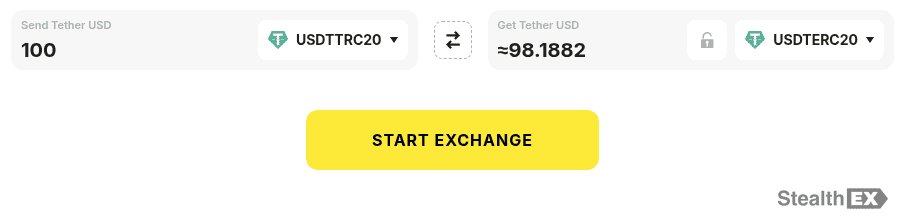
StealthEX USDT quote. Source: StealthEX
Mistakes That Cost More Than the Fee
The first mistake is the wrong rail, such as the USDT TRX network when the other side uses the USDT ETH network. It can cost the whole amount, while the fee gap between those two was about $2. The second is a headline fee taken as the full cost.
Sending USDT on a Network the Other Side Does Not Use
Sending on the USDT TRC-20 network to an address on the USDT ERC-20 network is not a normal transfer. The coins can fail to arrive, sit unrecognized, or need a recovery path the wallet or exchange may not offer, and nobody can promise they will come back. Stop and check the network before you send a second transaction.
TRC-20, ERC-20, BEP-20, Solana, Polygon, TON and Base addresses are not interchangeable, even when two of them look the same. An exchange deposit page lists every network it accepts for USDT, and any network missing from that list is the wrong one.
| What was sent | Where it went | What can happen |
|---|---|---|
| TRC-20 USDT | An ERC-20, BEP-20, Solana, Polygon, TON or Base address | It is not a normal transfer, and recovery is not guaranteed |
| ERC-20 USDT | A TRC-20 or other non-Ethereum address | It is not a normal transfer, so do not send a second payment until the first is identified |
| USDT on any network | A wallet that shows USDT but not that network | The ticker is not enough, so stop and match the network name |
A Low Fee Is Not the Whole Cost
A network fee, a withdrawal fee and a bridge fee are three different charges. The exchange you leave sets the USDT withdrawal fee, not the blockchain. A bridge is a separate transfer with its own fee, wait and risk of a wrong route, so even a low-fee USDT bridge is not a cheaper way to send USDT on the destination network.
A wallet shows a zero TRC-20 fee only when it already holds about 64,285 energy and 345 bandwidth, usually from staked or rented TRX. Without them, the same send burns 6.77 TRX, so zero is not the normal price.
Frequently Asked Questions
Do You Need TRX in the Wallet to Send USDT on TRON?
Sometimes. A wallet with enough bandwidth and energy for that transfer may not spend TRX. Without them, the fee is paid in TRX, 6.77 TRX per normal transfer on November 17, and the send fails until the wallet holds some. The current TRON network fee for USDT transfer also moves with the TRX price.
Does a Cheaper USDT Network Make the Transfer Faster?
No. A lower fee and a shorter wait are two different facts. Polygon cost about $0.002 at 1.5 seconds per block on November 17, while Base cost $0.0004 at 0.2 seconds. The fastest USDT network for you is one both sides accept that is confirming now.
Is USDT on Solana the Same Token as USDT on Ethereum?
It is the same USDT brand on a different network, issued on Solana as a separate token. USDT sent on Solana does not arrive at an ERC-20 address, so choose Solana only when both wallets list it.
Is the Network Fee Already Included in a USDT Swap Estimate?
On StealthEX, the estimate for a standard crypto-to-crypto swap includes the USDT network fee of the payout and the liquidity-provider fee. It does not remove the network fee of the coin you send from your own wallet, and verification may be requested in some cases.
How Long Does a USDT Transfer Take?
It depends on the network and how busy it is. On November 17, 2026, TRON made a block every 3 seconds and Ethereum every 12, and most services wait for several confirmations before they credit a deposit.
Why Can the Cheapest USDT Transfer Still Fail?
The usual reasons are a network the other wallet does not support, a fee token the sender does not hold, or a TRON wallet with no bandwidth, energy or TRX. Even on the cheapest USDT network, a low advertised fee does not prevent any of these.
Conclusion
For a fast swap, pick the USDT network both sides accept, check the fee and the wait on the day of the transfer, and make sure the wallet can pay that fee. Solana, BNB Chain, TON, Polygon and Base cost under one cent when both sides list them. TRON or Ethereum fit when the other side accepts nothing else. A cheap network on the wrong rail is not a saving.
If you already hold crypto and need to exchange it, a standard crypto-to-crypto swap on StealthEX needs no account, and you can swap USDT between networks wallet-to-wallet. See how it works. It cannot change another chain’s fee or finish a transfer sent on the wrong network.
Don’t forget to do your own research before buying any crypto. The views and opinions expressed in this article are solely those of the author.
Tags: ERC-20 stablecoin Tether TRON USDTThe post USDT Network Fees: Cheapest Way to Swap Quickly first appeared on StealthEX.
0
0


 Manage all your crypto, NFT and DeFi from one place
Securely connect the portfolio you’re using to start.


