
Solana price prediction: 2.57 long accounts per short as $12.9 million leaves the futures market

0
0

On Solana's futures market, 2.57 long accounts were open for every short account on Thursday evening, and $12.9 million in open interest vanished within a day. The figures come from the account statistics of the exchange OKX, retrieved on October 22, 2026. Our assessment follows further below: a long ratio that stays high while the price falls shows no strength, only positions that have not yet been closed.
The price stood at $103.61 on Thursday evening, 4.49 percent below the previous day. Between the day's high of $108.39 and the day's low of $103.30 lie 4.70 percent. Bitcoin gave up 3.79 percent to $81,252 over the same period, the wider market 4.2 percent. Solana is falling harder than the benchmark. Where the price may head over a horizon of months is set out in our Solana price prediction.
The futures market shrinks while the long side stays put
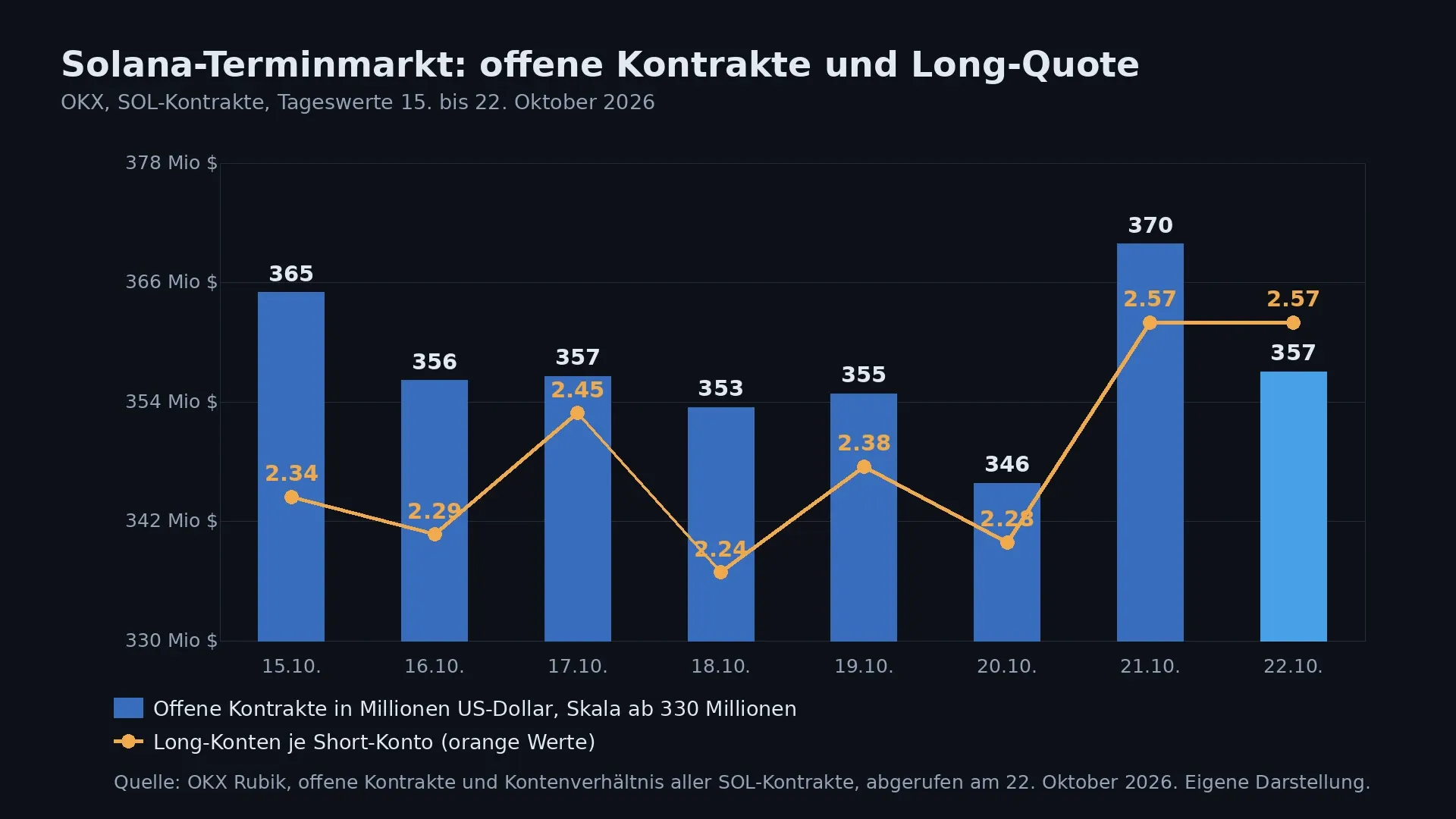
Open interest in SOL contracts at OKX stood at $357.0 million on October 22. The day before it was $369.9 million, the highest level of the week. The gap is $12.9 million, or 3.5 percent, that left the market within 24 hours. Open interest is the sum of all futures positions not yet closed out; when the number falls, positions have been closed or forcibly unwound.
What did not happen is the notable part. The ratio of long to short accounts stood at 2.57 on Thursday, exactly the previous day's reading. On October 20 it was 2.28, on October 18 it was 2.24. The long ratio has therefore climbed from 2.24 to 2.57 within four days and stayed there, while the price was passed down from $108 to $103. Traders who were long have remained long.
What open interest and the long-short ratio actually measure
Both numbers describe the same exchange from two angles, and they are regularly confused. Open interest measures the money: how much capital sits in unsettled futures positions, counted in dollars. The long-short ratio measures the heads: how many accounts are betting on rising prices, divided by the number betting on falling ones. A reading of 2.57 means 2.57 long accounts for every short account.
Because one number counts dollars and the other counts accounts, they can diverge, and that is exactly what has happened here. A single large short can tie up more capital than fifty small longs. The account ratio therefore says nothing about who has more money at risk; it describes the mood of the crowd. That mood has not turned this week, even though the price did.
Volume fits the picture: SOL contracts worth $759.2 million changed hands at OKX on October 22, after $712.4 million the day before. More was traded and yet less was held open. That is the signature of a day on which positions are closed rather than newly built.
The funding rate stays positive despite the sell-off
A perpetual contract has no expiry date. To keep its price from drifting away from the spot market, the two sides pay each other a balancing fee every eight hours, the funding rate. When it is positive, longs pay shorts; when it is negative, the flow reverses. That makes it the most honest price available for the question of which side is under pressure.
On Thursday evening the funding rate for the SOL-USDT perpetual at OKX stood at plus 0.00365 percent per period. The figure is small, but the sign is what counts: after a day of minus 4.49 percent, longs are still paying for the privilege of staying long. Annualised, that is roughly 0.011 percent a day and about 4.0 percent a year, measured against contract value. At ten times leverage, the trader's own stake carries ten times that burden.
In a genuine capitulation the funding rate turns negative, because shorts are in the majority and have to pay for their positions. That it remains positive here confirms the account ratio from a second angle: the long side has not given up.
The liquidation price and the arithmetic behind it
Anyone buying with leverage borrows the part of the stake they do not put up themselves. If the price falls far enough that their own collateral is used up, the exchange closes the position on its own. That point is the liquidation price, and for an isolated long position it can be estimated in a single line: entry price times (1 minus 1 divided by the leverage), then add the maintenance margin. The maintenance margin is the slice of collateral the exchange insists on leaving in place.
For an entry at the current price of $103.61 that works out at roughly $52 at two times leverage, around $83 at five times, around $93 at ten times and around $98 at twenty times. The maintenance margin shifts each of these values up by half a percentage point to a full point. The exact number is set out in each exchange's contract specification and differs from house to house.
How tight it was on the day is clear from one calculation: a trader entering at Thursday's high of $108.39 with twenty times leverage had a liquidation point between $102.97 and $103.51, depending on the maintenance margin. The day's low was $103.30, squarely inside that range. Part of the $12.9 million in open interest was released right there.
What has changed since the Alpenglow launch of October 21
On Tuesday, Alpenglow went live as the biggest change to Solana's consensus in years, cutting finality from around 12.8 seconds to about 150 milliseconds, as we described on October 21 in our piece on the switch to Votor. The price stood at roughly $108 at the time, with the level of the day at $107.51.
Since then 4.5 percent has been given up, and the blockchain's own metrics do not yet support the talk of a technical breakthrough: trading volume on Solana's decentralised exchanges came to $2.27 billion over the past 24 hours, 6.87 percent below the previous day, and network fees to $11.96 million, down 10.49 percent. Over seven days, decentralised exchange volume is at least 7.15 percent higher at $14.45 billion. The figures come from DeFiLlama, as of October 22.
The technology is delivering; demand has not followed it so far. That matches a pattern Solana has shown several times this year: a protocol upgrade is priced in beforehand and sold after the date.
The levels at $103.30 and $100
On the downside, the first documented level is the day's low of $103.30, where the price turned higher on Thursday. Below it sits the round $100 mark, which has not been breached in October and where the liquidation points of positions levered ten to twenty times cluster closely together. If the price reaches it, it meets not just a psychological number but a zone in which forced selling can accelerate the slide.
On the upside, the day's high of $108.39 is the first hurdle, above it the area around $112, where last week's recovery ended. For scale: Solana carries a market capitalisation of roughly $61 billion. The all-time high of $293.31 dates from January 19, 2025 and sits 64.7 percent above today's level.
Set against that is the stablecoin base on Solana: $15.75 billion sits on the blockchain as dollar tokens, and the value locked in protocols comes to $5.87 billion. That capital does not disappear in a sell-off; it is the demand that can buy at lower prices.
Leverage for retail investors in Germany is capped at two to one
The ratios above come from an international exchange, and therein lies a difference that matters for investors in Germany. At a provider under German or European supervision, leverage on contracts for difference with crypto assets is capped at 2:1 for retail clients. That limit goes back to the product intervention by BaFin, which made the European rule a permanent part of German law, and it comes with the exclusion of any obligation to top up losses.
Leverage of two to one means the liquidation point sits roughly 50 percent below the entry, in today's example at about $52. A day like this one, with a 4.70 percent swing, does not touch such a position. A trader working with twenty times leverage at a provider outside the EU, by contrast, has an exit point five percent below entry, and on an ordinary October day it is hit. The account ratio of 2.57 therefore describes, above all, an audience that German retail investors cannot reach through regulated channels at all.
Those who still follow this market or trade on decentralised venues will find the differences in fees, maintenance margin and settlement in our overview of perpetual exchanges. The maintenance margin decides the exact liquidation point, and it is rarely displayed on the front page.
Tax: spot holdings and derivatives run on separate tracks
For tax purposes the two routes are separate worlds in Germany, and mixing them produces the wrong answer. SOL held in your own portfolio falls under private disposal transactions under section 23 of the German Income Tax Act: after a holding period of one year the gain is tax-free, below that the personal income tax rate applies, and an exemption threshold of 1,000 euros a year is in force. That threshold is not an allowance; exceed it by a single euro and the entire gain becomes taxable.
A contract for difference or a perpetual on SOL falls instead under investment income with the flat withholding tax of 25 percent, plus the solidarity surcharge and, where applicable, church tax. There is no holding period. The former cap of 20,000 euros a year on offsetting losses from derivatives was scrapped outright by the 2024 Annual Tax Act and applies to all open cases; losses from derivatives can since be offset against all investment income. For allocating individual positions and documenting them for the tax office, the tools in our comparison of tax software help.
For today that means: holders of spot SOL who are already past the one-year mark have nothing to fear from a slide to $100 in tax terms, and nothing to gain either. Traders working with leverage create an immediately effective taxable event with every liquidation.
Our assessment of the long ratio
In the editorial team's view, the long ratio that has stayed in place is the weaker of the two signals. The numbers support that reading: the account ratio has climbed from 2.24 to 2.57 since October 18 while the price fell over the same period, and the funding rate remains positive at plus 0.00365 percent. Together these describe positions that are being held rather than newly opened. As long as they stay open, they are potential supply, because every liquidation is a sale nobody makes willingly.
Against that stands the capital side: at $357.0 million, open interest remains above the weekly low of $345.8 million from October 20, so the market has not been cleared out. And the stablecoin base of $15.75 billion on the Solana blockchain is demand that can become active on a drop below $100. We are assessing the situation here, not the question of whether buying makes sense; a total loss is possible at any time with crypto assets.
Solana at $103: below $100 the long side decides
Thursday showed that the $12.9 million left the futures market at $103.30 and no lower. The next zone with a comparable density of liquidation points lies at $100. Three steps make sense now:
- Work out your own liquidation distance. Entry price times (1 minus 1 divided by the leverage), then add your exchange's maintenance margin. If the result sits above $100, the position stands inside the dense zone. Which house applies which maintenance margin is set out in the perp comparison.
- Separate the holding from the leveraged position. Spot SOL falls under the one-year rule, the contract under the flat withholding tax. Running both on one account costs you track of the deadlines; separating them is easiest through separate accounts at a regulated exchange.
- Read the funding rate as an early warning. If it turns negative, the long side has given up and the selling pressure from liquidations eases. While it stays positive, the supply remains in the market.
(As of October 22, 2026. This article is not investment advice. Prices and fee structures change; check the terms with the provider before you buy.)
0
0

 Manage all your crypto, NFT and DeFi from one place
Securely connect the portfolio you’re using to start.


