
Solana News: JPMorgan Input, But What Does It Mean for SOL?

0
0
Solana News: What Did Solana Actually Release With JPMorgan Input?
The Solana Foundation launched Solana DvP on October 6. It is an open-source program for atomic delivery-versus-payment settlement. This Solana News report checks the release, JPMorgan's role and what it may mean for SOL holders.
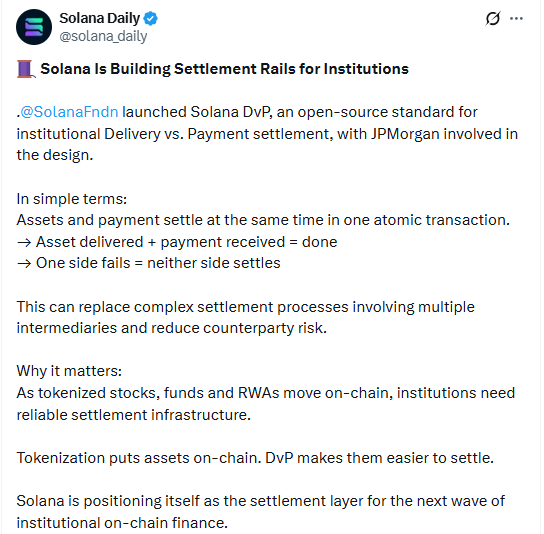 Source: X (formerly Twitter)
Tokenized stocks, funds and real-world assets need a settlement step. DvP targets that step.
Social posts say JPMorgan is helping Solana build the new infrastructure. The Foundation's own wording is narrower.
What the Foundation Actually Released on October 6
Item | Foundation statement |
Product | Open-source escrow program, MIT license |
Function | Asset and cash legs settle together, or neither does |
Tokens | SPL Token and Token-2022 |
Audit | Cantina, per Solana documentation |
Status | "Ready for use with real funds" |
Production release | No date given |
Atomic settlement means both legs sit in escrow and move in one transaction. The Foundation claims finality in seconds instead of days. The release gives no settlement data and names no institutional user.
The program accepts tokens with compliance extensions, such as pausable tokens and transfer hooks. It rejects four extensions, including transfer fees. Issuer freeze or pause powers can still act on escrowed tokens.
The documentation lists limits. There is no order book, no KYC check and no automatic transaction. A named settlement authority must sign. The program is also upgradeable, so it depends on whoever holds that authority.
What JPMorgan Did and Did Not Do in Solana DvP
Did: give input on institutional transaction practices
Did not: design, develop, operate, approve, certify, warrant, endorse or guarantee the program
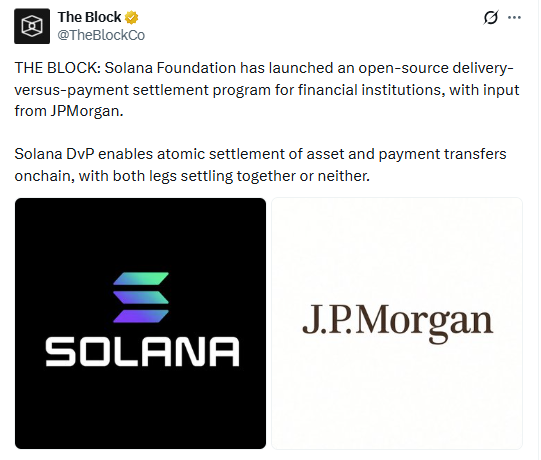
That is the Foundation's own disclaimer. This Solana News check therefore finds the "helping develop" framing stronger than the source.
JPMorgan has worked on Solana before. On December 11, 2025, it arranged commercial paper for Galaxy Digital on Solana. It handled the delivery-versus-payment settlement, with proceeds paid in USDC. That was one issuance. It was not Solana DvP.
Grayscale also spoke at the Solana Capital Forum in Singapore on October 6. Its post cites fast transactions, deep trading activity and growing stablecoin adoption. Those are Grayscale's views, not audited network data.
Solana News: What Investors Should Watch for SOL After DvP
Metric | October 7 |
SOL price | $118.81, down 0.82% in 24 hours |
Market cap | $69.99B |
24-hour volume | $2.85B, up 32.33% |
Circulating supply | 589.09M SOL |
Fully diluted value | $75.49B (635.38M total supply) |
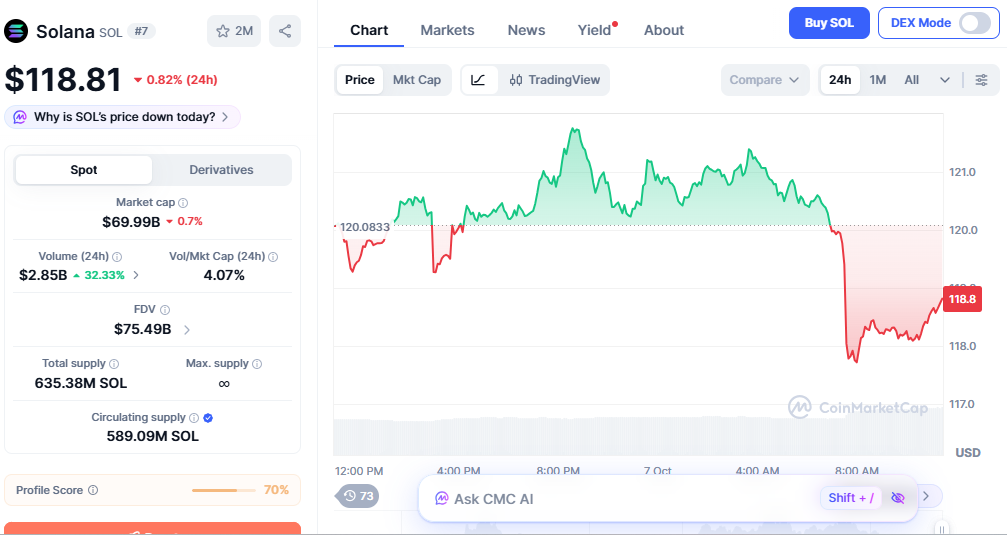
Source: CoinMarketCap Data
No source ties this move to the announcement. The documentation says the program charges no protocol fee beyond transaction fees and rent. Any effect on SOL would be indirect, through network usage.
Watch for:
A production release date
Named banks or design partners
On-chain settlement volume from real trades
The privacy feature the Foundation plans to add
Legal views on whether on-chain finality counts as settlement finality
The Bottom Line
This Solana News review finds an open standard with a stated external audit. It names no users and gives no production date. JPMorgan gave input. It did not build or endorse the program. Treat institutional adoption as unproven until usage data appears.
YMYL Disclaimer: This article is for information purposes only and is not financial, investment, or trading advice. Information is based on the Solana Foundation announcement and documentation, the Solana Capital Forum page, a JPMorgan press release, a Grayscale post and a market tracker screenshot, as of October 7, 2026. Product status, audits and adoption are project statements and may change. SOL is volatile, and tokenized-asset infrastructure is early-stage. Crypto assets carry risk of loss, including full loss of funds. Always verify current details directly with official sources and consult a licensed advisor before making investment decisions.
0
0

 Manage all your crypto, NFT and DeFi from one place
Securely connect the portfolio you’re using to start.


