
What Is an Oracle Attack? Nostra's $3.5M Lesson

0
0
How Does an Oracle Attack Work in DeFi, Step by Step
On September 17, 2026, a manipulated price let one account borrow about $3.5 million from Nostra Finance, a lending protocol on Starknet. The case shows how an Oracle attack can drain a lending market without a single bug in the contract code.
This guide explains how the Nostra oracle exploit worked, why audited smart contracts still lost funds, and what DeFi teams can check before accepting a token as collateral. Figures come from Pragma’s incident account and security firm reports, and they may change as investigations continue.
Quick answer: an Oracle attack happens when someone manipulates the outside price data a blockchain app relies on. At Nostra, an inflated NSTR price let an attacker pledge a tiny token as collateral and borrow roughly $3.5 million in other assets.
What Is an Oracle Attack in Crypto?
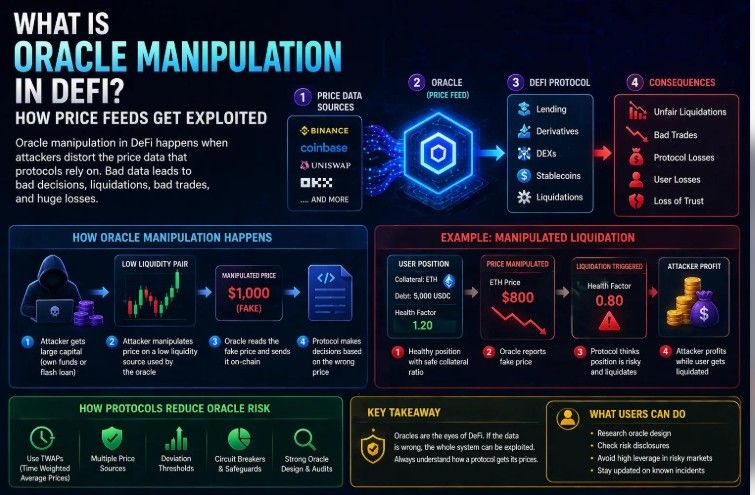
An oracle manipulation attack happens when a DeFi app prices assets with an outside source and an attacker twists that data for profit. Smart contracts can’t see beyond their own blockchain, so they accept whatever price the oracle reports. The code then runs exactly as written.
What Is a Blockchain Oracle?
A blockchain oracle brings off-chain data, like a token’s market price, onto the chain so contracts can read it.
That reliance is called the blockchain oracle problem, and blockchain oracle security always returns to it. A contract is only as honest as the data it gets.
How Does an Oracle Attack Work?
The attacker moves a token’s price, usually by trading in a thin pool where little money shifts the price a lot. The protocol then uses that number to value collateral. Here’s a simple example.
A user deposits tokens worth $1,000, the oracle reports $100,000, and the loan limit is 60%. That user can now borrow $60,000 against $1,000 of real value.
What Happened in Nostra’s $3.5M Oracle Attack?
Nostra Finance is a non-custodial money market on Starknet where users deposit collateral and borrow other assets. NSTR is its governance token, which lets holders vote on protocol decisions.
The token’s total market value was only about $550,000, yet it was accepted as collateral. Pragma’s documentation had already listed the NSTR feed as high risk. Collateral eligibility is the list of assets a lender accepts as security, and each one needs a limit based on how easily it can be sold.
How Did the Attacker Manipulate the NSTR Price?
Public reconstructions describe this sequence:
The attacker created a new NSTR/SolvBTC pool holding only about 1.5 SolvBTC.
Repeated wash trades, meaning trades made to fake activity, pushed NSTR from about $0.006 to near $49.5 in roughly 20 minutes.
The manipulated pool entered the oracle’s pricing process.
Nostra’s lending market accepted the inflated collateral value.
The attacker borrowed about $3.5 million in other assets before the platform paused.
How Did the Attacker Manipulate the NSTR Price?
Security firms shared a sequence that Nostra security breach coverage describes in similar ways:
The attacker set up a new NSTR/SolvBTC pool with only about 1.5 SolvBTC in it.
Repeated wash trades, meaning trades made to fake activity, pushed NSTR from about $0.006 to near $49.5 in roughly 20 minutes. That’s an 8,000-fold jump.
The oracle’s pool-selection logic picked up that pool, so the fake price entered the system.
Nostra’s lending market accepted the inflated collateral value.
The attacker borrowed about $3.5 million in other assets before the platform paused.
That chain is the core of the Nostra oracle exploit.
Which Crypto Assets Were Borrowed?
The reported assets were Ethereum (ETH), Starknet (STRK), USDC vs. USDT, Wrapped Bitcoin (WBTC), and DAI.
Why Did Nostra’s Oracle System Fail?
Audits check whether code follows its rules. They don’t automatically prove that incoming prices are reliable or that collateral can be sold at its quoted value. Four layers matter here: contract security, oracle security, market security, and risk management. The exploit hit the last three:
Thin source: a pool with about 1.5 SolvBTC set the price.
Few sources: two contributing sources passed a check that three would have failed.
Weak collateral: the borrowed amount was roughly six times the whole token’s market value, according to market data.
Missing limits: an 8,000-fold jump wasn’t stopped by deviation or exposure controls.
Liquidation depth adds another risk, because a lender recovers value only if collateral sells near its reported price.
What Was the Impact of the Nostra Exploit?
Nostra paused lending, borrowing, withdrawals, and liquidations. The $3.5 million figure is the amount borrowed, not a confirmed final loss. Early tracing reports said about $1.92 million was bridged to Ethereum and roughly $1.55 million stayed on Starknet.
Pragma reported that the attacker’s address was frozen and recovery work was ongoing, while Nostra said final losses and recoveries weren’t yet known. Total value locked reportedly fell from about $4 million to roughly $710,000 within a day, according to market data.
Different Types of Oracle Attacks in DeFi
Attack type | Explanation |
Price manipulation | Artificially changes an asset’s reported price |
Flash loan oracle attack | Uses temporary borrowed liquidity to manipulate prices |
Low-liquidity attack | Exploits shallow trading pools |
Data source manipulation | Targets unreliable external price information |
Time-weighted price attack | Exploits weaknesses in TWAP-based pricing |
How Can DeFi Protocols Prevent Oracle Attacks?
No single fix works, so protocols stack several checks:
Multiple independent oracle providers, though Pragma warns that different source labels can share the same market dependencies.
A minimum source count that rejects thin responses.
Price deviation limits that block sudden jumps.
Liquidity checks, since Pragma found NSTR sell quotes slipped about 15% at $10,000 compared with $10.
Time-weighted average prices (TWAP), which smooth quick spikes.
Emergency pause tools and strict collateral eligibility rules.
Oracle Attack vs. Smart Contract Attack: Key Differences
A smart contract attack targets a flaw in the code, so a code audit can often catch it. An oracle attack targets the data feeding that code, so even flawless contracts can lose funds. Code bugs need patches.
Price manipulation needs better sources, liquidity rules, and exposure limits. Spot pricing reads the latest trade, while TWAP averages prices over time, which makes quick manipulation costlier.
What Can DeFi Projects Learn From Nostra’s $3.5M Exploit?
A published price doesn’t prove collateral can be sold.
Small governance tokens need low borrowing limits or no collateral status.
Source count and source independence both matter.
Risk settings need regular review.
Users can research oracle design, read risk disclosures, avoid heavy borrowing in risky markets, and follow incident updates.
Conclusion: Why Oracle Security Matters for DeFi
Nostra shows that an Oracle attack doesn’t need broken code. A small token, a thin pool, and weak source checks were enough to create a multi-million-dollar loan. Stronger source rules and collateral limits reduce that risk.
Disclaimer
This article reflects public reports available on November 12, 2026, and isn’t financial advice. Crypto assets carry high risk, so readers should do their own research before making any financial decision.
0
0

 Manage all your crypto, NFT and DeFi from one place
Securely connect the portfolio you’re using to start.


