
Bitcoin miners earn 14.2 percent less per exahash as difficulty hits a record

0
0

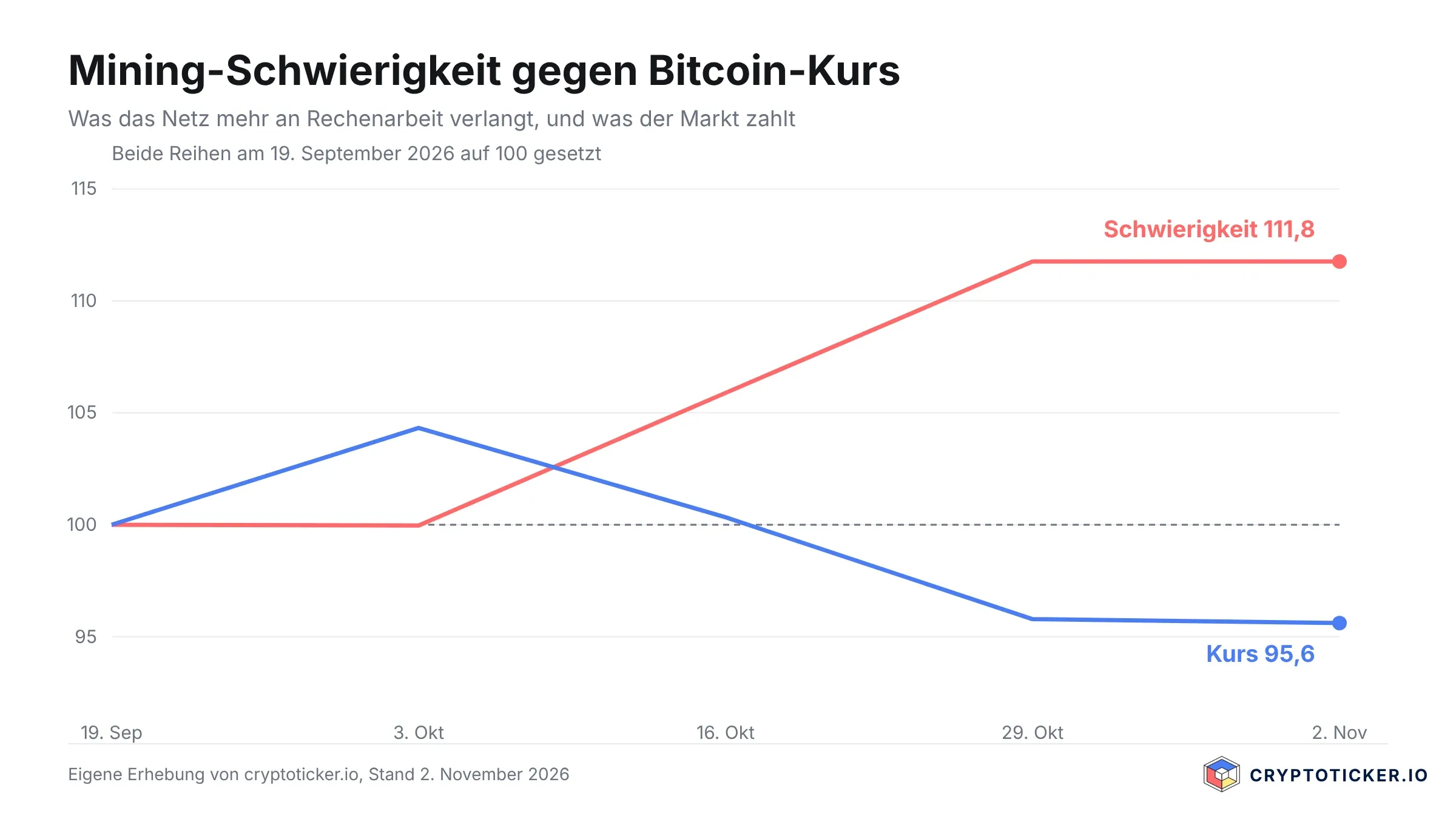
What is established: mining difficulty on the Bitcoin network has stood at 148.4 trillion since October 29, the highest on record. Over three adjustments since September 19 it has risen 11.8 percent, while bitcoin traded at $77,657 on Monday afternoon, 4.4 percent below its level on September 19. Our assessment follows further down: the miners' higher costs are no floor under the price, but they are a reason for continued selling pressure from this group.
Anyone looking at the chart today sees a quiet week: $77,511 as the daily low, $78,740 as the daily high, down 0.7 percent from Monday's close. Behind this calm sits a mechanism that rarely features in market commentary and that matters right now. Where the price could head over a horizon of months is covered in our bitcoin price prediction. This piece looks at the part the chart does not show: the miners' economics.
Bitcoin mining difficulty rises for the third time in a row
Every 2,016 blocks, roughly every two weeks, the Bitcoin network resets its difficulty. On October 16 it went up 5.92 percent, and on October 29 by a further 5.54 percent. Before that, on October 3, there was a flat adjustment of minus 0.03 percent. Taken together, the three steps add up to 11.8 percent, and the figure of 148.4 trillion is the highest the network has ever carried.
Difficulty is neither a fee nor a price that anyone sets. It determines how many hashing attempts are needed on average before a valid block is found. If it rises 5.5 percent, the same machine needs 5.5 percent more time, and therefore 5.5 percent more electricity, for the same share of the block reward.
What a mining difficulty adjustment sets in motion
The mechanism behind it is a feedback loop, and it explains why the number is rising now of all times. The network targets one block every ten minutes. When operators add hashing power, blocks arrive faster, and the next adjustment pushes difficulty up until the ten-minute rhythm is restored. When they switch machines off, it falls.
That is exactly what has happened in recent weeks. The network's hashrate averaged 1,069 exahashes per second over the seven days to November 2, against 984 at the start of October. One exahash is a quintillion hashing attempts per second. The network has therefore gained 8.7 percent more capacity, even though the price fell over the same period. Data centres ordered months ago are coming online now, regardless of what the price is doing.
For investors, this means the miners' cost side responds to the price with a delay, not immediately. Quarters pass between the decision to build a facility and the day its machines start hashing.

Hashprice: $33,095 instead of $38,552 per exahash
To measure the gap between effort and return, we calculated the network's daily revenue per exahash of hashing power. The inputs are the block reward of 3.125 bitcoin, the 144 blocks produced on an average day, daily closing prices on the Kraken exchange and the network's seven-day average hashrate. cryptoticker.io compiled this analysis itself on November 2, 2026.
The result: in the week to November 2, one exahash of hashing power earned $33,095 in daily revenue. In the week to October 9 it was $38,552. That is a decline of 14.2 percent. It has two components pulling in the same direction: 8.7 percent more hashrate cuts the same cake into more slices, and a price 6.7 percent lower makes the cake smaller.
The block reward has been 3.125 bitcoin since the halving in April 2024. The next halving is not due until 2028. Until then, only the price or transaction fees can improve the miners' economics, and fees currently contribute only a small share.
Why miners sell in this situation
A miner has two kinds of cost. The machines are paid for before the first block is found; that is sunk capital. Electricity, by contrast, is incurred every day and has to be paid every month. If revenue per exahash falls while the power bill stays the same, there are exactly three options: sell their own bitcoin, take on debt or switch machines off.
All three show up in the market. Sales from this group hit an order book that is already thin. If you buy or sell yourself, pay attention to the fees and market depth of your exchange; our crypto exchange comparison shows where the spread between bid and ask stays narrow on larger orders.
The 200-day moving average at $73,161 as the lower level
On Sunday the futures curve was the focus here; today it is the levels on the chart. We calculated both lines that matter at present ourselves, from the daily closing prices of the past 200 trading days.
On the downside, the 200-day average sits at $73,161. The price is 6.2 percent above it. This line has held as a support zone several times this year, and it is still rising, if slowly. Closer to hand is the 30-day low of $77,204 from October 31, only 0.6 percent below the current price. If that level gives way, the chart shows no fresh price history between it and the 200-day line.
The 50-day moving average at $81,932 caps the upside
On the upside, the 50-day average stands at $81,932, 5.2 percent above the price. As long as bitcoin stays below it, the medium-term trend points down. The 30-day high was $86,510 on October 3; the price is now 10.2 percent away from it.
Between $73,161 and $81,932 lies the corridor in which the coming weeks will probably be decided. It is just under twelve percent wide, and the price currently sits in its lower third.
The next difficulty adjustment on November 13 points lower
The current difficulty period is a little more than a quarter complete, with 1,487 blocks still to go. Extrapolated from the pace so far, the next adjustment on November 13 would be 1.45 percent lower. That would be the first meaningful cut since August 23, when difficulty eased 1.31 percent; the flat adjustment of minus 0.03 percent on October 3 was noise.
This estimate is no promise, however. The projection rests on the pace of the first 500 or so blocks and could reverse before the adjustment date, particularly as hashrate has picked up again over the past three days. A cut would nonetheless be a signal: it would mean operators are actually taking machines off the network because running them no longer pays at these prices.
What has changed since Sunday's futures market analysis
On November 1 we described the missing premium in the futures market here; the price stood at $77,370 at the time. Little has changed in the picture since then: at $77,657 the price is 0.4 percent higher, the $77,204 level has held again, and the daily high of $78,740 did not get past the weekend's zone.
What is new is the cost side. The futures curve says something about traders' expectations; revenue per exahash says something about the constraints on a group that receives 450 new bitcoin every day and has to sell part of them. Taken together, the two give a fuller picture than either metric on its own.
Our view: mining costs are no price floor
In the newsroom's view, the miners' economics are regularly misread. The idea that the price cannot fall below production costs sounds plausible and has not held historically: in the 2022 downturn, bitcoin traded for months below the electricity costs then estimated for many operators, and the network kept running. The mechanism itself explains why. When the price falls, the most expensive operators switch off, difficulty drops, and the remaining operators produce more cheaply. The system finds a new equilibrium; it does not support any particular price.
What the figures do offer, in our view, is something else: an indication of the supply side over the coming weeks. 14.2 percent less revenue per exahash with an unchanged power bill raises the pressure to sell ongoing production. Against that, many listed operators have hedged their electricity costs over the long term and have credit lines available. The pressure can therefore be shown as a tendency, not as a number.
Holding period and tax: what a sale costs in Germany
For investors in Germany, this situation comes with a concrete calculation that has nothing to do with the chart. Under current law, anyone who holds bitcoin for more than a year sells the gain tax-free; within the year, your personal income tax rate applies once total gains from private sales exceed €1,000 in the calendar year. So if you are thinking about selling today, check the purchase date first, not the price.
What happens to the holding period is politically open; we track the latest state of play on our page on the crypto holding period. If you bought at several different times, you also need a clean allocation using the first in, first out method. Which tools do this automatically and produce the annual summary for the tax office is covered in our crypto tax software comparison.
How to calculate revenue per exahash yourself
The calculation takes three numbers and a minute. Current hashrate and difficulty are publicly available on the mempool.space mining dashboard, and any exchange will give you the price. Multiply 450 bitcoin by the price in dollars, divide the result by the hashrate in exahashes per second, and you have the daily revenue per exahash.
If you want the trend rather than the daily figure, mempool.space shows difficulty and hashrate in a combined chart. Because daily hashrate readings fluctuate widely, between 867 and 1,228 exahashes in October alone, it makes sense to work with a seven-day average rather than a single day.
Mining costs and the bitcoin price: below $77,204 it gets serious
Three points from this piece to work with:
- Note the levels. $77,204 as the 30-day low, $73,161 as the 200-day line below it, $81,932 as the 50-day line above. If you want to buy, place your order at one of these levels rather than somewhere in between; our exchange comparison shows which platform charges the lowest fees for it.
- Mark November 13 in your calendar. If difficulty does fall then, part of the hashing power has given up. Historically, that tends to be a late signal rather than an early one.
- Check the purchase date before the price. In Germany, a sale before the one-year period ends costs income tax; a sale after it does not. The tools in our tax tool comparison handle the allocation.
(As of November 2, 2026. This article is not investment advice. Prices and fee structures change; check the terms with the provider before you buy. Trading crypto assets carries the risk of total loss.)
0
0

 Manage all your crypto, NFT and DeFi from one place
Securely connect the portfolio you’re using to start.
 Where will Bitcoin trade next?
Live Polymarket and Kalshi odds on Bitcoin price targets, compared side by side.
See Bitcoin price odds


