
XRP Price Prediction, $1.4445 and a Delayed XRPN Market Debut: What to Watch Now

0
0

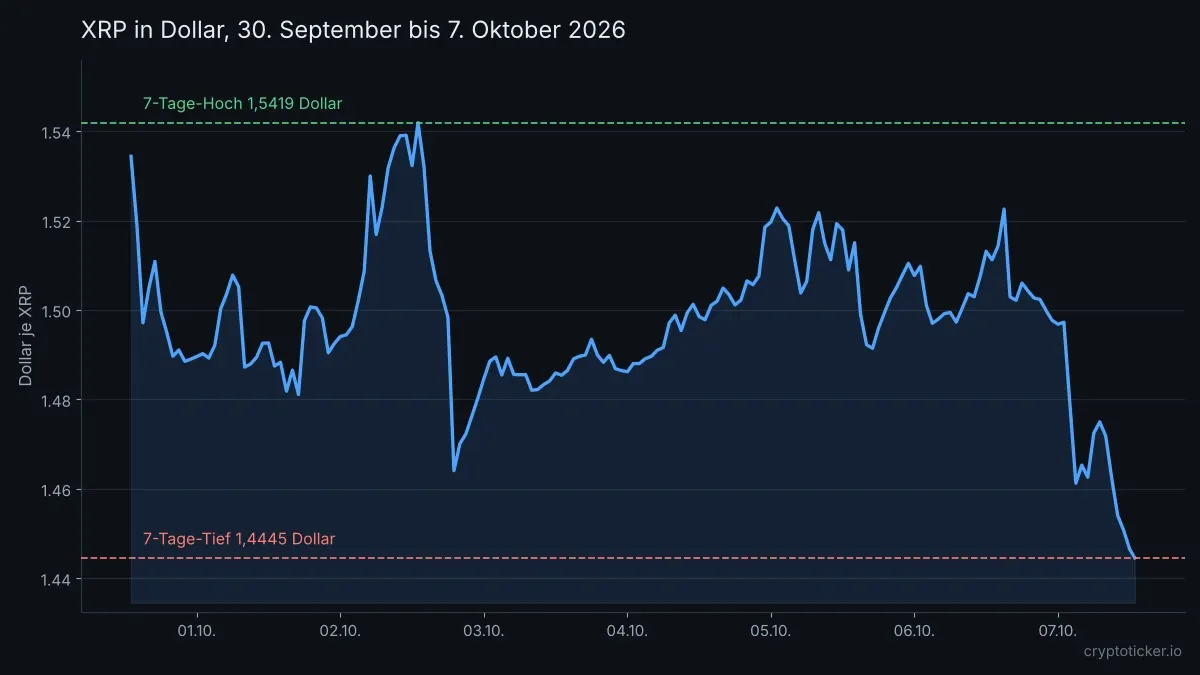
XRP costs $1.4445 on Wednesday afternoon, 4.4 percent less than 24 hours earlier. In euro terms that is €1.2933. Anyone looking for an XRP price prediction should spend less time on chart technicals this week and more on the calendar. Three dates fall within seven days, and each of them is verifiable for investors in Germany.
On Friday, October 9, the merger that creates the listed XRP treasury Evernorth is due to close. On Monday, October 12, its shares begin trading on the Nasdaq. On that same Monday the Petitions Committee of the Bundestag takes up the case for keeping the tax holding period on crypto assets, and two days later, on October 14, the federal cabinet turns to the bill that would scrap that very holding period for future purchases.
Those three dates are the real content of the week. The price is the occasion for it, not the explanation.
XRP price today: $1.4445 and 4.4 percent down in 24 hours
The reading from Wednesday afternoon, October 7: $1.4445 per XRP, down 4.4 percent on the previous day. Market capitalisation stands at around $91.1 billion, turnover over the past 24 hours at around $2.27 billion. That puts XRP fifth among the largest crypto assets. In circulation are 63.09 billion XRP out of the 99.99 billion the protocol will ever know.
Longer horizons put the daily loss in perspective. Over seven days XRP is down 4.5 percent; over 30 days it is up 3.5 percent. Against the level of a year ago it is 51.3 percent short, and 60.4 percent separates the price from its all-time high of $3.65 on July 17, 2025. A daily loss of 4.4 percent is an ordinary swing inside that range.
The rest of the market belongs in the picture. Bitcoin lost 3.2 percent on the same day, Ethereum 5.3 percent, Solana 3.0 percent. XRP is moving with the broad market rather than against it. Read an XRP-specific weakness into the daily loss and you are measuring the market, then calling the result XRP.
XRPN on the Nasdaq: the trading debut slips from October 8 to October 12
Evernorth Holdings is merging with the listed shell Armada Acquisition Corp. II and is then to trade under the ticker XRPN on the Nasdaq. The merger was originally due to close on October 7, with the first trading day on October 8. Both dates have slipped. Closing is now expected on Friday, October 9, the trading debut on Monday, October 12. The company points to an administrative step that is holding up settlement, as crypto.news reports, citing the announcement.
A short definition, because the term keeps coming up: a digital asset treasury is a listed company whose business purpose consists in holding a particular crypto asset. Buying its share does not buy XRP. It buys a stake in a company that holds XRP. That sounds like a nicety and is the decisive difference for tax, a point this piece returns to below.
Both dates remain subject to the usual closing conditions and to the Nasdaq listing requirements. A delay of four trading days is no failure, and it is no detail either: anyone who had pencilled in October 8 as a price driver no longer has that date in the calendar.
473 million XRP in the Evernorth treasury and a $2.54 entry for early investors
On completion of the merger Evernorth expects a holding of around 473 million XRP. At Wednesday afternoon's price that is worth around $684 million. The company says it has raised more than $1 billion, including $214 million from early investors who subscribed for XRP at $2.54 apiece. Measured against the current $1.4445, those subscribers are well under water.
Shareholders in the listed shell approved the deal on September 30: 20,514,034 votes in favour, 1,362,081 against, 930 abstentions. The approval was clear, the timetable that followed was not. How the holding was built up was described by cryptoticker.io in early October in its piece on Evernorth and the 473 million XRP heading for the Nasdaq.
For the price question, one thing counts above all. A holding of that size sits outside the market for as long as the company keeps it. On paper that tightens freely tradable supply by around 0.75 percent of the circulating amount. The effect is measurable, it is no supply crisis, and no price jump can be derived from it.
Holding-period petition with 44,439 co-signatures at the Petitions Committee on October 12
On the same Monday that XRPN is due to trade for the first time, the Petitions Committee of the German Bundestag meets in public in Berlin. From 12 noon the agenda carries the petition titled "Preservation of the tax holding period for private disposals of crypto assets". The session runs until 2 p.m. in room 3.101 of the Marie-Elisabeth-Lüders-Haus, as the Bundestag states on its calendar page. The session will be streamed online. Anyone wanting to attend in person registers with the committee secretariat by 12 noon on October 9.
The petition comes from Nicole Nowak, the initiator of ProHaltefrist, and has been co-signed by 44,439 people according to BTC-Echo. Fritz Güntzler, the finance policy spokesman for the CDU/CSU parliamentary group, is quoted there as saying: "A tightening of crypto taxation is not agreed in the coalition agreement." What is on the agenda at the hearing, and how the proceedings run, is set out in the cryptoticker piece on the crypto holding period before the Petitions Committee on October 12 from October 6.
A hearing at the Petitions Committee changes no law. The committee does not bind the federal government and it stops no procedure. What the hearing delivers is public attention at a moment when the procedure is still running.
Cabinet on October 14: the bill on taxing crypto assets held in private wealth
Two days after the hearing, the federal cabinet is due to take up the Finance Ministry's bill, which runs under the title "Act to reform the taxation of certain crypto assets held in private wealth". The consultation of industry bodies on it ran until October 6. The core of the bill: gains on crypto assets would in future be assigned to investment income under Section 20 of the Income Tax Act instead of to private disposals under Section 23.
A cabinet decision is not yet a law. What follows is the parliamentary procedure through the Bundestag and the Bundesrat, in which the bill can be amended, postponed or rejected. Anyone expecting a final decision on October 14 is expecting the wrong event.
Grandfathering until December 31, 2026 and Section 20 of the Income Tax Act from 2027
The bill provides for a cut-off rule, and that cut-off rule is the most important figure of the week for every German XRP holder. Crypto assets acquired before January 1, 2027 are to stay under the law as it stands. Whatever is bought from January 1, 2027 falls under the new regime, and withholding of the investment income tax is to start on January 1, 2028.
The law as it stands works like this. Under Section 23 of the Income Tax Act, a gain on the sale of crypto assets is tax free if more than a year lies between purchase and sale. Within the year an exemption threshold of €1,000 per calendar year applies to all private disposals taken together. An exemption threshold is not an allowance: break the threshold by one euro and the entire gain is taxed at your personal income tax rate.
Under the planned regime there would be no holding period at all. Gains would be charged as investment income at 25 percent withholding tax, plus the 5.5 percent solidarity surcharge on top of that, 26.375 percent in total, and more again for anyone liable to church tax. In exchange the saver's allowance of €1,000 would apply, and losses could be offset within the investment income pot. Which tools document acquisition dates cleanly is shown by the comparison of crypto tax software and portfolio trackers.
The practical consequence for XRP: every purchase still settled in 2026 falls under the grandfathering set out in the bill. Every purchase from January 2027 does not. Between those two worlds lie 26.375 percent tax or zero on the same gain, depending on whether the one-year period is observed. That is why December 31, 2026 feels like a market date to German holders.
XRP directly or the XRPN share: two buying routes, two tax rules
From October 12 there are two different routes for anyone interested in XRP, and the two are treated differently for tax. Buy XRP directly and hold it in your own control and you fall today under Section 23 of the Income Tax Act, with the one-year period and the €1,000 exemption threshold. Buy the XRPN share through a broker instead and you hold a US security: a price gain on it is investment income under Section 20 of the Income Tax Act and is charged at 26.375 percent regardless of the holding period, with the saver's allowance of €1,000 in exchange.
For the share that rule already applies today; for XRP itself it applies only once the bill becomes law and the purchase falls after the cut-off date. Anyone who was never going to sit out the one-year period on XRP gives up little in tax terms by taking the share. Anyone intending to hold XRP for the long run surrenders, with the share, an advantage the security never offered.
On top of that come differences that have nothing to do with tax. The share does not track the XRP price one for one: listed crypto treasuries trade at a premium or a discount to the value of their holdings depending on the market, and in between sit costs, management and corporate risk. In the other direction, the share needs no wallet, no backup and no seed phrase. Which route fits depends on the holding period and on your own portfolio, not on the price on a single day. Which custody account serves the purpose depends on your broker and on its access to the US venue.

Buying route under MiCA: CASP authorisation and the BaFin register when you buy XRP in Germany
Since the European regulation on markets in crypto assets applies in full, every provider that trades, holds in custody or exchanges crypto assets for customers in the EU needs authorisation as a crypto-asset service provider, CASP for short. In Germany, BaFin grants that permission and supervises it.
For buying XRP that means something concrete. Before the first deposit you can check whether the provider appears in BaFin's register or in the European register kept by ESMA, and under which legal form it operates in Germany. The check costs two minutes and decides whether German supervisory law applies in a dispute. Which platforms hold the authorisation, and what they charge per order, is set out in the comparison of the best crypto exchanges.
Fees remain the second lever. The difference between a spread of 0.1 and 1.5 percent per purchase works out at €14 on an order of €1,000, and it repeats with every top-up. At a price of $1.4445 per XRP, that item decides more than a single day's move.
Custody and staking: XRP carries no protocol yield
The XRP Ledger knows no staking in the sense of proof of stake. There is no protocol reward that pays holders a yield for holding, because the network reaches its consensus through a validator list rather than through capital at stake. Anyone offered a double-digit yield on XRP is getting that yield from a provider, not from the network.
That is no argument against such offers, but it shifts the question. With a protocol yield you carry the risk of the network; with a provider's offer, the risk of the provider. There is a tax side effect as well: anyone putting crypto assets to work to earn income does better to settle the effect on the holding period before the money is tied up.
The same sobriety applies to custody. Leave XRP sitting on an exchange and you hold a claim against that exchange. Hold it yourself and you carry the risk of your own backup. Both are defensible, and only one of them survives a provider's insolvency.
Leverage and liquidation: at five times leverage the zero line sits at $1.1560
On an entry at the current $1.4445 with five times leverage, the collateral put up is arithmetically used up after a 20 percent decline, so at $1.1560. That value lies below the 30-day low of $1.2833, which means a liquidation there needs a new low for the past four weeks.
At ten times leverage the distance halves to 10 percent, so to $1.3001, and that value already sits above the 30-day low. A single day like October 7, with its 4.4 percent loss, eats almost half of it. Fees, funding costs and slippage come on top and are not yet in that calculation.
Levels below and above: $1.4445, $1.2833, $1.5419 and $1.5713
The four values that follow come from our own analysis of the CoinGecko price series for the past 7 and 30 days, 169 hourly values and 31 daily values. cryptoticker.io compiled that analysis itself on October 7, 2026.
To the downside: at $1.4445 the price sits exactly on the low of the past seven days. Should it fall below, the next documented level is the 30-day low at $1.2833, around 11 percent lower. Between the two values lies no zone that can be justified from the data of the past four weeks.
To the upside: the high of the past seven days stands at $1.5419, around 6.7 percent above the current level. Above that follows the 30-day high at $1.5713. Only beyond that mark would the sideways range of recent weeks be left behind.
What these levels are not is a price target. They are the points at which something was decided in recent weeks, and therefore the more honest frame for the days ahead than any figure nobody can justify. The three dates of October 9, 12 and 14 are the events capable of breaking that frame this week.
XRP Price Prediction: The key points for your decision
- Check the cut-off date before the calendar settles it for you. Under the bill, every XRP purchase before January 1, 2027 stays under today's law with its one-year period. Anyone who meant to buy anyway sets and documents the acquisition date deliberately. Where that is possible, at what fees and under which authorisation, is set out in the comparison of the best crypto exchanges.
- Choose the buying route deliberately. XRP directly and the XRPN share are two different products with two different tax rules, and the two do not run in step. Anyone wanting to weigh the routes against each other finds the custody account side in the comparison of the best crypto brokers.
- Settle custody while nothing is on fire. XRP pays no protocol yield, which leaves custody as the decision with lasting effect. Which devices and procedures serve the purpose is shown by the hardware wallet comparison.
(As of October 7, 2026. This article is not investment advice. Prices and fee structures change; check the terms with the provider before you buy.)
0
0

 Manage all your crypto, NFT and DeFi from one place
Securely connect the portfolio you’re using to start.


