
Tether Signals “Big Short” Critique of S&P Over USDT Reserve Risks

0
0
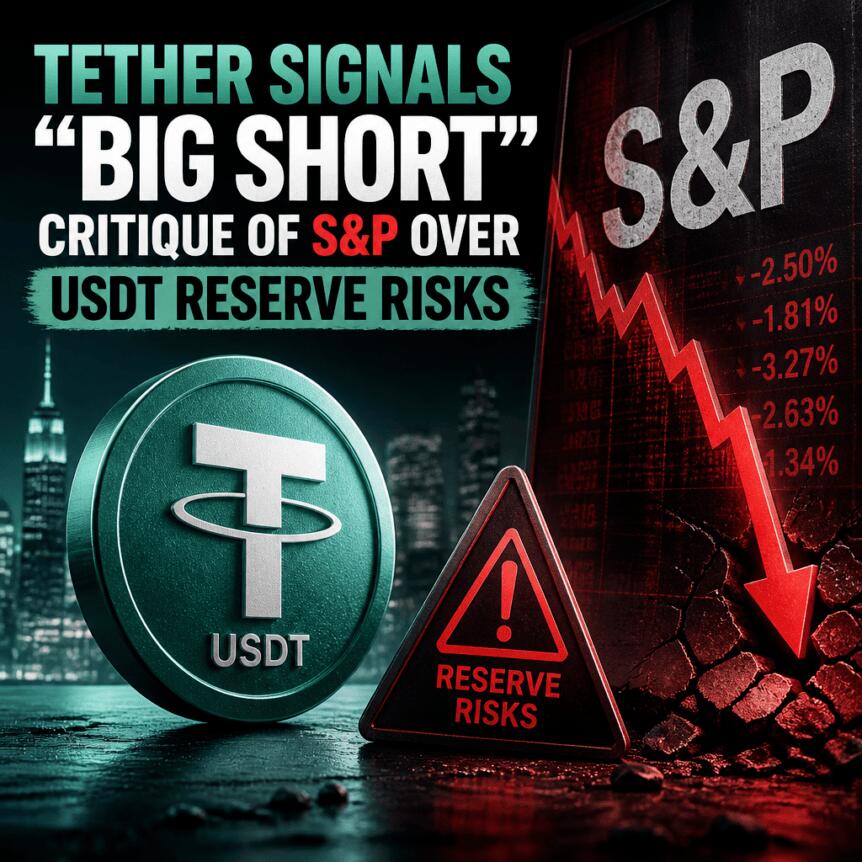
S&P Global Ratings has left Tether’s USDt (USDT) pegging resilience at the lowest tier on its stablecoin stability scale, warning that riskier reserve assets are making up a larger portion of the token’s backing.
In a report published Nov. 18, S&P assigned USDT an ability-to-maintain-its-dollar-peg score of 5 (“weak”), unchanged from November 2025. The update focuses less on recent peg performance and more on how reserve composition and oversight safeguards could affect downside risk.
Key takeaways
- S&P kept USDT’s peg-holding assessment at 5 (“weak”) for the second consecutive year, citing concerns tied to reserve risk levels and governance.
- According to S&P, higher-risk holdings such as gold, Bitcoin, public equities, secured loans and corporate bonds rose to 28% of reserves as of Sept. 30, from 24% a year earlier.
- S&P highlighted structural gaps in how El Salvador’s digital-asset regulator oversees reserve custody and segregation requirements after Tether’s relocation in January 2025.
- The rating methodology noted audit transparency limits: S&P said Tether’s audited materials and details on custodians/counterparties have not been published in a way that allows full independent verification.
Reserve mix drives a persistently low peg resilience score
S&P’s report frames the core issue around whether USDT’s backing assets could suffer value declines that impair full collateralization during stress. It flagged that a “significant drop” in higher-risk holdings could leave USDT undercollateralized.
On Sept. 30—the date referenced in Tether’s reserve reporting—S&P pointed to a higher-risk slice of the reserve portfolio totaling 28% of USDT in circulation. That compares with 24% from a year earlier, indicating a gradual shift toward assets that may be more volatile than cash-like instruments.
Even so, S&P’s rating did not reflect a downward reassessment below its own scale’s floor. The agency said its evaluation “cannot be lower than 5,” and it therefore did not adjust the score even after identifying additional weaknesses.
Separately, Tether’s Sept. 30 reserve report—attested by BDO—showed approximately $191.5 billion in assets against $183.5 billion in liabilities, implying roughly $7.95 billion in excess assets at that snapshot.
Tether disputed the underlying premise of the rating framework in correspondence with Cointelegraph, arguing that S&P’s concern is rooted in the methodology rather than the company’s reserves. Tether also referenced the movie “The Big Short,” pointing to the broader argument that traditional systems can fail under stress.
El Salvador oversight rules are cited as insufficiently protective
S&P said additional weaknesses relate to reserve oversight safeguards in El Salvador, where Tether relocated in January 2025. The report identifies the National Commission of Digital Assets of El Salvador (CNAD) as the regulator overseeing Tether in the country.
According to S&P, CNAD’s framework requires that 70% of reserves be held in assets that can be liquidated within 30 days. In Tether’s view, the rule is “broad,” because it allows the reserve basket to include relatively higher-risk assets such as gold, Bitcoin and loans.
The report also draws attention to an apparent absence of a requirement to segregate reserve assets. S&P states that, unlike expected approaches in the US and Europe, there is no publicly available information showing how USDT reserve holdings are separated from broader corporate risk. Without transparency on segregation practices, the agency said it has limited visibility into whether the assets are insulated during corporate or counterparty stress.
For investors and market participants, this distinction matters because stablecoin risk is not only about whether reserves exist on a given date, but also about whether those assets can be accessed and protected when conditions deteriorate.
Audit transparency continues to limit independent verification
Audit and disclosure practices were another focus of S&P’s latest assessment. Earlier coverage referenced that, in August 2026, KPMG confirmed it issued an unqualified opinion on Tether’s 2025 accounts and that this was the first “full independent audit.” Tether has said the audit supports its financial statements.
However, S&P argued that the audited statements and the auditor’s report have not been published, reducing its ability to validate the underlying information. The agency also said reserve reporting does not name custodians and counterparties holding Tether’s assets.
In addition, S&P noted that Tether’s attestations remain quarterly, whereas other stablecoin issuers generally publish reserve updates monthly. For traders relying on frequent transparency signals, differences in reporting cadence can affect how quickly markets detect changes in reserve composition.
S&P also emphasized that, while it previously downgraded the rating in 2025 and Tether challenged that outcome, the peg stability score remained unchanged at 5. In its Nov. 18 report, S&P concluded that Tether has maintained a “good history of price stability,” particularly during the prior 12 months—yet kept the rating low due to persistent structural concerns rather than short-term peg behavior.
What to watch next
The question for markets is whether future reserve disclosures and audit transparency will address the specific gaps S&P points to—especially reserve segregation visibility, named counterparties/custodians, and how often comprehensive information is made public. Until those issues are clarified, S&P’s lowest-tier peg resilience assessment is likely to remain a recurring headline as USDT’s reserve mix evolves.
This article was originally published as Tether Signals “Big Short” Critique of S&P Over USDT Reserve Risks on Crypto Breaking News – your trusted source for crypto news, Bitcoin news, and blockchain updates.
0
0


 Manage all your crypto, NFT and DeFi from one place
Securely connect the portfolio you’re using to start.


