
Solana News Today: Validator Rules Spark Decentralization Debate

0
0
Solana News Today: Why Layer33 Wants New Validator Rules Paused
Here is the latest solana news today: a collective of independent operators called Layer33 has published an open letter asking the Foundation to pause new rules for its stake-support scheme.
The rules took effect on 6 November. The group says they push out experienced node runners and weaken decentralization.
Below is a plain-language look at the rules, the complaints, and what is still unclear.
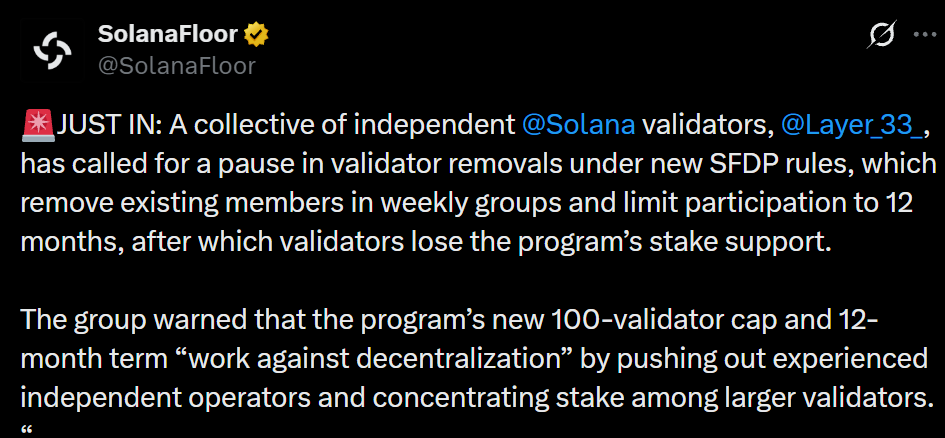
Source: Solana floor post
What Changed on 6 November
The program is the Solana Foundation Delegation Program (SFDP). In simple terms, the Foundation lends some of its own SOL to node runners so they can earn rewards while building a following of their own, as the program page explains.
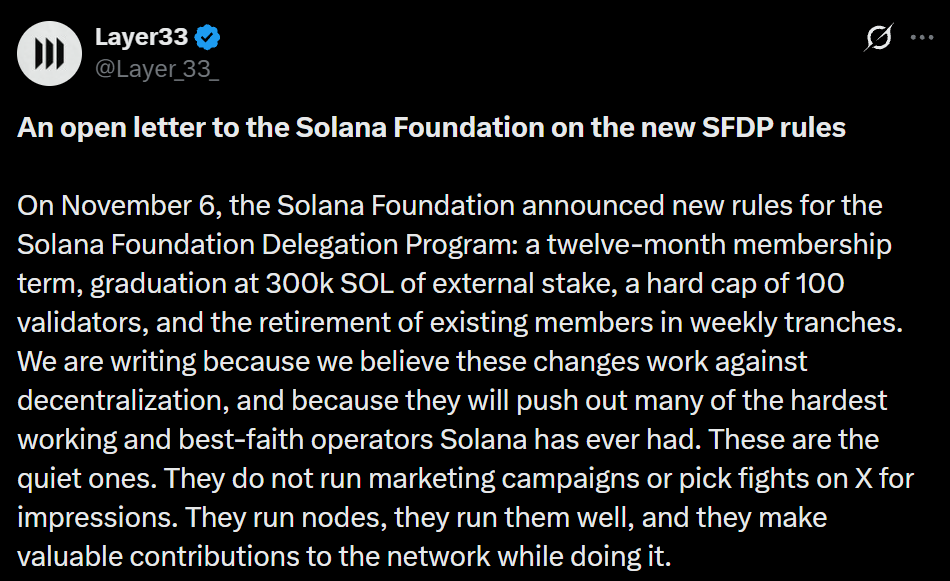
According to the open letter, the Foundation announced four new rules on 6 November:
-
A membership term of 12 months
-
Graduation once outside stake reaches 300,000 SOL
-
A hard cap of 100 validators
-
Weekly retirement of existing members in groups
The Foundation’s FAQ confirms the first two. Membership lasts 12 months from a node’s first eligible epoch (a time period of about two days), and members retire once stake from other sources passes 300,000 SOL.
Retirement is not a penalty, and retired operators can keep running and apply for renewal.
The FAQ mentions 100 new validators joining its onboarding queue each week but states no overall cap, so that figure comes from the letter.
The FAQ also says help with voting costs already shrinks from 100% to zero over 180 epochs, roughly a year.
| Rule | Plain meaning | Where it appears |
| 12-month term | Support ends a year after eligibility begins | Foundation FAQ |
| 300,000 SOL exit | Support ends once outside backers hold more than this | Foundation FAQ |
| 100 cap | A limit on program size, as the letter describes it | Open letter |
| Weekly retirements | Current members leave in groups, week by week | Open letter |
Why Layer33 Says the Rules Backfire
The group argues the “launchpad” idea no longer fits. Its letter says the program did its job when the network needed new operators, but a forced exit after 12 months turns members into short-term tenants rather than lasting independent operators.
It also says attracting outside backers is close to impossible unless a node runner is already among the biggest.
In its view, constant churn at the bottom sits beneath an ever-smaller set of ever-larger players.
As a case study, the letter points to an outage at hosting firm Teraswitch. The group says the network stayed up because stake was spread across many independent operators and hosting providers.
It warns that shrinking the program would make the next outage more dangerous. It also cites its own figures.
The Nakamoto coefficient, which counts the fewest operators that could together disrupt the network, is 8 today and 3 at a 20% safety threshold.
The group says it was 6 before Alpenglow raised a liveness threshold from 33% to 40%.
These numbers come from the letter. That is why this solana news today debate matters beyond the operators directly affected.
The Alpenglow Argument
Alpenglow is a major network upgrade that, according to the letter, reached the main network a few weeks ago.
The group says it was tested mainly by independent operators in a community cluster, meaning a shared test network, and that none of the biggest operators took part.
It adds that independents paid for extra servers, stayed up late through repeated restarts, and absorbed higher voting costs during faster 200ms block times.
Its complaint is about timing: retirements are starting before many have earned those costs back.
Five Requests and a New Model
The letter asks the Foundation to:
-
Pause the weekly retirements until the community has been consulted
-
Give members who joined the Alpenglow cluster at least six months of continued support on the new upgrade
-
Publish the analysis behind the 100 cap and the 12-month figure
-
Open a formal consultation with current members before the rules are final
-
Adopt a long-term contributor model, alongside or instead of the launchpad model
Under that model, members would be rewarded for network health, such as uptime during upgrades, client diversity, and geographic spread. Only inactive members would be removed.
The group also lists its own work, including a testnet faucet it says refills about 450,000 test SOL monthly and a monthly community call it says has run for over three years.
Conclusion
In short, this solana news today story is a clash between two ideas: a temporary launchpad and a long-term home for independent operators.
Layer33 wants a pause, a public explanation and a say in the final rules. Watch for any official reply and for changes to the Foundation’s FAQ.
Disclaimer
This article is for educational and informational purposes only and is not financial or investment advice. Crypto assets are high risk, their prices can be very volatile, and you can lose some or all of your money. Always do your own research and consider speaking with a licensed financial advisor before making investment decisions.
0
0


 Manage all your crypto, NFT and DeFi from one place
Securely connect the portfolio you’re using to start.


