
Solana price at $103.82 with 12 percent fewer open futures positions: will the $100 level hold?

0
0

Solana traded at $103.82 on Wednesday evening. That is 3.7 percent above the round $100 line, 2.99 percent below the previous day and 10.35 percent below a week ago. The short answer to whether the level holds: the futures market currently lacks the leverage that would accelerate a break, and it lacks it on the buy side just as much. We collected the figures ourselves from the exchange OKX, and they tell a different story from the price alone.
Solana price at $103.82, 3.7 percent above the $100 mark
The Solana price stood at $103.82 on October 14 at around 20:44 CEST. During the session the high was $108.45 and the low $103.51, so the price closed the day near its daily low. Market capitalisation therefore comes to $61.17 billion.
The distance to the downside is easy to work out. From $103.82 to $100 is 3.68 percent. The last daily close below $100 is almost a month old and dates from September 17, 2026. Solana has held above that line since, including on the weak days in early October.
The week before looked different. On October 7 Solana still stood at $120.68. From there to today, 13.9 percent has gone, in eight trading days. The steepest single decline fell on October 9, when the daily close slid from $116.23 to $109.51.
Open futures positions fall to $357.4 million
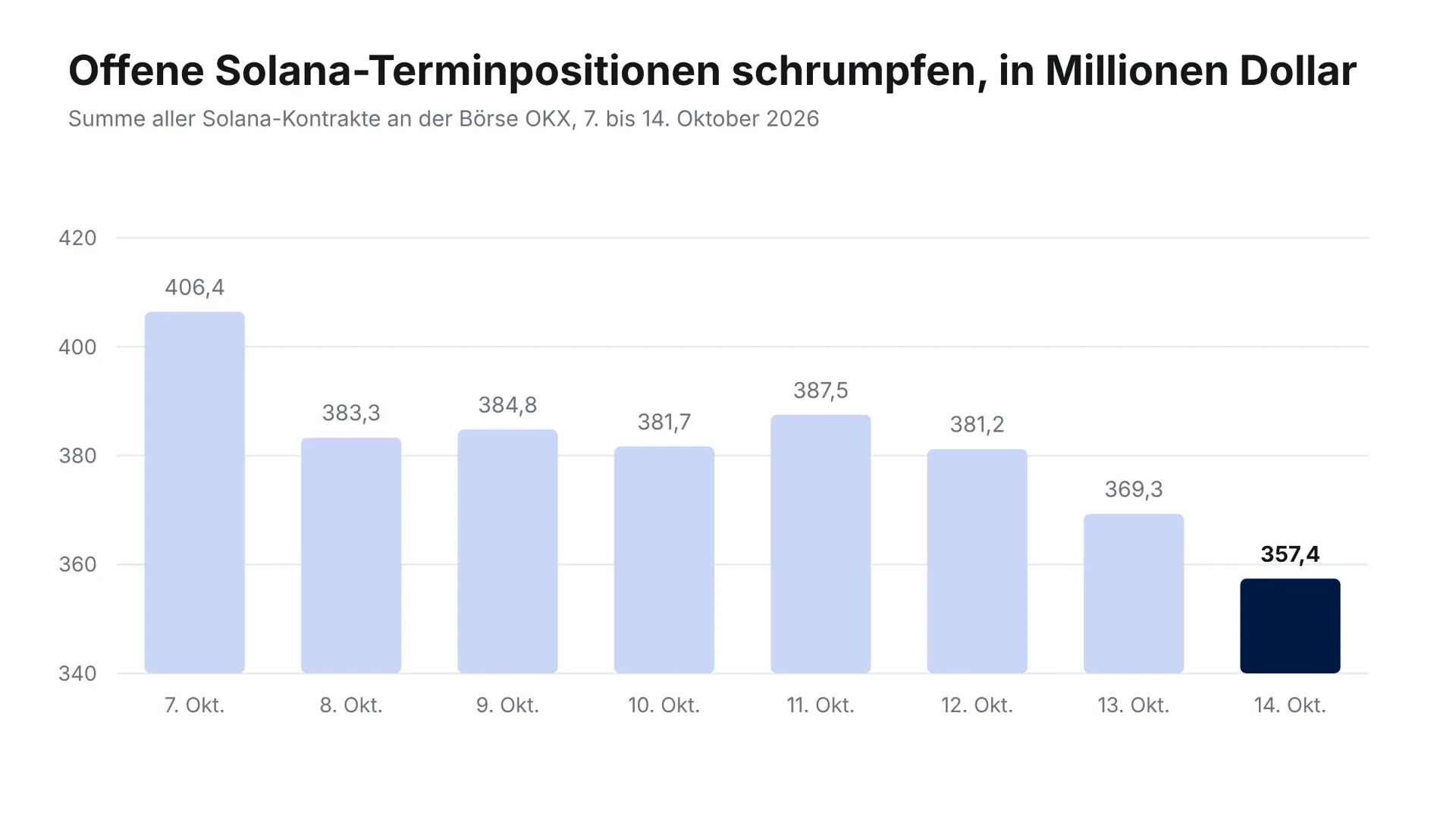
This is the actual occasion for this article, and it appears on no price chart. The sum of all open Solana contracts on the exchange OKX stood at $357.4 million on October 14. On October 7 it was still $406.4 million. That is a drop of 12.1 percent in seven days and the lowest reading since September 17. From September's peak of $426.6 million on September 27, 16.2 percent has been unwound.
Open positions, known in the trade as open interest, are the sum of all futures contracts that have not yet been closed. The figure says how much capital sits in leveraged bets on a coin. It rises when new positions are opened and falls when positions are closed or forcibly liquidated.
In the SOL-USDT swap alone, the most heavily traded perpetual contract on Solana, 3,033,471 SOL are currently open. At the price at the time of the query that is $315.2 million. The rest is spread across the contracts with fixed expiry dates and the variants in other settlement currencies.
The funding rate sits at zero, the leverage is gone
The second figure is the funding rate. On a perpetual contract with no expiry date, it keeps the contract price from drifting away from the spot price: every eight hours one side of the bets pays the other. When the rate is positive, buyers pay sellers, and that is the normal state in a friendly market.
Three rates were settled on OKX on October 14. At 00:00 UTC it was plus 0.0100 percent, at 08:00 plus 0.0089 percent, at 16:00 minus 0.0001 percent. The rate has therefore tipped from slightly positive to exactly zero over the course of the day. For comparison: on October 11 all three settlements ranged between plus 0.0073 and plus 0.0078 percent, a good three times today's level across the day.
The size sounds tiny, and in a single settlement it is. Annualised, however, plus 0.0075 percent every eight hours works out at around 8.2 percent. That is exactly the fee now falling away, because hardly anyone is still willing to pay for a leveraged long.
How open positions, the funding rate and the price hang together
For the question about the $100 mark, the combination of the two figures matters more than either on its own. Falling prices alongside falling open positions mean bets are being unwound. Falling prices alongside rising open positions would instead mean new short bets are being added and fresh pressure is building.
In Solana's case the first variant applies. Open positions have fallen on six of eight days, most recently two days in a row and with the largest single drop on October 14. The market is shedding risk rather than building new risk.
That has a consequence many people miss. A wave of liquidations needs leveraged positions that get closed by force. The fewer of those are open, the less fuel sits below the next round level. Equally, though, that removes the demand which carries a price back up under its own steam.
What a funding rate of zero says about sentiment
A rate at zero means long and short bets are evenly balanced. That is neither a buy signal nor a sell signal, but above all a statement about indifference: nobody is currently paying to bet on a quick rise. Historically such phases mark bottoms rather than tops, but they say nothing about how long they last.
Solana against Bitcoin: 14 percent below the September high
The dollar price alone shows only half the picture, because the whole market gave ground this week. The ratio to Bitcoin is more revealing. One SOL cost 0.00124986 Bitcoin on October 14. On September 26 it was 0.00145259, the highest reading of the past 120 days. From there, 14.0 percent has gone, 11.4 percent of it in the seven days since October 7.
The figures alongside make it plain: Bitcoin lost 2.00 percent in seven days, Ethereum 5.25 percent, Solana 10.35 percent. Solana has therefore fallen roughly five times as hard as Bitcoin this week. This is no Solana accident but the usual pattern when investors take risk out of the market. It does explain why the $100 question is being asked right now.
The trigger for the market's weakness lay outside the Solana blockchain this week. The US inflation rate rose to 3.7 percent, the core rate came in higher than expected, and risk assets gave way accordingly.
The levels: $98.27 as the 200-day line, $107.29 as the 50-day line
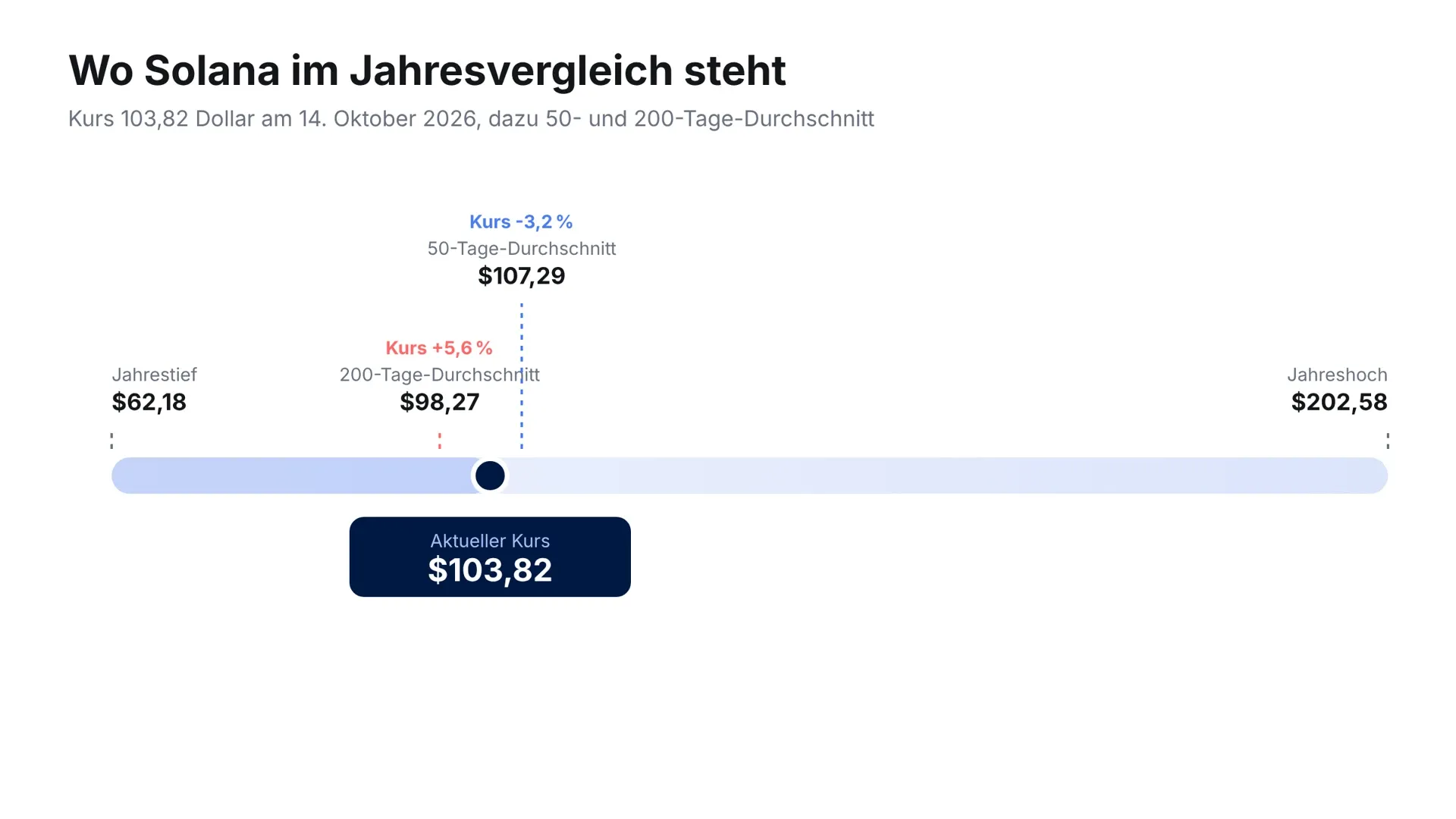
Three lines can be justified for the coming days, and two of them sit close to the round number. The 200-day moving average stands at $98.27, putting the price 5.6 percent above it. The 50-day average is at $107.29, so 3.2 percent above the current price.
That produces a narrow corridor. To the downside, barely a dollar separates the round $100 from the 200-day line at $98.27. Lose the round level and the next technical support arrives almost immediately. To the upside, Solana would first have to get back above $107.29 to turn the medium-term direction around.
Over the year, Solana sits between a low of $62.18 from June 7 and a high of $202.58 from October 15, 2025. The all-time high of $293.31 is 64.6 percent away from the current price.
Our assessment: no fuel for a liquidation wave, but no bid either
From the editorial team's point of view, the data argue against a crash and equally against a quick recovery. The evidence is above: open positions have fallen 12.1 percent in seven days to $357.4 million, and the funding rate stands at minus 0.0001 percent. Under these conditions, a break of $100 would be an orderly slide to the 200-day line at $98.27 rather than a chain reaction of forced selling.
Two things argue against that reading. First, the picture on the futures market can turn within hours if new leveraged positions are built; the figures above are a snapshot from the evening of October 14. Second, at a funding rate of zero there is no visible demand for leveraged buying, and without it a rise above $107.29 stays unlikely. An assessment is not a recommendation, and total loss remains possible with any crypto asset.
Alpenglow: a protocol date reaches into the price question
A technical date falls in the same week. Our editorial team reported on October 14 that the developer Anza has set the switch to Alpenglow for October 21. Alpenglow replaces the Solana blockchain's existing consensus mechanism and is meant to push the time to final confirmation of a transaction down to around 150 milliseconds.
The rebuild itself is documented. The official Solana changelog of October 1 lists Alpenglow among the feature gates on devnet and describes how the Agave client software intends to expose the Alpenglow ranking through its RPC interface. That page says nothing about the exact mainnet date, which is why the date here stands as a report of Anza's statements and not as a commitment of our own.
For the price, such a date means one thing above all: an additional source of uncertainty in a week when little risk is being sought anyway. If you plan to move larger amounts on October 21, expect exchanges to suspend deposits and withdrawals temporarily around protocol changes.
Leverage and liquidation distance for investors in Germany
Concretely: holders of a leveraged long on Solana should now recalculate the distance to their liquidation threshold. At five times leverage a decline of around 20 percent suffices, at ten times one of around 10 percent, before the position is closed by force. From the current price, a fall to $98.27 is 5.3 percent. A ten-times leveraged entry from last week at $120 would have been closed long ago.
In the EU, derivatives on crypto assets are tightly restricted for retail investors. What is permitted under the MiCA regulation are spot transactions and exchange-traded products; the large perpetual contracts run on platforms outside EU authorisation. Trading there carries platform risk on top of price risk. A sober look at the fees and terms of the venues for perpetual contracts therefore belongs before any decision about leverage.
The alternative without a liquidation threshold is buying in the spot market with your own custody. Moving your SOL onto a device of your own removes the risk of a forced close, but it puts the full responsibility for securing your access data on you.

Holding period and exemption threshold on a sale below $100
For investors in Germany, more hangs on the timing of a sale than the price. Gains from selling crypto assets count as a private disposal transaction under Section 23 of the Income Tax Act. If more than a year lies between purchase and sale, the gain stays tax-free. Below that it counts towards taxable income and is charged at the personal tax rate.
For short-term transactions an exemption threshold of €1,000 per calendar year applies. The word threshold is to be taken literally: at €1,001 of gains you are above it and pay tax on the entire amount, not only on the euro that overshoots. Losses from such transactions can be offset only against gains of the same kind, but they can be carried forward into later years.
Before selling below $100, then, check the purchase date of every individual position. With several purchases, the first in, first out method applies per wallet for the allocation. A tax and portfolio tool takes that allocation off your hands; the legal responsibility stays with the investor. With larger amounts there is no way around a tax adviser.
Solana at the $100 mark: below it waits the 200-day line at $98.27
The futures market has unwound 12.1 percent of its open positions over the past seven days, and the funding rate stands at zero. That takes the force out of a break of $100 and the strength out of any rebound. Three steps follow from it:
- Recalculate position size and leverage. If the liquidation threshold is closer than 5.3 percent, it already catches the 200-day line at $98.27. To buy in the spot market instead, first compare the costs of the venues for crypto assets.
- Look up the purchase date of every position before a sale comes up. If the purchase is more than a year old, the gain stays tax-free; below that the €1,000 exemption threshold applies. The tools for tax and portfolio allocate purchases by first in, first out.
- Plan around the October 21 date and decide whether your existing SOL should be put to work. Exchanges suspend deposits and withdrawals temporarily around protocol changes. A look at the providers of staking rewards shows which yields and which lock-up periods apply; those yields count as income for tax purposes, not as disposal gains.
We described yesterday's state of play on October 13, when Solana traded at $108.21 and a buyback of $201 million hung on the $100 condition. The price has lost 4.1 percent since, the condition has moved closer, and the futures market has unwound a further $12 million of open positions. The data in this article come from the public OKX market interface and from CoinGecko.
(As of October 14, 2026. This article is not investment advice. Prices and fee structures change; check the terms with the provider before you buy.)
0
0

 Manage all your crypto, NFT and DeFi from one place
Securely connect the portfolio you’re using to start.


